Saudi Arabia’s 2034 FIFA World Cup stadium programme is moving forward, but it is not a smooth straight line. Reports say early delivery pressure is building because the Public Investment Fund (PIF) wants to scale back costs. The Guardian reported that several architecture firms have been asked to resubmit plans after designs were judged too expensive. It also reported that contractors due to start work next year have been told the build will not begin on time.
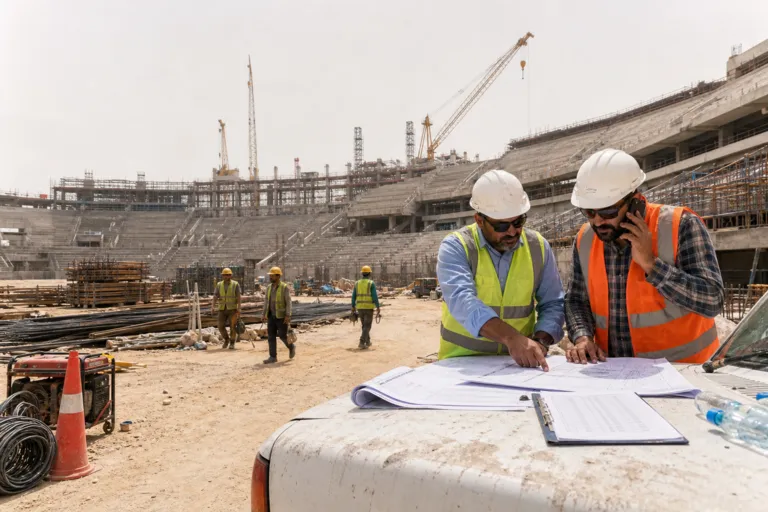
The current stadium plan in the bid includes 15 venues in total. That is made up of 11 new venues, plus four stadiums to be renovated and expanded. The bid is based around four host cities, Riyadh, Jeddah, Al Khobar, and Abha, plus Neom Stadium. Neom Stadium is planned to sit inside The Line, a futuristic mega-project that has yet to be constructed. Construction is reported to have started on three venues, but industry sources cited by The Guardian say several other builds are facing delays.
Riyadh alone has multiple new stadium projects listed with capacities in the public programme. These include ROSHN Stadium (45,000), King Salman Stadium (92,000), New Murabba Stadium (45,000), Prince Mohammed bin Salman Stadium (46,979), and South Riyadh Stadium (47,060). These five figures show how different venue sizes may drive different design, procurement, and construction needs.
Contractor Pipeline Risks: Cost Reviews, Retenders, and Start-Date Slips
The biggest near-term risk is a stop-start pipeline. The Guardian and The Stadium Business both describe a cost review cycle where some design teams have been asked to reduce costs or retender elements of work. One company was understood to have been warned it could lose its stadium contract if it does not produce significant cost savings. When design scope changes late, contractor pricing and schedules can also shift. That creates uncertainty for teams preparing to mobilise.
Budget pressure is tied to PIF’s wider spending position. The Guardian noted that PIF announced plans in April to cut spending by at least 20% in 2025, with mega-projects such as Neom and other developments initially feeling the pinch. A Saudi source confirmed that although spending on sport would be prioritised, some World Cup projects were likely to be affected. PIF is reported to view the reassessments as normal, with key decisions still to be made and nine years remaining before the tournament, expected in November and December 2034.
Delivery risk also appears in renovation work, where project teams may start with limited records. One renovation example described how the only existing architectural records were hand-drawn plans from the 1980s, which were not enough for digital construction. A team scanned the entire exterior in five days and built a BIM model that had to comply with ISO 19650 standards. This model is now used by the architectural and engineering team to design and implement the upcoming renovation, and it gives stakeholders a live platform to track progress.
What is the current stadium plan for the 2034 World Cup in Saudi Arabia?
Why is FIFA 2034 stadium construction Saudi Arabia facing delivery pressure?
Which international design firms are involved in the stadium programme?
What is a key risk to the contractor pipeline?
How can renovation projects reduce risk when records are outdated?
Talk to us for your needs in:
-
Sustainable Construction Solutions
-
Strategic Construction Planning
-
Customer-Centric Construction Services
-
Operational Excellence in Construction
-
Leadership and Change Management for Construction
-
Digital Transformation in Construction
-
Saudi Construction Market Research
-
In-Depth Market Study for Construction
-
Market Intelligence and Insights in Construction
-
Feasibility Study and Assessment in Construction
-
Saudi Construction Benchmarking