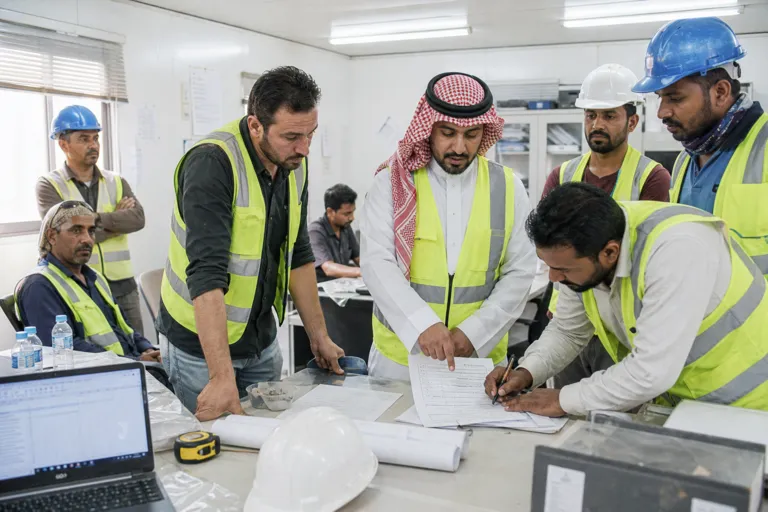
Saudisation construction sector 2026 planning is different from past years. Several sources describe 2026 as a new phase for Nitaqat. Thresholds are rising, reviews happen roughly every six months, and compliance is more data-driven than before. For construction companies, this means you cannot treat Saudisation as last-minute hiring. You need a workforce plan that holds up when projects change and people leave.
Nitaqat is the Saudisation program run by the Ministry of Human Resources and Social Development (MHRSD). It classifies each private-sector employer into five tiers: Platinum, High Green, Medium or Mid Green, Low Green, and Red. Your tier affects what you can do. Red companies can face blocked visa processing, restricted access to government contracts, and trouble renewing work permits. Moving up from Red can be slow and expensive, with one source noting it typically takes six to twelve months of focused effort to improve by one band.
The biggest structural change in 2026 is that the Yellow classification has been eliminated. One source explains that previously borderline companies are pushed directly into Red. Another major shift is that quotas are no longer only a single headline number. Profession-specific quotas now apply across 269 roles. This means a company can look compliant overall, but still violate Nitaqat inside one department or job family.
What Construction Leaders Should Change in 2026
In 2026, Saudisation is described as an organizational design challenge. Strong performers are redesigning structures, job architecture, career frameworks, and workforce planning around Saudisation requirements. This is important in construction because teams can be project-based and change fast. If your compliance depends on a few roles, a resignation can drop your percentage immediately. One source warns that churn resets compliance calculations and replacement timelines are regulated and increasingly enforced through Nitaqat classification and platform controls.
Also, Nitaqat 2.0 assesses more than headcount. One source states that role weighting, salary thresholds, and profession classification influence Saudisation rates. So, a construction company should protect compliance by ensuring Saudi hires are placed into correctly classified roles and real career paths, not only added to payroll. This reduces the risk of being downgraded to Low Green or Red, where operational restrictions can slow hiring and limit growth.
Planning matters because the national push is large. MHRSD is implementing a three-year plan to localize more than 340,000 additional private-sector jobs. A separate source also says over 340,000 private-sector jobs are set to shift to Saudi nationals between 2026 and 2028. Employers should treat this as a forward plan, not a one-time quota. Build forecasts, run internal audits, and invest in training programs for Saudis, as recommended in one compliance guide.
Finally, treat Saudisation as both compliance and hiring opportunity. One source reports that since 2020, more than 2.2 million Saudis have entered the private sector. For construction firms, this supports a practical strategy: design stable teams, develop Saudi talent, and track Nitaqat status frequently, including through Qiwa, where you can monitor status in real time and use tools like the Nitaqat calculator.
What changed in Nitaqat that affects Saudisation construction sector 2026 planning?
What are the Nitaqat tiers employers are measured against?
Why can employee turnover hurt compliance in 2026?
Is Saudisation only about headcount under Nitaqat 2.0?
What scale of localization is MHRSD targeting in 2026 to 2028?
Talk to us for your needs in:
-
Sustainable Construction Solutions
-
Strategic Construction Planning
-
Customer-Centric Construction Services
-
Operational Excellence in Construction
-
Leadership and Change Management for Construction
-
Digital Transformation in Construction
-
Saudi Construction Market Research
-
In-Depth Market Study for Construction
-
Market Intelligence and Insights in Construction
-
Feasibility Study and Assessment in Construction
-
Saudi Construction Benchmarking