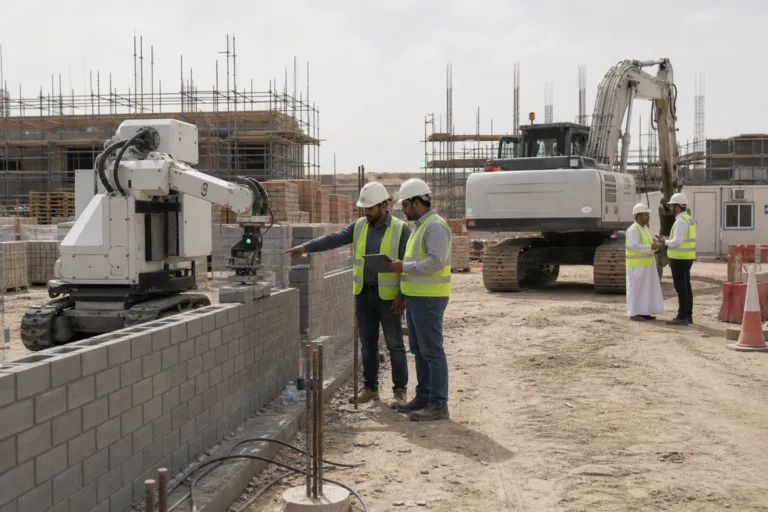
Construction robotics Saudi Arabia is part of a wider shift in the industry. Construction Digital says the sector is seeing a once-in-a-generation transformation driven by automation, data, and robotics. The push comes as labor shortages, safety concerns, and sustainability targets intensify. Many robots now focus on tasks that are heavy, repetitive, or easy to standardize.
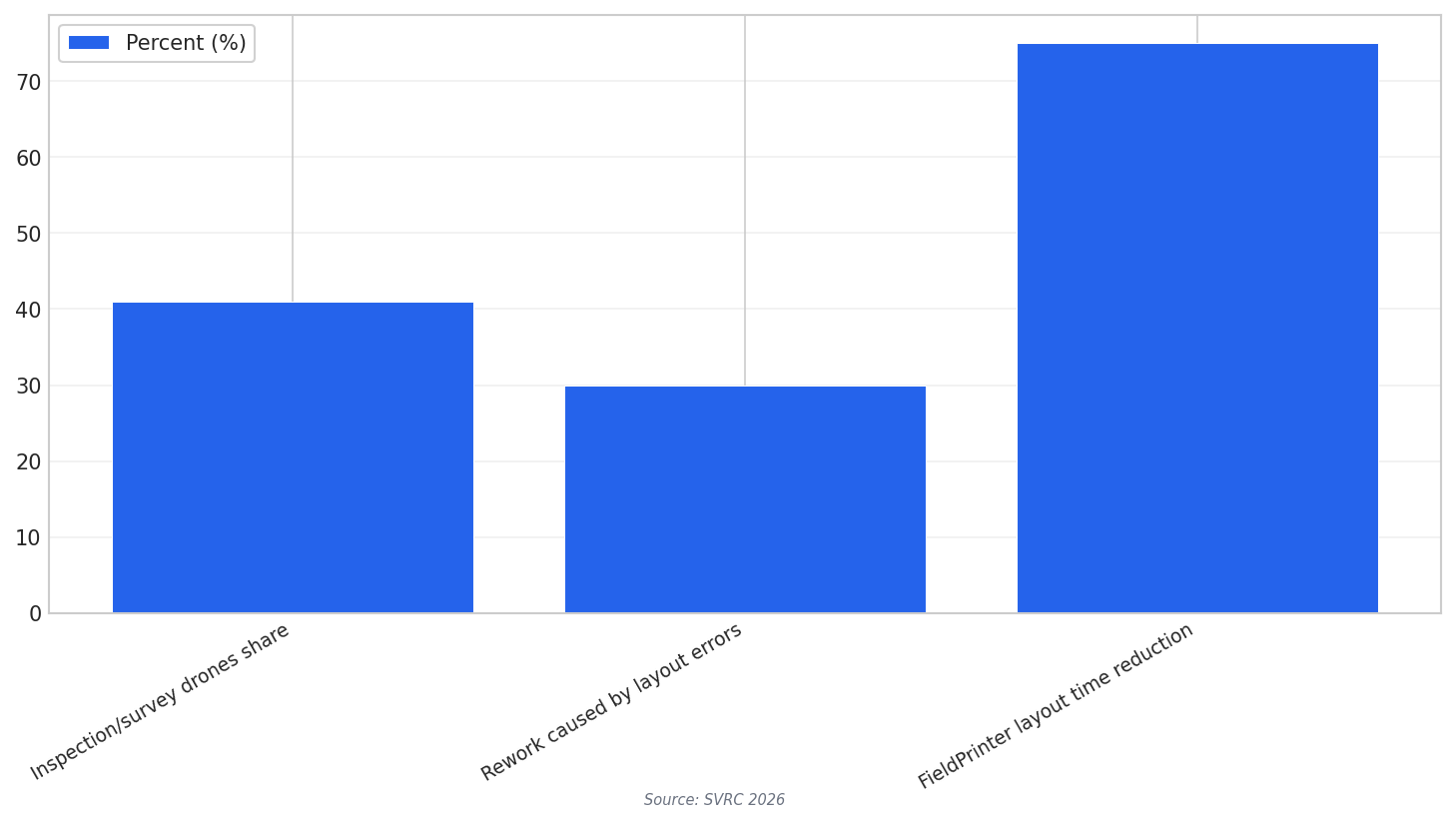
Before choosing a robot, it helps to see what is deployed most today. SVRC says inspection and survey drones make up 41% of deployments. It also says layout errors cause 30% of construction rework. That is why layout marking robots can matter for ROI. SVRC adds that Dusty Robotics’ FieldPrinter reduces layout time by 75%.
For bricklaying, two approaches stand out: assist workers or push toward high output. Construction Digital describes Construction Robotics’ SAM100 as a Semi-Automated Mason that works alongside human masons. It picks, butters, and places bricks from a digital plan, while crews handle alignment, detail work, and finishing. SVRC also notes FBR’s Hadrian X can lay 200+ bricks per hour, compared with 300–500 for a skilled mason, but the robot can work 20 hours per day and never takes breaks.
Autonomous Excavation and the Practical Path to Site ROI
Earthmoving is another area where automation can start without replacing the whole fleet. Infratechhub explains that autonomy retrofits for heavy equipment are kits that turn excavators and dozers into supervised autonomous units for repetitive tasks. Robotics and Automation News also points to Built Robotics retrofitting existing heavy equipment, such as excavators, with autonomous systems to bridge the automation gap in earthmoving. This matches the idea that near-term ROI often comes from scaling proven use cases, not chasing full autonomy everywhere.
Layout and site marking can also give fast feedback because it connects directly to plans. Construction Digital says Dusty Robotics’ FieldPrinter prints full-scale BIM drawings onto floors with millimetre accuracy, replacing chalk lines and tape measures. New Atlas adds another marking example: Civ Robotics uses a CSV of coordinates and can achieve precision down to 8 mm. Civ Robotics says its bots can lay out up to 3,000 points per day, or 17 miles of markings per day, compared with 200–450 points per day for a traditional surveying crew.
Adoption is real, but it is not uniform. Wikipedia cites a 2021 survey saying 55% of construction companies in the United States, Europe, and China used robots in some form, while also noting that real-world adoption on active sites remains limited. The same source highlights why: job sites are unstructured and variable, unlike factories. Robotics and Automation News adds that regulations and safety standards are still evolving, with open questions on liability, training, and certification.
What is driving construction robotics Saudi Arabia and similar markets?
Which robot type is deployed most often today?
How can layout robots improve ROI on a site?
Do bricklaying robots replace masons?
What is an autonomy retrofit for excavators and dozers?
Talk to us for your needs in:
-
Sustainable Construction Solutions
-
Strategic Construction Planning
-
Customer-Centric Construction Services
-
Operational Excellence in Construction
-
Leadership and Change Management for Construction
-
Digital Transformation in Construction
-
Saudi Construction Market Research
-
In-Depth Market Study for Construction
-
Market Intelligence and Insights in Construction
-
Feasibility Study and Assessment in Construction
-
Saudi Construction Benchmarking