
For the iktva construction sector, IKTVA is not a “nice to have.” It is Saudi Aramco’s flagship local content initiative, launched in 2015. It is designed to maximize the economic impact of Aramco’s procurement spending inside Saudi Arabia. Suppliers and contractors are expected to progressively increase the share of goods and services sourced domestically. IKTVA ratings influence procurement decisions, contract awards, and commercial terms. High performers get preferential treatment in bid evaluations.
Aramco also set clear local content direction over time. IKTVA started from a baseline of approximately 35% local content at launch and targeted 70% by 2025. Progress was reported at approximately 60–65% by 2024. For construction firms, this matters because construction materials and industrial engineering services are listed among the sectors most impacted by IKTVA.
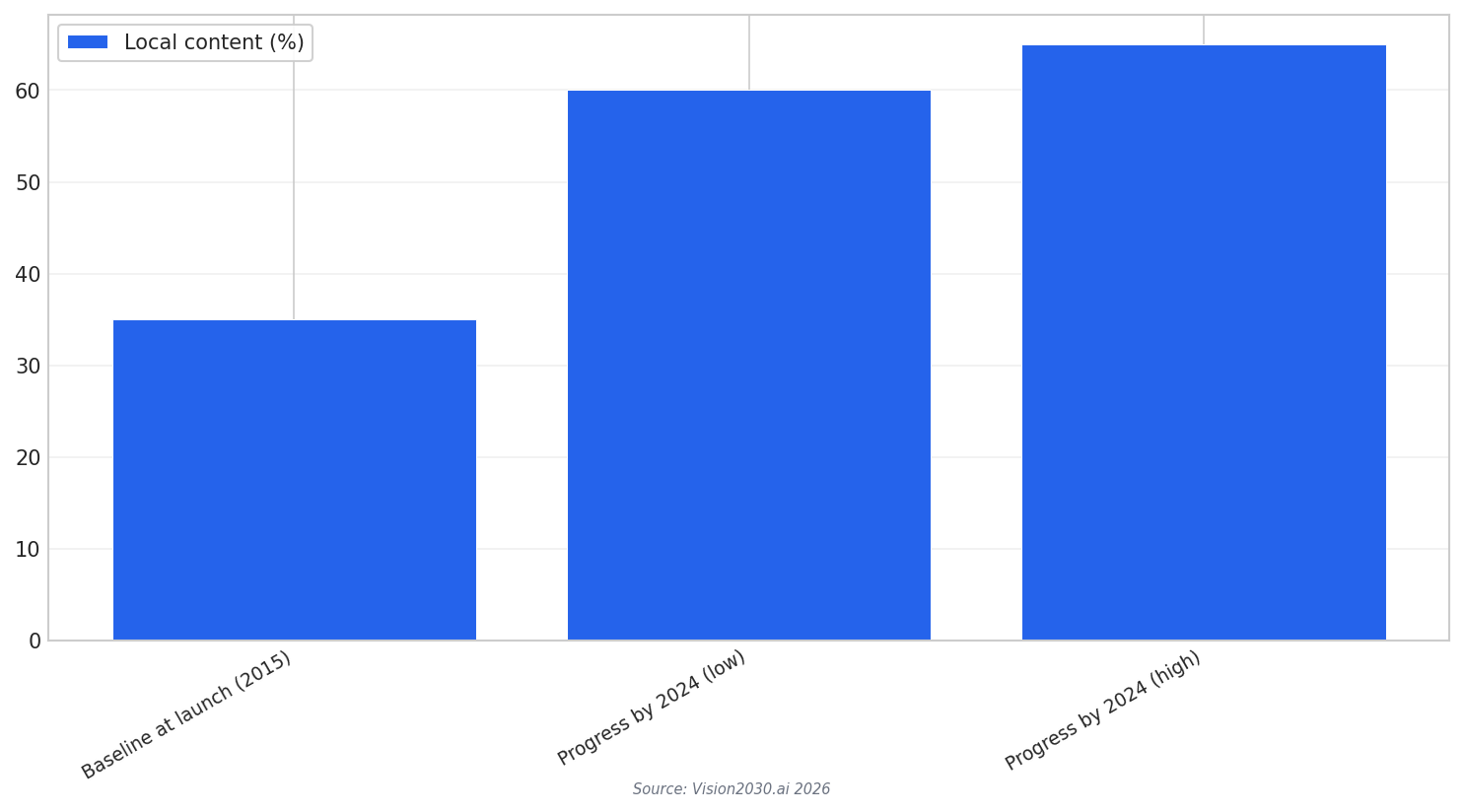
The chart shows three distinct IKTVA local content figures stated in the sources: approximately 35% at launch (2015), approximately 60% by 2024, and approximately 65% by 2024.
What goes into your IKTVA picture is broader than simple purchasing. IKTVA measures total economic value retained within Saudi Arabia from procurement activities. It captures Saudi workforce employment, locally manufactured goods, Saudi-owned business participation, and domestically provided services. Another source describes similar tracking areas, including locally sourced procurement, Saudi workforce development, capital investments, and R&D in the Kingdom. This is why “surface” compliance is risky.
A Practical Compliance Sequence for Construction Suppliers
Start with readiness and documentation discipline. One advisory source describes an IKTVA readiness assessment to identify gaps in localization, compliance, and reporting. It then moves to score improvement planning and documentation and reporting for Aramco submissions. It also notes ERP and systems integration to track IKTVA metrics, naming SAP, Oracle NetSuite, and Odoo ERP. It lists example timelines: an initial assessment in 2–3 weeks, planning in 4–6 weeks, and documentation preparation in 6–8 weeks, before final submission ahead of Aramco deadlines.
In parallel, plan supplier registration and procurement access. One source lists typical Aramco registration time as 6–10 weeks and says delays can happen due to missing workforce or financial data. It also outlines the process: apply via the Aramco Supplier Portal, complete pre-qualification, submit audited accounts, workforce data, and HSE policies, then obtain an IKTVA score. For firms supplying materials or engineered packages, 9COM also matters. Another source states 9COM approval connects directly to Aramco’s IKTVA program, and suppliers with strong local content scores and Saudi manufacturing presence are given priority in procurement cycles.
What is IKTVA and why does it matter for the iktva construction sector?
What local content levels are mentioned for IKTVA progress?
What documents and inputs can delay Aramco supplier registration?
How long can an IKTVA advisory compliance cycle take in the sources?
How does 9COM relate to IKTVA for construction-linked suppliers?
Talk to us for your needs in:
-
Sustainable Construction Solutions
-
Strategic Construction Planning
-
Customer-Centric Construction Services
-
Operational Excellence in Construction
-
Leadership and Change Management for Construction
-
Digital Transformation in Construction
-
Saudi Construction Market Research
-
In-Depth Market Study for Construction
-
Market Intelligence and Insights in Construction
-
Feasibility Study and Assessment in Construction
-
Saudi Construction Benchmarking