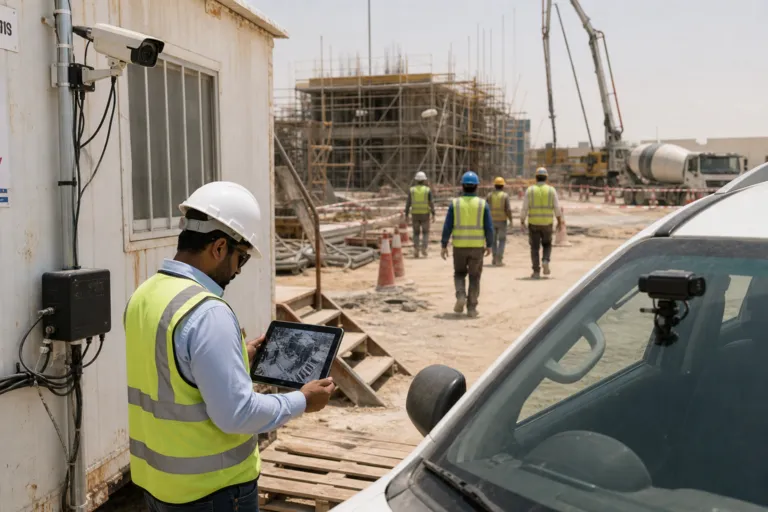
Saudi Arabia is pushing for safer construction through AI-powered monitoring. These systems use computer vision to analyze live camera feeds and flag hazards in real time. They can spot missing personal protective equipment (PPE), workers entering restricted zones, or unsafe machine operation. Alerts go to supervisors and control centers within seconds, so managers can intervene right away. This supports a stronger safety culture because rules are checked consistently, not only during periodic inspections.
One clear area is software investment for smarter projects. A Saudi construction consulting source states that the Construction and Design Software market in Saudi Arabia is expected to reach US$22.61 million in 2025 revenue. It also projects a 2.35% compound annual growth rate through 2030, reaching US$25.39 million. In the same source, the United States is estimated at US$5.47 billion in 2025. These figures show how fast software-led construction is becoming part of project delivery, including safety systems that can work with standard CCTV and align with regional safety codes.
On site, the big change is “always on” hazard detection. An AI-based Safety Command Center (SCC) connected to a Project Control Center (PCC) can use video analytics, edge computing, and IoT sensors to monitor activities, worker locations, equipment operation, and environmental conditions. Some systems also use behavior recognition. That means the AI does not only see objects. It understands context, such as a worker near an edge without a harness or heavy machinery being reversed unsafely.
Why Edge AI and Fleet Monitoring Matter in Saudi Conditions
Edge AI is important when connectivity is weak. Arab News notes that edge AI processes data on site rather than in a distant cloud. This allows systems like viAct to deliver insights even in areas with weak internet connectivity, including more isolated development zones or early-phase sites with minimal setup. It helps safety teams keep real-time awareness without waiting for uploads or remote processing.
Vehicles add another layer of risk on large sites. A viAct guide describes an EHS manager on a busy Saudi industrial site responsible for hundreds of vehicles, operating around the clock and often within metres of on-foot workers. It also says transportation incidents contributed around 38.2% to workplace fatalities in 2024, based on the U.S. Bureau of Labour Statistics. The same guide cites a workplace fatality rate of 1.12 per 100,000 workers in Saudi Arabia, referencing the National Council for Occupational Health and Safety, and argues that traditional tools often document what happened but do not intervene in the exact moment.
AI-powered in-vehicle monitoring systems (IVMS) aim to close that gap. The guide explains that when AI is embedded through edge devices, computer vision, machine learning models, and smart sensor arrays, the system can process data in real time, recognize developing risk conditions, and respond before an incident occurs. Alongside this, broader safety AI uses computer vision, sensor data analysis, predictive analytics, and pattern recognition across cameras, wearables, and equipment monitoring. Together, these tools move sites closer to a practical “zero-harm” target: earlier detection, faster intervention, and continuous improvement through data feeding into digital twins and smart site models.
What does AI safety construction sites Saudi Arabia mean in practice?
Why is edge AI useful on Saudi construction sites?
What safety issues can computer vision detect on a jobsite?
What numbers do the sources give about safety and risk?
Talk to us for your needs in:
-
Sustainable Construction Solutions
-
Strategic Construction Planning
-
Customer-Centric Construction Services
-
Operational Excellence in Construction
-
Leadership and Change Management for Construction
-
Digital Transformation in Construction
-
Saudi Construction Market Research
-
In-Depth Market Study for Construction
-
Market Intelligence and Insights in Construction
-
Feasibility Study and Assessment in Construction
-
Saudi Construction Benchmarking