AlUla’s development story is inseparable from its setting. AlUla County spans 22,000 square kilometers in north-west Arabia, across desert, canyon, and mountain terrain carved from sandstone. The Royal Commission for AlUla (RCU) estimates the county holds over 200,000 years of human history and 7,000 years of continuous civilization. That depth is visible at Hegra (Mada’in Saleh), Saudi Arabia’s first UNESCO World Heritage Site, with over 100 monumental rock-cut tombs that date back to the first century CE. It is also present at Ancient Dadan and the inscriptions of Jabal Ikmah. In 2026, the construction pipeline is therefore not just about adding buildings. It is about delivering projects in a landscape where, as architect Jean Nouvel put it, “every wadi and escarpment” deserves careful consideration.
In practical terms, AlUla’s 2026 pipeline is increasingly about conversion into execution, not only planning. The RCU was established to govern AlUla’s long-term development and its masterplan is built around 12 guiding principles of sustainable, responsible development. Within that direction, delivery engines are stepping forward. AlUla Development Company (UDC), a Public Investment Fund (PIF) company announced in 2023, states its role is to support AlUla’s development while preserving its natural environment, heritage, and culture. This helps explain why the most relevant “package” in 2026 is not a single standalone building, but a set of hospitality, residential, and community developments designed to keep AlUla functioning as a living destination, not a disconnected visitor enclave.
NUMAJ Moves From Concept to Construction in 2026
The clearest construction milestone in 2026 is NUMAJ, Autograph Collection. UDC announced the start of construction on NUMAJ, signaling a shift “from concept to execution” and reinforcing UDC’s role in turning AlUla’s masterplan into tangible assets in collaboration with RCU. NUMAJ is a 250-key hotel expected to open in 2027. UDC is developing it, and Marriott International will operate it under the Autograph Collection Hotels brand. Design is by GioForma, described as the architects behind Maraya, with the concept drawing inspiration from AlUla’s natural landscapes, cultural heritage, and celestial history. The development program described includes five dining venues, wellness facilities, and integrated business and leisure offerings. In the language of the AlUla heritage tourism construction pipeline for 2026, NUMAJ stands out as an on-the-ground proof point of delivery that still aims to stay rooted in place.
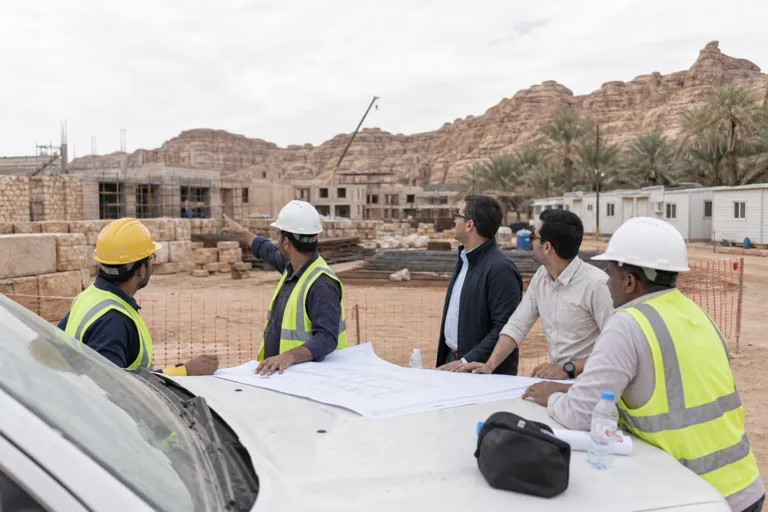
Other pipeline signals help show the breadth of what is being packaged and sequenced beyond headline masterplans. Construction Week reports progress continuing across hospitality and residential sectors, referencing the Diyar AlMahash staff accommodation residential project as being “in the pipeline.” It also lists an existing diversified asset portfolio that includes Maraya Theatre, Our Habitas AlUla, Caravan by Habitas, Banyan Tree AlUla, and Ashar Estate, alongside managed properties such as Cloud7 Residences, The Chedi Hegra, and Dar Tantora The House Hotel. In that same account, NUMAJ is framed as moving from completed excavation and shoring into a construction start, with a stated opening in 2027 and 250 keys added. Together, these references describe a pipeline that spans guest-facing hotels, operational community housing, and mixed-use development, rather than a single-track buildout.
The “why” behind this pipeline is explicitly tied to long-term positioning. Business Today Middle East links AlUla’s rise to Vision 2030 and frames it as a destination rooted in geography and heritage, supported by a government commitment described as “fully funded and structurally serious.” The RCU masterplan targets two million visitors annually by 2035, which raises the stakes for sequencing assets without eroding what makes the destination distinct. For 2026, the takeaway is straightforward. Heritage-sensitive building packages are moving forward through executed hospitality projects like NUMAJ, while complementary residential and community projects sit alongside an operating portfolio of assets. The pipeline is being built to welcome visitors, but also to sustain AlUla as a place where culture and landscape remain the core product.
What is the main 2026 construction milestone in AlUla’s pipeline?
Who is developing and operating NUMAJ in AlUla?
How does AlUla’s construction pipeline stay tied to heritage and place?
Beyond new hotels, what other project types appear in AlUla’s pipeline?
What does the AlUla heritage tourism construction pipeline for 2026 aim to support long term?
Talk to us for your needs in:
-
Sustainable Construction Solutions
-
Strategic Construction Planning
-
Customer-Centric Construction Services
-
Operational Excellence in Construction
-
Leadership and Change Management for Construction
-
Digital Transformation in Construction
-
Saudi Construction Market Research
-
In-Depth Market Study for Construction
-
Market Intelligence and Insights in Construction
-
Feasibility Study and Assessment in Construction
-
Saudi Construction Benchmarking