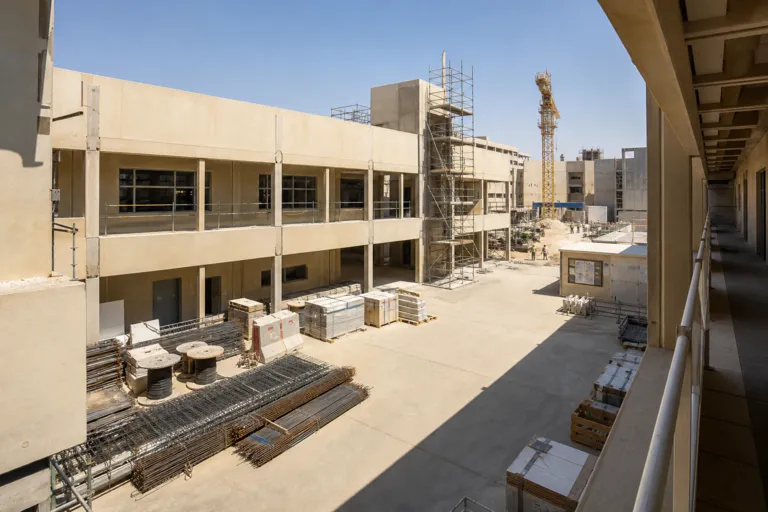
Saudi Arabia’s classroom build-out is increasingly framed as a capacity problem, not just a real-estate choice. Mordor Intelligence links enrolment pressure to “new-build campuses” and higher seat utilization, and also points to more capital moving through public-private partnership (PPP) programs that support greenfield projects. Within private K-12, the market is expected to grow from USD 9.17 billion in 2025 to USD 9.94 billion in 2026, with a forecast to USD 15.45 billion by 2031 at a 9.23% CAGR for 2026–2031. Those market dynamics do not equal construction spend on their own, but they explain why operators prioritize faster time-to-market and scalable campus delivery.
Seat demand is quantified in multiple ways across sources, and the range matters for planning assumptions. Mordor Intelligence states Saudi Arabia’s school-age population is increasing 2.5% annually and is projected to hit 7.2 million by 2030, requiring 1.2 million additional seats to avoid overcrowding pressures. Separately, GMI Research says K-12 student registrations are projected to reach 8.3 million in 2030 from 6.1 million in 2018, and that the increase in demand will require an additional 2.2 million seats across the Kingdom. Both figures point to a sustained pipeline of new schools and expansions, especially in high-demand urban districts and in areas where developers can secure land and approvals quickly.
What’s Reshaping the Schools-and-Universities Build Pipeline
Location and segment mix shape where the near-term pipeline concentrates. In 2025, the Riyadh area held 36.12% of the private K-12 market share, according to Mordor Intelligence. The same source reports expatriate students represented 72.88% of the private K-12 market size in 2025, while local students are expected to grow at about 13.74% between 2026 and 2031. Tuition segmentation also signals diverse facility types: schools charging less than SAR 15,000 per year led with 52.41% share in 2025, while fees above SAR 80,000 per year are advancing at a 15.74% CAGR through 2031. For construction, that mix can translate into both volume-driven standard campuses and higher-spec premium builds with more specialized spaces.
Higher education adds another layer to the “schools universities construction pipeline Saudi Arabia” conversation because it requires different building typologies and often more complex stakeholder governance. Grand View Research reports the Saudi Arabia higher education market generated revenue of USD 5,675.4 million in 2023 and is expected to reach USD 13,913.3 million by 2030. It also notes offline was the largest segment with a 69.86% revenue share in 2023, underscoring that physical campuses remain central even as online grows. On the public investment side, Saudi Market Research Consulting cites a USD 37.5 billion education allocation in 2022 (attributed to Mordor) as a signal of commitment to modernizing infrastructure and expanding international schools.
Delivery capability is increasingly defined by compliance and technical scope. Dar Anan emphasizes that all schools operating in Saudi Arabia, government or private, must comply with Ministry of Education (MoE) design and construction standards, including space allocation and minimum classroom sizes tied to student capacity. It also describes education construction as regulatory-intensive, with requirements for safety, accessibility, acoustics, ventilation, and multi-body approvals. As private provision expands—GMI Research says the number of private institutes reached over 7,337 schools in 2024, up by 490 over 2023, with over 1 million students enrolled—contractors and consultants that understand standards and approvals are positioned to execute faster and with fewer redesign cycles.
What is driving Saudi Arabia’s school construction demand toward 2030?
How concentrated is private K-12 demand in Riyadh?
What do the sources say about private school growth indicators linked to new builds?
How does the schools and universities construction pipeline in Saudi Arabia relate to higher education trends?
What construction requirements are highlighted for building schools in Saudi Arabia?
Talk to us for your needs in:
-
Sustainable Construction Solutions
-
Strategic Construction Planning
-
Customer-Centric Construction Services
-
Operational Excellence in Construction
-
Leadership and Change Management for Construction
-
Digital Transformation in Construction
-
Saudi Construction Market Research
-
In-Depth Market Study for Construction
-
Market Intelligence and Insights in Construction
-
Feasibility Study and Assessment in Construction
-
Saudi Construction Benchmarking