Riyadh Metro phase 2 is moving from headline infrastructure to practical expansion and integration work. The Royal Commission for Riyadh City (RCRC) oversees the King Abdulaziz Project for Riyadh Public Transport, which combines the Riyadh Metro and Riyadh Bus networks in “seamless integration.” King Salman bin Abdulaziz Al Saud inaugurated the Riyadh Metro on November 27, 2024. For contractors, the next wave is less about proving the concept and more about delivering extensions, interchanges, and operational readiness.
The core metro network spans 176 kilometers across 6 lines and includes 85 stations, with a stated daily capacity of 3.6 million passengers. The network is positioned as the backbone of the city’s public transport system and is integrated with a new bus network. This integration focus is important, because it drives demand for stations, interchanges, systems interfaces, and ongoing maintenance practices that keep service steady across modes.
Several numbers show why this pipeline is attractive for delivery teams. The Line 2 extension is 8.4km long and includes five stations. A separate planned Line 7 is about 65km long with 19 stations. And MEED reported an estimated $800m–$900m contract award for the next phase of the Riyadh Metro project.
Where Civil MEP and O&M Opportunities Cluster
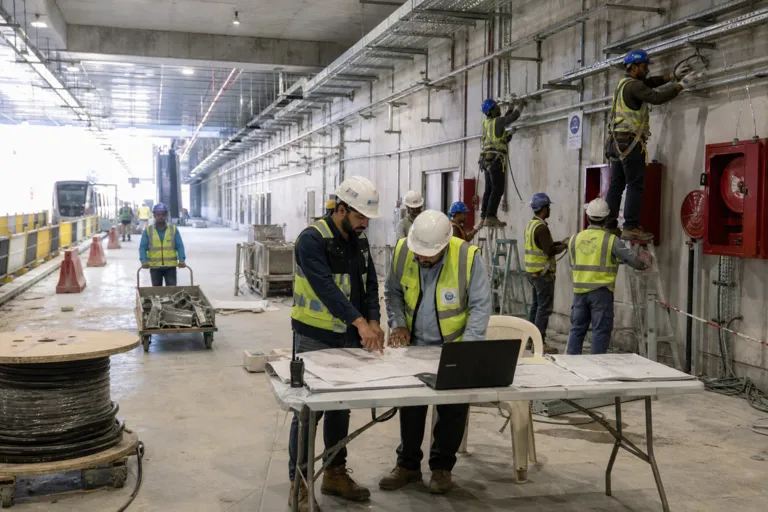
Civil and MEP scope is proven to be broad on this programme. Consolidated Contractors Company (CCC) described its earlier work as covering civil, structural, architectural, and mechanical, electrical, and plumbing (MEP) works, plus integration, construction management, and commissioning. That precedent matters, because extensions and new stations repeat the same problem set: power, ventilation, drainage, fire and life safety interfaces, and station systems that must work together from day one.
For Riyadh Metro phase 2, the Line 2 extension scope is clearly defined. It is 8.4km in total, with 1.3km elevated and 7.1km underground, and five stations (two elevated and three underground). It will run from the current Line 2 terminus at King Saud University to KSU Medical City, KSU West, Diriyah East, Diriyah Central (with an interchange with the planned Line 7), and Diriyah South. This corridor creates immediate packages for underground station MEP, elevated station services, tunnel-related systems, and interchange readiness.
Operations and maintenance is another contracting layer that keeps expanding as services mature. Construction Review Online cites an O&M contractor arrangement for Lines 3, 4, 5, and 6: the Flow consortium (Alstom and Hitachi) under a 12-year contract valued at SAR 10.9bn ($2.91bn). The Business Year also notes that the operations phase supports roles in train operations, station management, maintenance, security, and administration, with international operators training Saudi staff. For O&M bidders and specialist subcontractors, integration with the bus network raises the bar on reliability, passenger flow management, and coordinated incident response.
What is included in Riyadh Metro phase 2 work right now?
How long is the Riyadh Metro Line 2 extension and how many stations does it have?
How does bus network integration connect to contracting opportunities?
What O&M contract information is publicly stated in the sources?
Talk to us for your needs in:
-
Sustainable Construction Solutions
-
Strategic Construction Planning
-
Customer-Centric Construction Services
-
Operational Excellence in Construction
-
Leadership and Change Management for Construction
-
Digital Transformation in Construction
-
Saudi Construction Market Research
-
In-Depth Market Study for Construction
-
Market Intelligence and Insights in Construction
-
Feasibility Study and Assessment in Construction
-
Saudi Construction Benchmarking