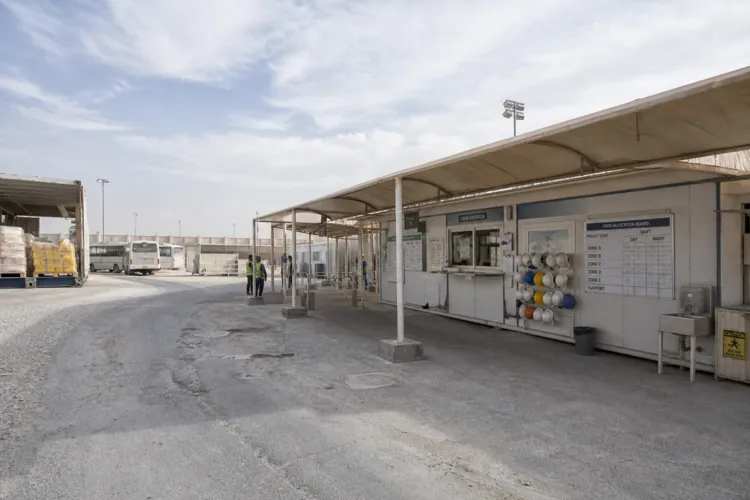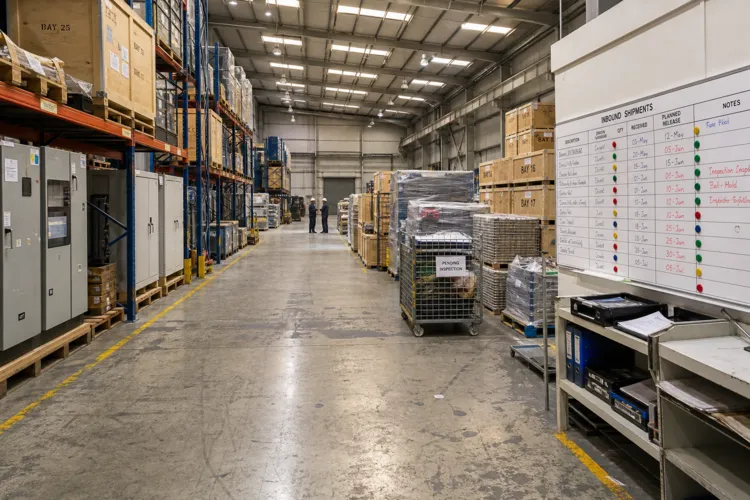
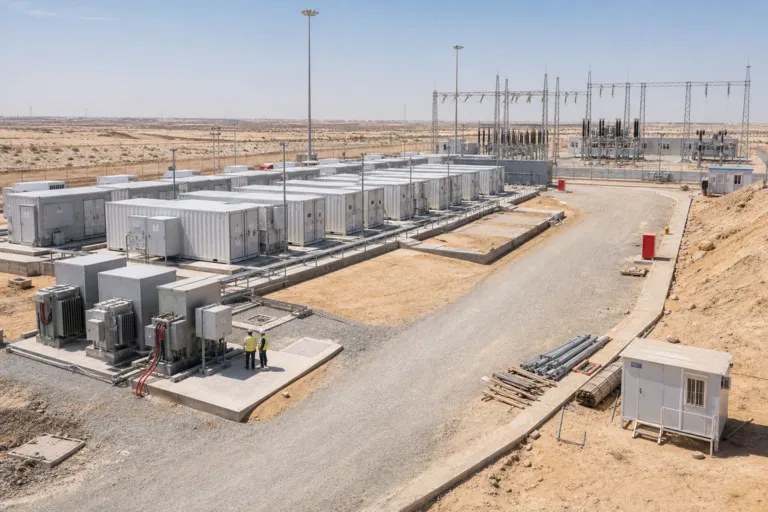
Grid scale battery storage construction in Saudi Arabia is moving from pilot thinking to multi-site execution. Saudi Energy (formerly Saudi Electricity Company) said it has commissioned a grid-side, grid-forming BESS project with total installed capacity of 2.5 GW, using BYD technology across five locations. The sites serve major power regions including Riyadh, Rabigh, Dawadmi, Al Jouf, and Qassim. The project completed grid-tied charging and discharging tests and is officially operational. It is also described as the largest grid-side grid-forming energy storage cluster in the world, incorporating more than 2,000 PCS units. For delivery teams, that scale turns planning, laydown areas, access roads, and sequencing into core civil and EPC design variables.
On the EPC side, Saudi Energy named Alfanar Projects as EPC contractor for the five-site 2.5 GW build and said it delivered all five projects within a “record timeframe.” That wording matters because it signals a delivery model built around repetition, standardization, and parallel workfronts. A grid-forming BESS is not only a battery yard. It is power electronics, protection, control, and commissioning discipline that must be repeated consistently across sites. The stated intent is system stability, renewable integration, and flexible grid regulation. For civil and installation teams, it pushes earlier coordination around earthing, foundations, cable routing, and interfaces where PCS density becomes a practical constraint rather than an abstract design detail.
Civil, Grid Interconnection, and Compliance: Where Timelines Are Won or Lost
Another utility-scale benchmark described in the sources is the 7.8 GWh project that has officially completed grid connection. It spans three sites in the Kingdom’s southwestern regions: Najran, Khamis Mushait, and Madaya. Each site is 2.6 GWh and connects to the transmission network at 380 kV. The project is owned by SEC, with National Grid SA as offtaker, and Algihaz Holding delivered it under a full turnkey EPC contract that included O&M and high-voltage transformer equipment supply and integration. It was designed as a grid-forming system providing black-start, virtual inertia, fast frequency response, and voltage support. These service requirements translate into commissioning complexity and tight coordination between EPC, OEM, and grid operator test windows.
Equipment packaging and factory-to-site logistics are also positioned as schedule levers. For the 7.8 GWh project, Sungrow said it completed manufacturing of over 1,500 PowerTitan 2.0 systems in 58 days and delivered the entire project within a challenging timeline. The solution is described as an all-in-one AC-DC block integrating embedded PCS, pre-assembled battery containers, medium-voltage transformers, RMU, and factory testing, and Sungrow also deployed a local service team in Saudi Arabia for installation, commissioning, and grid connection activities. Separately, IndexBox notes that compliance with grid codes is mandatory for all grid-connected storage projects and that certification can take 3–6 months. Safety standards are governed by SASO, adopting IEC 62619 and IEC 62477, with fire safety requirements specified by Saudi Civil Defense and local building codes.
These delivery patterns sit inside a broader buildout context described at the 13th Saudi Smart Grid Conference. Assistant Minister of Energy for Electricity Affairs Nasser Al-Qahtani said Saudi Arabia has a renewable energy project pipeline of nearly 64 GW, with 12.3 GW already connected to the national grid, and that 30 GWh of battery energy storage capacity is under development. On the contractor market side, MarkWide Research values the Saudi Arabia Power EPC market at $8.7 billion in 2026 and projects $19.53 billion by 2035 at a 9.40% CAGR. Together, the sources point to a delivery environment where civil readiness, modular integration, grid compliance, and multi-site EPC governance determine whether grid-forming BESS programs scale smoothly across the Kingdom.
What is the commissioned grid-forming BESS capacity Saudi Energy reported in Saudi Arabia?
Which regions are served by the five-site 2.5 GW grid-forming BESS cluster?
How is the 7.8 GWh grid-connected BESS in southwestern Saudi Arabia structured?
What timeline factors can affect grid scale battery storage construction in Saudi Arabia?
What do the sources say about Saudi Arabia’s wider pipeline for renewables and storage?
Talk to us for your needs in:
-
Sustainable Construction Solutions
-
Strategic Construction Planning
-
Customer-Centric Construction Services
-
Operational Excellence in Construction
-
Leadership and Change Management for Construction
-
Digital Transformation in Construction
-
Saudi Construction Market Research
-
In-Depth Market Study for Construction
-
Market Intelligence and Insights in Construction
-
Feasibility Study and Assessment in Construction
-
Saudi Construction Benchmarking