Saudi Arabia’s Council of Ministers approved a new Government Tenders and Procurement Law (GTPL) in early August 2026, positioning it as part of a broader effort to modernize public procurement, promote transparency and fairness, and improve planning and execution efficiency. The law was later issued by Royal Decree No. M/76 dated 27/2/1448 AH and published in Umm Al-Qura on 4 September 2026. It has 101 articles and is set to enter into force 120 days after publication, which is around early January 2027. For construction, the practical question is how this framework reprices risk in bids, especially where cost pressures intersect with contract administration rules and the way variations are controlled.
One direct pricing signal is the GTPL’s higher ceiling for contract changes. The permissible threshold for increasing a contract’s value is increased to 20%, and separate analysis of the 2026 procurement law describes an aggregate 20% cap as a key control to prevent cumulative amendments from turning an awarded scope into a materially different procurement. That same analysis also warns the cap does not, by itself, prevent immature scope definition, because an agency can still tender incomplete requirements and consume contingency through legitimate change. In that environment, contractors may treat a price escalation clause under the new Saudi procurement law less as a “nice-to-have” and more as part of a joined-up strategy with variation governance, contingency planning, and documentation discipline.
Faster Approvals, Wider Delegation, and More Pressure on Front-End Risk
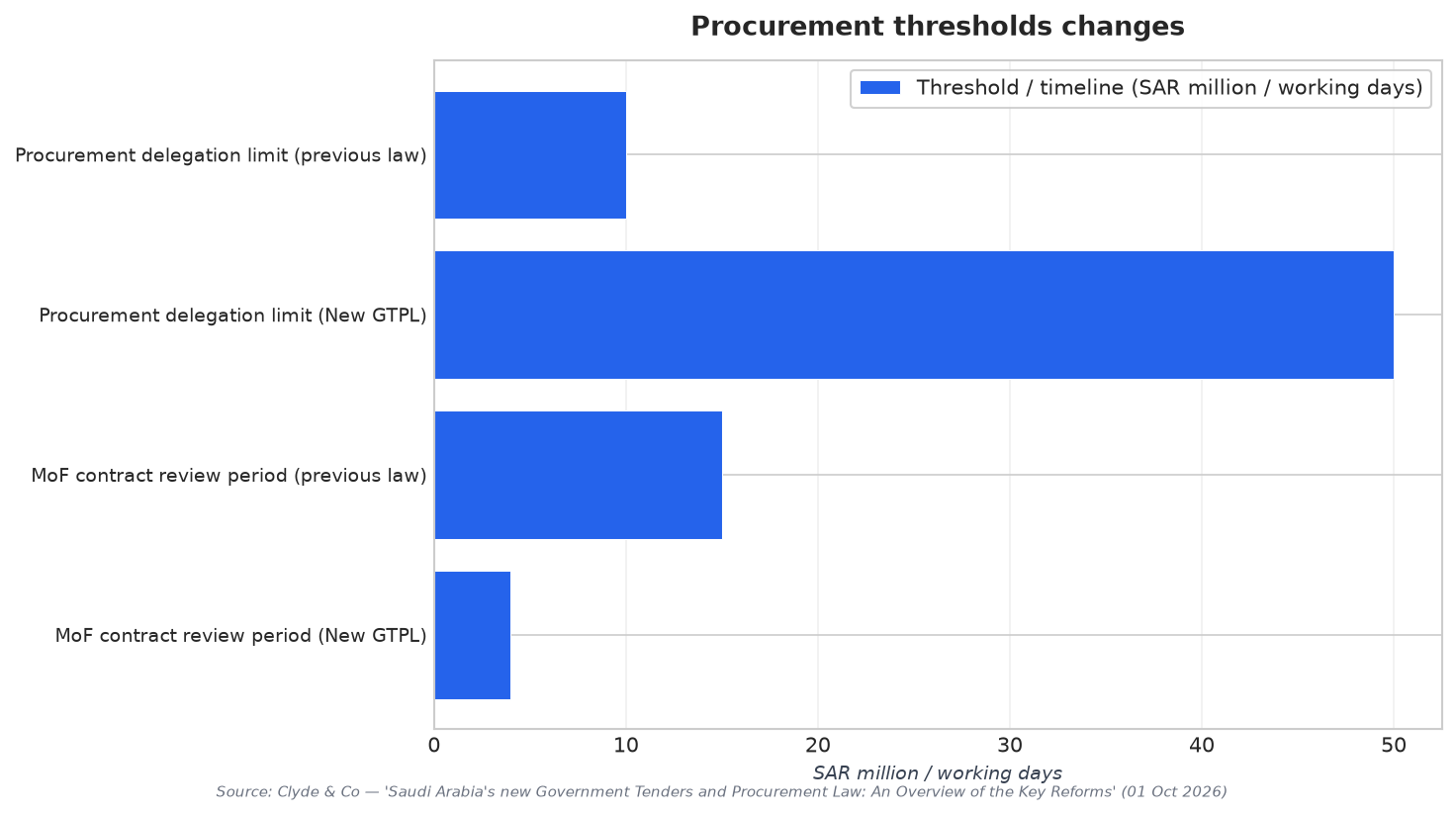
The law also targets speed and decision efficiency, which affects how quickly risk crystallizes after bid submission. The Ministry of Finance review period is reduced to up to four working days, compared with a previously referenced window of fifteen working days. Delegation expands too: the value limit within which the head of a government entity may delegate authority over procurement procedure decisions increases from SAR 10 million to SAR 50 million in certain circumstances. Separately, the head of an entity may delegate contract-signing authority without any financial limit. These measures can shorten the time between tender completion and award, but they also compress the bidder’s window to resolve open assumptions, refine escalation mechanics, and ensure the tender clarifies what will be treated as a compensable change versus baseline price risk.
Dispute pathways also carry hard deadlines that can influence how contractors document escalation events and variation impacts. A bidder may file a grievance with the government entity against a pre-award decision within five working days, and the entity must decide within fifteen working days, with silence treated as rejection. A bidder may then escalate to the review committee within three working days, and the committee decides within fifteen working days, extendable once. Escalation requires a deposit of 0.5% of the bid value (as described in the bidder guide). These timelines and procedural steps make contemporaneous record-keeping more than a best practice, because delayed action can quickly become a lost opportunity to challenge a decision that affects price, scope, or eligibility.
Finally, external shocks underline why escalation and change controls cannot be separated. A Saudi construction-law trends note links force majeure delay concepts in public procurement contracts to Article 144 of the GTPL, and highlights that the Strait of Hormuz has been closed by Iran in the context of an Iran–US–Israel conflict dated 28 February 2026. The same note states approximately 20% of global petroleum consumption transits through the strait, adds that a significant proportion of imported construction materials also pass through it, and observes that King Abdulaziz Port in Dammam and the industrial port at Jubail sit inside the strait. Against that backdrop, the new GTPL’s 20% variation cap and faster administrative cycles can push contractors to price logistics and escalation risk more explicitly at bid stage, and to align any escalation clause drafting with the law’s change-order boundaries.
When does Saudi Arabia’s new GTPL enter into force?
What is the new cap on contract value increases through variations?
How fast is the Ministry of Finance review period under the new GTPL?
How does a price escalation clause work under the new Saudi procurement law in practice?
What are the key grievance deadlines a bidder should know?
Talk to us for your needs in:
-
Sustainable Construction Solutions
-
Strategic Construction Planning
-
Customer-Centric Construction Services
-
Operational Excellence in Construction
-
Leadership and Change Management for Construction
-
Digital Transformation in Construction
-
Saudi Construction Market Research
-
In-Depth Market Study for Construction
-
Market Intelligence and Insights in Construction
-
Feasibility Study and Assessment in Construction
-
Saudi Construction Benchmarking