Sandstorm season adds a natural PM10 load to air that is already affected by man-made sources such as construction and mining. PM10 is particulate matter with a diameter of 10 micrometers (μm) or smaller, and it can include mineral dust alongside other materials. In Saudi Arabia’s cities, the issue is visible in real-time tracking: one dashboard reports Riyadh’s PM10 at 84 μg/m³ (Moderate), described as acceptable but with caution for sensitive individuals, and also noted as 1.8x above the WHO guideline of 45 μg/m³. For project teams, this means the baseline can start elevated before any earthworks, hauling, or cutting begins, so site controls need to be proactive rather than reactive.
Construction sites are repeatedly cited as a major source of PM10 air pollution, and the risk is not limited to the boundary fence. PM10 from construction can drift into surrounding areas, and under specific conditions very fine dust can travel up to hundreds of kilometers, although moisture and low wind speeds drastically decrease that distance. PM10 sources are broader than construction, including wildfires, agriculture, and wind-blown dust, but site activity is one source owners can manage directly. For “construction site dust control air quality Saudi” planning, it helps to separate what you cannot control (regional dust events) from what you can (material handling, traffic dust, and cutting or grinding processes).
PM10 Control on Saudi Sites: Monitor, Suppress, and Prove Compliance
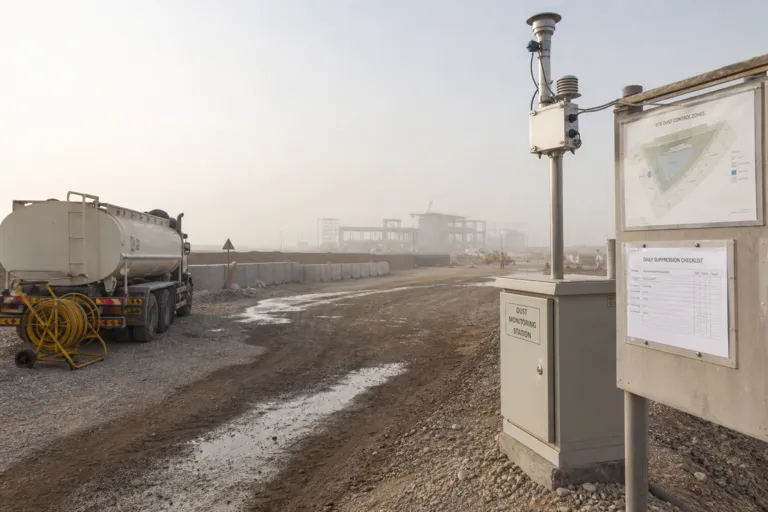
PM10 management improves when monitoring is tied to action. In Saudi Arabia, IMARC Group figures cited in a 2026 press release put the air quality monitoring market at USD 68.7 Million in 2025, with a forecast of USD 139.5 Million by 2034 at a CAGR of 8.19% (2026–2034). The same source describes AI approaches that estimate daily PM10 levels using satellite and ground data, and it also lists emission limits that include PM10 capped at 150 mg/m³, alongside SO2 at 500 mg/m³ and NOx around 400 mg/m³. On-site, the practical translation is straightforward: place monitors where people work and where dust leaves the site, use real-time readings to trigger controls, and keep records that show what was measured and what was done when levels rose.
Suppression is increasingly designed to be automated, not purely manual. A Saudi dust control market overview citing IMARC Group places the dust control solutions market at USD 167.1 Million in 2025 and expects USD 238.7 Million by 2034, at a CAGR of 4.04% for 2026–2034. That same source points to AI-powered sensors and IoT-enabled systems that track dust continuously and trigger automated suppression mechanisms at construction and mining sites, and to machine-learning approaches that forecast dust events hours in advance to enable proactive deployment. It also describes optimization that targets water usage and chemical suppressant deployment, aiming to reduce manual intervention and improve response times. During sandstorm-prone periods, this “monitor-and-activate” loop can help teams act before the site becomes visibly dusty.
Scale is one reason PM10 management is getting more attention. One overview of Vision 2030 activity cites Knight Frank reporting construction contracts worth $196 billion across Vision 2030 projects, and notes NEOM with $24 billion in contracts to date, alongside developments such as Qiddiya and Diriyah Gate building more than 382,500 new homes and 3 million square meters of office space. More active sites increase the need for consistent controls across contractors and packages. The same overview states the Kingdom has planted 137 million trees to date as part of a 10 billion tree target, and mentions a $10 million, five-year commitment through the UNCCD COP16 Presidency initiative to expand dust storm prediction capabilities. For construction teams, the takeaway is that dust planning is becoming a system problem: coordination, monitoring, and documented response matter as much as any single spray truck.
Why is PM10 a priority for construction during sandstorm season in Saudi Arabia?
What does PM10 mean in practical terms for site health and exposure?
How far can construction dust travel beyond a site boundary?
How can construction site dust control support air quality in Saudi projects?
What market signals suggest monitoring and dust control are expanding in Saudi Arabia?
Talk to us for your needs in:
-
Sustainable Construction Solutions
-
Strategic Construction Planning
-
Customer-Centric Construction Services
-
Operational Excellence in Construction
-
Leadership and Change Management for Construction
-
Digital Transformation in Construction
-
Saudi Construction Market Research
-
In-Depth Market Study for Construction
-
Market Intelligence and Insights in Construction
-
Feasibility Study and Assessment in Construction
-
Saudi Construction Benchmarking