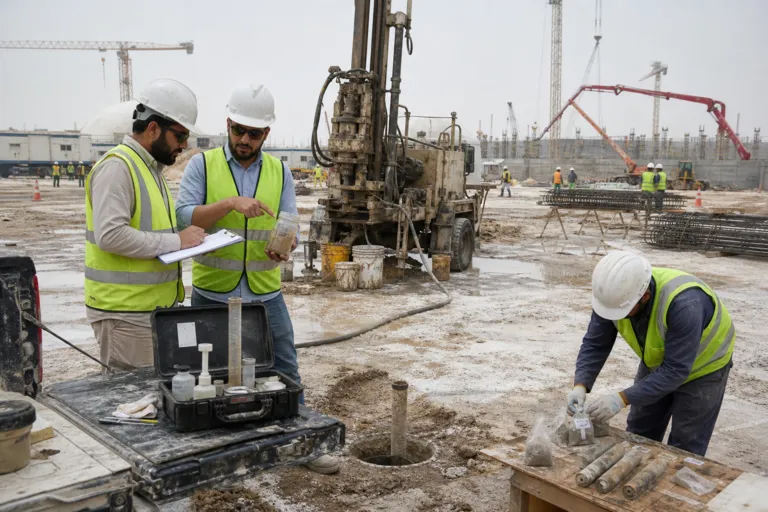
Every Saudi giga-project begins with a ground-truth problem: what the soil and rock will actually do under load. Sources focused on Saudi Arabia and the Gulf highlight that reliable geotechnical data is critical, because projects can face settlement, foundation failure, and expensive changes when site assessments are not done accurately. That risk profile directly influences deep foundations and basement construction, where piling and raft foundations are used to securely carry loads in areas of unstable soil. In practice, that means the earliest investigation choices can shape the entire cost and schedule narrative for a large site, long before superstructures rise.
Across Saudi Arabia and Qatar, several recurring ground challenges drive foundation engineering decisions. Shallow groundwater levels can make excavation and foundation work more difficult, complicating basements and underground works. Competitive soil conditions can also appear, with salinity and sulphates in the soil creating corrosion risks for construction materials, including concrete and structural steel. These conditions push teams toward comprehensive geotechnical engineering and, when needed, soil improvement methods such as compaction, grouting, and stone columns for ground stabilisation. For developers, the message is simple: treat subsurface uncertainty as a core design input, not a late-stage problem to value-engineer away.
What the Market Signals About Demand for Better Ground Decisions
Market signals reinforce why deep foundations and rigorous ground investigation are becoming central across Saudi giga-project programs. Ken Research values the Saudi Arabia geotechnical engineering market at approximately USD 80 million, and describes it as driven by rapid urbanization, significant infrastructure investments, and demand for sustainable construction practices. The same source notes that the market spans soil investigation, foundation engineering, ground improvement techniques, geosynthetics, and environmental and geophysical survey, reflecting how multidisciplinary “ground” decisions have become. It also identifies a mix of regional and international players active in Saudi Arabia, including Riyadh Geotechnique & Foundations Co. (RGF), Saudi BAUER Foundation Contractors Ltd., Huta Foundation Works Co. Ltd. (HUTA Group), Fugro-Suhaimi Ltd. (FSL), and others.
Global benchmarks help frame the scale of capability being built, without implying the same numbers apply locally. One global report sizes the geotechnical engineering market at USD 2.57 billion in 2023 and estimates a 6.3% CAGR from 2024 to 2030. Another report states the geotechnical engineering market size was valued at USD 4,964,738.28 million in 2024 and is expected to reach USD 6,649,665.49 million by 2033, growing at a CAGR of 3.3% from 2025 to 2033. That same source says North America reached USD 9.34 billion in 2024 and accounted for over 45.8% of the global share, while Asia-Pacific accounted for 30.11% with a total market value of USD 0.81 billion. These comparisons underscore how foundation and investigation services are evolving into a tech-enabled, high-value discipline.
For deep foundations geotechnical Saudi giga projects, the practical takeaway is to connect site investigation, ground improvement, and foundation selection into one continuous risk-management workflow. The Gulf-focused source notes that comprehensive geotechnical engineering supports appropriate basements, using piling and raft foundations to carry loads where soils are unstable, and applying stabilisation techniques where collapsable soils threaten long-term integrity. Ken Research also points to technology integration, stating that AI and data analytics can enhance project efficiency and safety in Saudi Arabia’s geotechnical market. Together, these signals argue for early investment in data quality, disciplined interpretation, and construction-ready geotechnical design—because the ground is the one scope no project can outsource or ignore.
Why is reliable geotechnical data so critical for Saudi giga-project sites?
What ground conditions commonly complicate deep foundations and basements in Saudi Arabia?
Which techniques are cited for improving weak or unstable ground?
How large is Saudi Arabia’s geotechnical engineering market in the cited sources?
How do deep foundations and geotechnical needs connect in Saudi giga-project delivery?
Talk to us for your needs in:
-
Sustainable Construction Solutions
-
Strategic Construction Planning
-
Customer-Centric Construction Services
-
Operational Excellence in Construction
-
Leadership and Change Management for Construction
-
Digital Transformation in Construction
-
Saudi Construction Market Research
-
In-Depth Market Study for Construction
-
Market Intelligence and Insights in Construction
-
Feasibility Study and Assessment in Construction
-
Saudi Construction Benchmarking