Saudi Arabia’s screen sector is expanding across exhibition, domestic production, international location shoots, post-production, and distribution, shaped by Vision 2030 cultural policy and Film Commission incentives. Since cinemas reopened in 2018, the market has grown to more than 700 screens across more than 60 multiplex locations, and annual box office revenue has exceeded SAR 1 billion. Another sector snapshot puts the Kingdom at over 800 screens by 2025. That exhibition base matters for builders and planners because it signals repeatable demand for content, which in turn increases the need for production infrastructure in Riyadh, Jeddah, and NEOM.
The Saudi Film Commission administers a production incentive programme offering cash rebates of up to 40% on qualifying production expenditure in Saudi Arabia. Alongside location scouting, permits, and logistics coordination, that rebate functions like a demand engine for stages, workshops, offices, and supporting services. Saudi Arabia has also set a target to produce and shoot 100 films by 2030, including local and international projects. For developers, the construction question becomes less about a single building and more about a system: sound isolation, power, loading access, security, and adjacent accommodation that can handle production schedules.
From Soundstages to Media Hubs: What’s Being Built
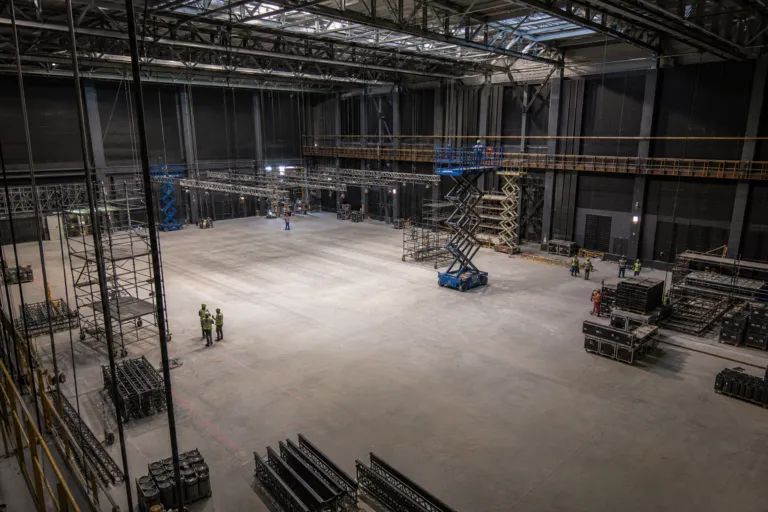
New-stage plans in the Kingdom already point to multi-tenant, production-ready compounds. Screen reports capacity of six operational stages with 12,000 sq m of production space, plus onsite accommodation for 350 cast and crew. Another studio profile highlights backlots spanning more than 50 acres and two high-specification soundstages, with construction underway on two additional soundstages scheduled for 2026 to accommodate large-scale productions simultaneously. The same reporting describes planned additions that go beyond filming, including post-production, visual effects, volumetric, and music studios, which changes construction requirements from simple shells to specialist technical environments.
NEOM’s roadmap pushes the “media-production city” concept further. Plans include increasing its stage count to more than 25 soundstages within a comprehensive media hub of between 850,000 and 1 million square metres by 2045. That scale suggests a long-duration construction pipeline and a need to sequence utilities, roads, workshops, and production offices so the hub can function while expanding. It also implies a steady pull on professional audiovisual systems, from capture and monitoring to networked workflows that can serve multiple stages at once.
On the equipment side, Saudi Arabia’s audiovisual equipment market is positioned for a 6–8% compound annual growth rate through 2035, and it remains import-dependent, with more than 80% of audiovisual equipment sourced internationally. IndexBox notes supply chain lead times of 8–16 weeks for professional-grade equipment, while regulatory compliance can add 2–4 months to product introduction timelines for new equipment entering the market. Displays and monitors are cited as the largest segment at 35–40% of market value, followed by professional audio equipment at 20–25%. In parallel, Saudi Arabia’s display market reached USD 1,644.2 million in 2025 and is anticipated to reach USD 2,207.3 million by 2034. For film studio media city construction in Saudi Arabia, those constraints and growth signals translate into earlier procurement, phased commissioning, and designs that anticipate changing display and LED wall configurations.
How fast has Saudi Arabia’s cinema exhibition market expanded since 2018?
What production incentive is used to attract shoots to Saudi Arabia?
What soundstage capacity and facilities are already described for new studio developments?
What is NEOM planning for a large-scale media hub?
What should teams expect when planning film studio and media city construction in Saudi Arabia?
Talk to us for your needs in:
-
Sustainable Construction Solutions
-
Strategic Construction Planning
-
Customer-Centric Construction Services
-
Operational Excellence in Construction
-
Leadership and Change Management for Construction
-
Digital Transformation in Construction
-
Saudi Construction Market Research
-
In-Depth Market Study for Construction
-
Market Intelligence and Insights in Construction
-
Feasibility Study and Assessment in Construction
-
Saudi Construction Benchmarking