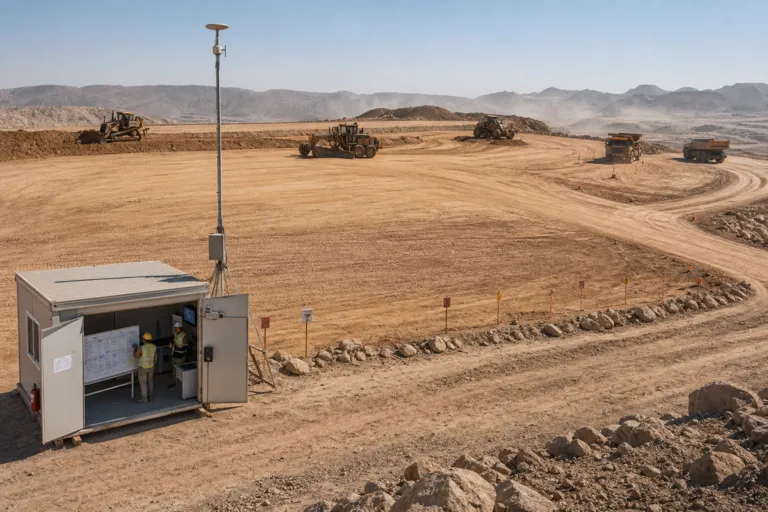
Machine-control has become a practical way to organize earthworks on megasites, especially where schedule pressure and fleet scale punish rework. Industry reporting on heavy construction equipment highlights how GPS, telematics, and automation systems are now integrated into modern machinery to enhance operational efficiency. The same sources point to real-time monitoring of equipment performance, predictive maintenance, and better fleet management as core benefits. For contractors building on Saudi giga-project footprints, those capabilities translate into cleaner grading handoffs, fewer blind spots in production tracking, and a tighter link between plan, machine, and supervision without relying on guesswork.
On earthmoving spreads, GPS grading is more than guidance. It becomes the shared reference that ties survey intent to dozer and excavator execution, and then to reporting. ResearchAndMarkets notes that earthmoving equipment such as excavators and loaders holds the largest market share, driven by widespread use in construction and mining, while infrastructure leads market application as governments worldwide invest heavily in transportation and urban development projects. That global context matters because Saudi development programs are often infrastructure-heavy in scope. It also clarifies why machine-control features show up first on production-critical assets like dozers, excavators, and loaders, where each pass can be measured and managed.
Autonomy Is Spreading From Haul Roads to Full-Scenario Work
Autonomy is already credible in heavy-duty transport, but the gap is what happens outside hauling. A mining-focused report notes that autonomous mining trucks cover only about 30% of the transport segment within the mining production chain. It adds that the remaining 60% to 70% of operations—drilling, blasting, excavating, and charging—are the high-risk, high-difficulty core areas that set a mine’s efficiency and safety baseline. Even though those figures come from mining, the lesson transfers to megasite earthworks: partial autonomy is not the same as autonomous production. For Saudi construction sites exploring autonomous earthmoving equipment, the challenge is expanding from isolated driving functions into coordinated, multi-activity workflows.
Vendors are also signaling what advanced, automation-ready equipment can look like in practice. A Zoomlion update reported that more than 3,700 units of earthmoving and mining machinery, valued at around 2.3 billion yuan (about US$335 million), were shipped from its Earthmoving Machinery Park and other facilities. The same report said the company planned to ship orders to more than 40 countries, explicitly including Saudi Arabia. It also described a ZTC250N-EV mobile electric crane equipped with unmanned path management for autonomous driving and operation, with a stated 10% to 80% charge in under an hour and 230 km of range. While that example is a crane, it illustrates how autonomy and electrification are being packaged into commercial equipment that can appear on regional projects.
Policy and investment themes help explain why Saudi stakeholders care about localization, capability building, and the data layer behind machine-control. A legal and policy overview states that Saudi Vision 2030 emphasizes local manufacturing, aiming for 400,000 domestically produced vehicles by the end of the decade, supported by joint ventures, localization mandates, and investment in research and development hubs. In mining, a market note reports that Saudi Arabia allocated US$182 million for minerals exploration in January 2024, tied to initiatives to advance the sector and local equipment manufacturing capacity. Together, these signals suggest that machine-control on Saudi megasites will not be only about buying technology. It will also be about operating it securely, maintaining it predictably, and building local capability around GPS, telematics, and automation-enabled fleets.
What technologies are most associated with machine-control on modern heavy equipment?
Why does GPS-based grading matter on large Saudi giga-project earthworks?
How far along is autonomy in heavy industry, and what remains difficult?
What real-world shipments indicate rising availability of automation-ready equipment for Saudi projects?
How is the push for autonomous earthmoving equipment shaping Saudi construction sites in practice?
Talk to us for your needs in:
-
Sustainable Construction Solutions
-
Strategic Construction Planning
-
Customer-Centric Construction Services
-
Operational Excellence in Construction
-
Leadership and Change Management for Construction
-
Digital Transformation in Construction
-
Saudi Construction Market Research
-
In-Depth Market Study for Construction
-
Market Intelligence and Insights in Construction
-
Feasibility Study and Assessment in Construction
-
Saudi Construction Benchmarking