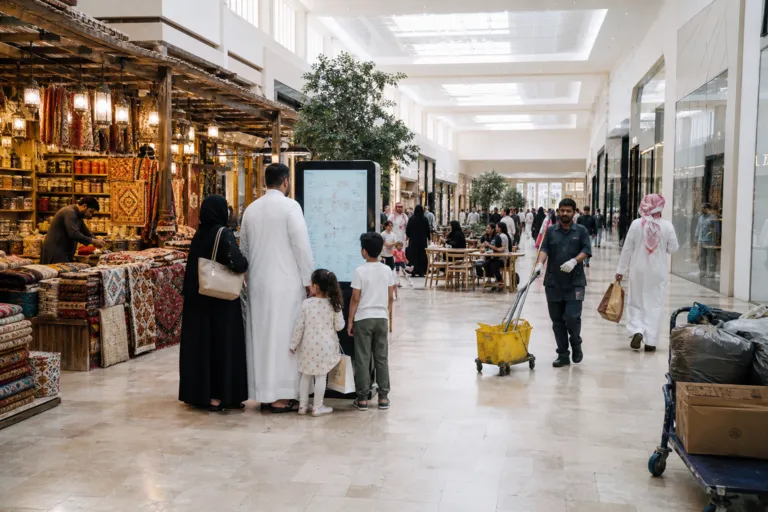
Saudi Arabia’s retail environment is evolving through a mix of traditional formats and modern destinations. Sources describe a market historically shaped by brick-and-mortar stores and bustling souks, now increasingly complemented by mega-malls, hypermarkets, and fast-growing e-commerce. In parallel, the Saudi Arabia retail market was valued at USD 168.8 billion in 2025, with a stated CAGR of 7.8% for 2026–2030. This shift also shows up operationally: retailers adopting an omnichannel model reported customer lifetime value that is 30% higher than single-channel operators, while AI-driven demand forecasting has reduced inventory holding costs by up to 15%.
Developers and operators are responding by building spaces designed to keep people on-site longer. One source frames this as “retailtainment,” where malls allocate significant portions of gross leased area to non-retail activities such as entertainment zones, dining experiences, and community events. Knight Frank data reported that lifestyle retail space in Riyadh and Jeddah is projected to grow by nearly 600,000 sqm, reaching a total of 1.31 million sqm by 2027. The same reporting also noted Jeddah deliveries, projecting an additional 205,600 sqm from seven new developments, taking Jeddah’s total lifestyle retail supply to 439,000 sqm by 2027.
What the 2026 Retail Supply Signals for Experiential Mall Formats
Riyadh is a key reference point in the current construction narrative because sources provide explicit supply and rent signals. Knight Frank reporting said Riyadh’s total retail supply is expected to grow by 20% to an estimated 5.2 million sqm by 2026, while average rents increased by 4% in the last year. This is the context in which retail mall construction in Saudi Arabia in 2026 is often discussed: not only as new floor area, but as a push toward cinemas and family-oriented attractions described as “experiential retail.” That same source links the demand backdrop to rising population and disposable incomes, aligning retail design with longer dwell times and higher-frequency visits.
At the broader commercial level, IMARC research cited in a construction-market overview put Saudi Arabia’s commercial construction market size at USD 37,031.21 million in 2025, projecting USD 73,357.10 million by 2034, at a growth rate of 7.89% for 2026–2034. Within that framing, the same overview states that 800,000 square meters of new retail space is expected by 2027, led by named flagship projects such as Westfield Riyadh and Avenues Mall. It also describes Vision 2030 as a driver of commercial real estate demand across retail and mixed-use, while noting contract awards of SAR 118.8 billion in the first quarter alone, described as a 79% year-over-year surge.
Operators, meanwhile, are planning for a shopper who moves between digital and physical touchpoints. A Riyadh-focused retail mall report highlighted digital and omni-channel integration and stated that e-commerce grew by 30%, accounting for nearly 45% of all PoS transactions (as written in that source). Technavio also points to technology adoption inside non-food retail: augmented reality for virtual try-ons increased customer engagement by over 20%, and retailers using AI saw a 15% uplift in conversion rates. With high operational costs also noted in one source—where commercial rent for retail spaces can exceed $2,500 per square meter annually in urban centers like Riyadh and Jeddah—the case for efficiency, data-driven merchandising, and experiential differentiation becomes central to how malls and souk-adjacent destinations compete.
What does retail mall construction in Saudi Arabia in 2026 look like in terms of supply and rent signals?
How much lifestyle retail space growth is projected for Riyadh and Jeddah by 2027?
What is the expected new retail space pipeline by 2027 mentioned in the sources?
What do the sources say about omnichannel performance in Saudi retail?
Which pressures could shape mall operator strategies in major Saudi cities?
Talk to us for your needs in:
-
Sustainable Construction Solutions
-
Strategic Construction Planning
-
Customer-Centric Construction Services
-
Operational Excellence in Construction
-
Leadership and Change Management for Construction
-
Digital Transformation in Construction
-
Saudi Construction Market Research
-
In-Depth Market Study for Construction
-
Market Intelligence and Insights in Construction
-
Feasibility Study and Assessment in Construction
-
Saudi Construction Benchmarking