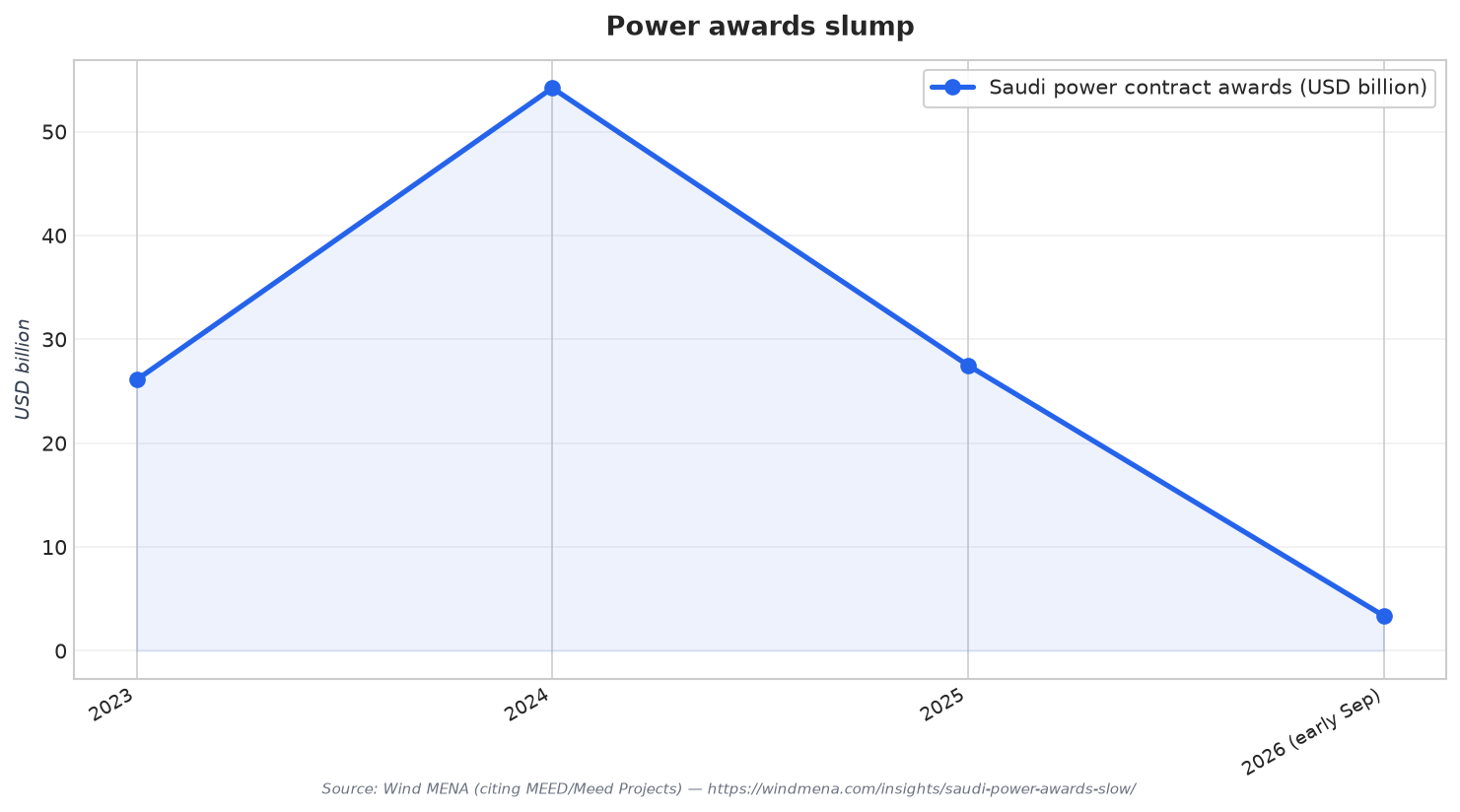
Saudi subcontractors live in the gap between “promised” work and “paid” work. That gap gets wider when awards slow or procurement is delayed. In Saudi power, awards were USD 54.2 billion in 2024, then fell to USD 3.38 billion by early September 2026, according to Wind MENA. MEED’s Mark Dowdall puts 2023 at USD 26.1 billion and 2025 at USD 27.5 billion. Wind took USD 4.4 billion of the 2025 awards, while USD 2.2 billion of wind work was still at bid evaluation or main-contract tender. For tier-2 firms, that distinction matters because a bid is only a promise, while an award is the purchase order that activates the supply chain.
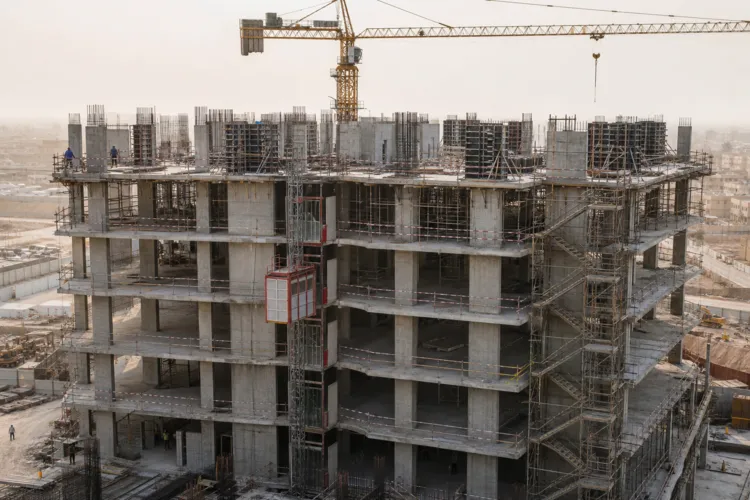
The pressure can rise even when activity is growing on the ground. EnterpriseAM reports that Al Rajhi Capital’s Saudi Construction Index reached 55.4 in August, up from 55.2 in July, and stayed above the 50 contraction line for a fifth straight month. All three segments expanded: residential led at 56.6, infrastructure improved to 55.8 from 53.9, and non-residential came in at 50.9. At the same time, the same report describes new contract awards falling and building costs hitting an annual high in 2026. That combination is tough for subcontractors. Crews and suppliers must be paid while award schedules and payment milestones sit upstream with main contractors and employers.
Why Award Counts, Tender Value, and Cash Are Not the Same
Saudi procurement reporting also shows why subcontractors should separate stages of money. Vision2030.ai notes that SCA/SCAVO recorded 97 Saudi awards worth SAR111.31 billion through July 2026, and that May and June supplied SAR59.539 billion, or 53.5% of the seven-month value. In parallel, another Vision2030.ai analysis highlights that issued value and awarded value cannot be treated as the same money, and describes at least five numerical stages that can exist between an estimate and audited local-content value. The practical takeaway for the supply chain is simple. A tender pipeline is not a receivables pipeline. For firms thinking about supply chain finance construction subcontractors Saudi strategies, the quality and timing of the underlying award and payment data matters as much as the headline opportunity narrative.
Competition can make payment discipline even more important. Arab News reports the number of foreign contracting companies entering the Saudi market has reached 1,648 since the establishment of the Saudi Contractors Authority, and the same source says the contracting sector contributes about 8% of GDP. Mordor Intelligence adds that rivalry is intensifying as local champions form joint ventures with global majors to secure technology and balance-sheet strength for large awards. IMARC notes that under Saudi contract law, main contractors may delegate work to subcontractors while remaining fully accountable to the employer. For tier-2 suppliers, that structure creates both a dependency and an opening. If the main contractor stays accountable, then payment workflows and verification systems become central to whether subcontractors can accelerate cash, reduce disputes, and keep working capital from freezing.
So what can subcontractors do when awards slip and execution still needs to move? Start by mapping exposures by stage, not by marketing label. Wind MENA’s warning that Round 7 wind bids were due in September for 1,300 MW at Bilgah and 900 MW at Shagra, and that MEED expects contracts may fall into 2027 rather than lifting this year’s total, is a reminder that timing risk is real. Next, treat local-content requirements as operational processes, not slogans. Vision2030.ai describes “local-content mechanisms” as an umbrella with multiple routes, including mandatory national products and local-content weighting in financial evaluation, plus the need for clearer publication of tender, award, payment, and audited local-content values. When subcontractors align documentation, delivery proof, and invoicing cadence to these stages, they are better positioned to use structured payment solutions tied to verified work and accepted invoices, rather than waiting on the slowest part of the chain.
Why are Saudi subcontractors feeling squeezed even when construction activity is expanding?
What do Saudi award figures show about timing risk for the supply chain?
How do tender value and awarded value differ in Saudi procurement reporting?
How competitive is the Saudi contracting market, and why does that matter for getting paid?
How can supply chain finance help construction subcontractors in Saudi Arabia when awards slow?
Talk to us for your needs in:
-
Sustainable Construction Solutions
-
Strategic Construction Planning
-
Customer-Centric Construction Services
-
Operational Excellence in Construction
-
Leadership and Change Management for Construction
-
Digital Transformation in Construction
-
Saudi Construction Market Research
-
In-Depth Market Study for Construction
-
Market Intelligence and Insights in Construction
-
Feasibility Study and Assessment in Construction
-
Saudi Construction Benchmarking