Large, multi-disciplinary construction projects generate vast quantities of information across contractors, consultants, and timelines. When this information is fragmented, version conflicts multiply and rework risk increases. ISO 19650 addresses this by defining how information should be produced, shared, and managed across the lifecycle of a built asset using BIM processes. At the core is the Common Data Environment (CDE), described as a centralized digital workspace and the “single source of truth” for project information. For Saudi BIM delivery teams, the point is not simply buying a platform, but setting up the structure and rules so the CDE functions as one controlled dataset rather than scattered email threads, shared drives, or discipline-specific servers.
ISO 19650 is organized into five parts: Part 1 (concepts and principles), Part 2 (delivery phase of assets), Part 3 (operational phase), and Part 5 (a security-minded approach). For large construction delivery, Parts 1 and 2 are often treated as the operational foundation. They define the chain of information requirements from the client’s Asset Information Requirements (AIR) to the Employer’s Information Requirements (EIR), and then into each appointed party’s BIM Execution Plan (BEP). This matters because a CDE only becomes enforceable when it is connected to these requirements and used as the governed place where models and project documentation are published, reviewed, and approved as “information containers.”
Configure the CDE as a Controlled Workflow, Not Cloud Storage
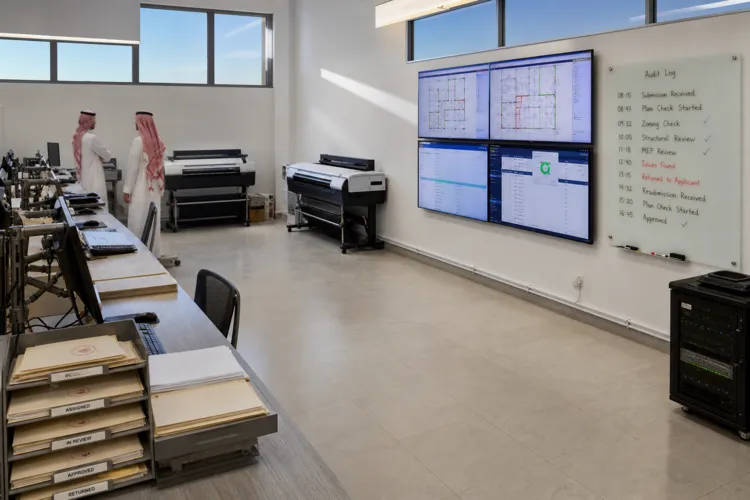
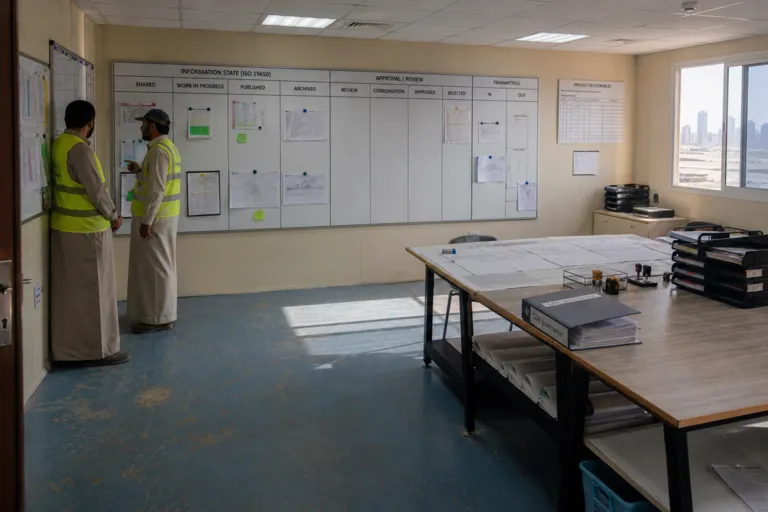
Under ISO 19650, information in a CDE moves through four defined states: Work in Progress (WIP), Shared, Published, and Archived. WIP is where authors work before formal sharing. Shared is for review and comment across disciplines. Published is formally approved and authorized for use. Archived retains superseded information for audit and record purposes. This state model prevents a common failure mode: teams acting on outdated or unapproved information. It also supports the shift described by ISO 19650-aligned guidance from “archiving” toward active information management, where revisions, issues, and approvals determine what is reliable and when it may be used.
A CDE does not replace specialist authoring and analysis tools such as Revit or Tekla. Instead, it consolidates outputs from those tools so teams can coordinate through consistent publication and validation steps. Research on ISO 19650-compliant information management emphasizes that the core question is no longer whether a CDE platform is necessary, but how it should be configured and organizationally implemented to operate as a true single source of truth. Effectiveness depends on more than configuration. It depends on agreed procedures, publication rules for models and documents, and the information management competencies and discipline of project participants, reinforced through role-based access and controlled information sharing.
For teams targeting a common data environment ISO 19650 approach in Saudi Arabia, governance should be defined early and then tested in day-to-day coordination. Start by aligning the EIR, AIR, and BEP to the CDE workflow so everyone understands what gets shared, when, and by whom. Then implement the four-state lifecycle to separate drafting from cross-discipline review and authorized use. Ensure review and approval steps are explicit so that “Published” information is trusted for decisions, procurement, and construction. Finally, retain an Archived record so change history and audit needs are supported. The result is a single point of truth that reduces uncertainty caused by inconsistent information and creates a repeatable way to manage delivery-phase data and handover-ready information.
What does ISO 19650 mean by a Common Data Environment?
What are the four ISO 19650 information states inside a CDE?
How do AIR, EIR, and BEP connect to setting up a CDE?
Does a CDE replace BIM tools like Revit or Tekla?
How should Saudi teams approach a common data environment under ISO 19650?
Talk to us for your needs in:
-
Sustainable Construction Solutions
-
Strategic Construction Planning
-
Customer-Centric Construction Services
-
Operational Excellence in Construction
-
Leadership and Change Management for Construction
-
Digital Transformation in Construction
-
Saudi Construction Market Research
-
In-Depth Market Study for Construction
-
Market Intelligence and Insights in Construction
-
Feasibility Study and Assessment in Construction
-
Saudi Construction Benchmarking