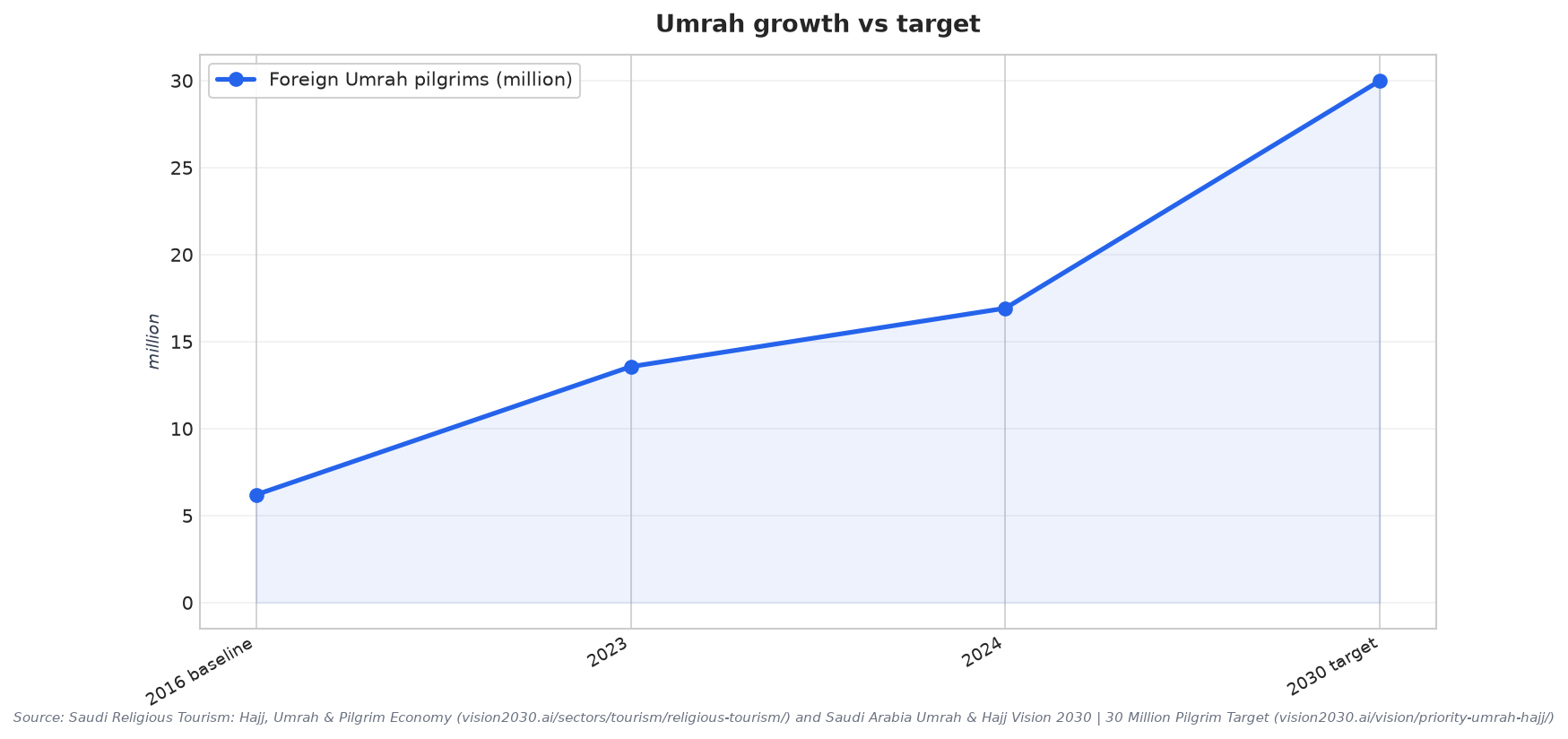
Saudi Arabia’s Vision 2030 pilgrimage agenda is built on scale. The stated target is 30 million foreign Umrah pilgrims annually by 2030, up from an earlier capacity described as approximately 8 million when the Vision launched. Progress is already visible in the numbers. Foreign Umrah arrivals reached 16.92 million in 2024, surpassing an interim target of 11.3 million. Another 2024 view of the same system logged 18.5 million total pilgrims, including 16.92 million Umrah arrivals and roughly 1.61 million Hajj pilgrims. That demand makes the case for sustained building and operational upgrades around the holy cities.
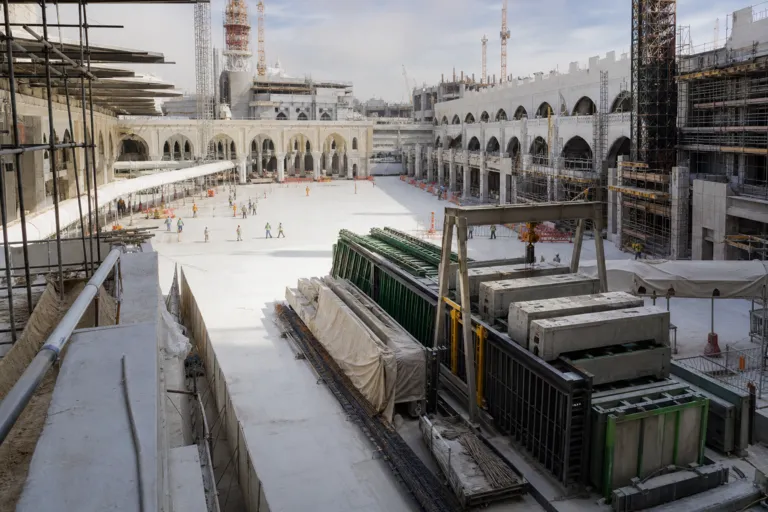
For Hajj, capacity is constrained by fixed geography and timing, which forces planning to focus on flow, safety, and the built environment that supports both. In the 1447 AH season (May 2026), the total reached 1,707,301 pilgrims, with 1,546,655 arriving from outside the Kingdom and 160,646 citizens and residents participating from within. The port mix also matters for infrastructure. Of pilgrims arriving from abroad in 1447 AH, 96.1% came through airports, with land and sea ports handling the remainder. The same report describes historic expansions of the Two Holy Mosques and smart crowd-flow management as part of the experience upgrades linked to Vision 2030 programs.
Construction in Makkah: Contracts, Land, and Mixed-Use Support
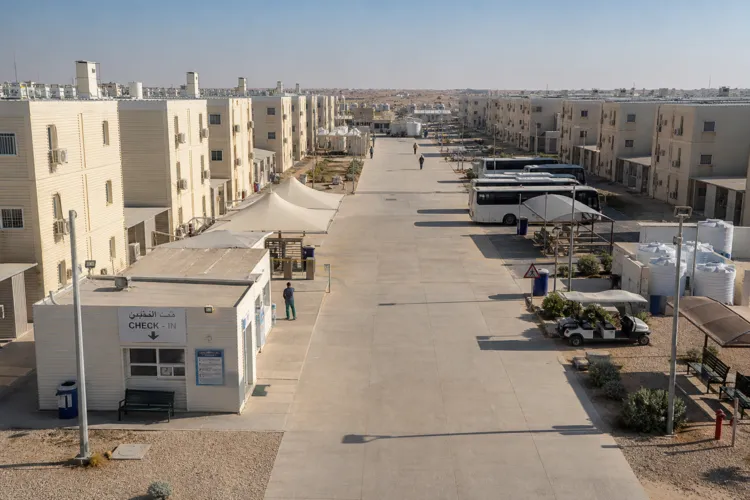
Beyond mosque precinct work, Mecca’s development pipeline is expanding the urban fabric that houses and moves pilgrims. In June 2026, new development contracts were reported across six sites covering more than 2.7 million square meters in total. These sites are planned to include homes, hotels, shops, and offices in the holy city, aligning real estate supply with expected pilgrim growth. The largest single award was around 6 billion riyals, won by a consortium of three local developers—Umm Al Qura, Makkah Construction and Development, and Al Rajhi United Real Estate—and it covers two sites adjacent to the Masar mixed-use project, which is also underway. The contracts were framed as part of the push to raise Hajj and Umrah visitor numbers to more than 30 million annually by 2030.
Operational resilience is another driver of build decisions, because crowd peaks and climate risks expose weak links quickly. Hajj 1446 AH (2025) was described with a global ceiling of 1,372,482 international pilgrims, and the season ended with 1,673,230 total when 166,654 domestic participants were added. A major stress test arrived in June 2024, when extreme heat killed at least 1,301 Hajj pilgrims as Mecca temperatures peaked at 51.8 degrees Celsius. Saudi authorities reported that 83% of the dead were unauthorised pilgrims who bypassed quotas, lacked air-conditioned accommodation, and walked long distances under direct sun. These realities connect directly to why Saudi Arabia continues to invest in structural upgrades, site planning, and safer circulation.
Umrah is the year-round growth engine, and it pushes continuous construction rather than seasonal capacity alone. In 2024, the General Authority for Statistics recorded 35,802,452 Umrah performers from inside and outside the Kingdom, including 18.88 million domestic performers. Momentum continued into early 2025, with more than 15.2 million worshippers performing Umrah in the first quarter alone, and arrivals from abroad growing 10.7% year on year. Against this backdrop, the story of Two Holy Mosques expansion construction in Saudi Arabia becomes less about a single project and more about an integrated system: holy-site operations, surrounding mixed-use districts, and the logistics that can handle millions safely and repeatedly.
What is Saudi Arabia’s Vision 2030 target for foreign Umrah pilgrims?
How many foreign Umrah arrivals did Saudi Arabia record in 2024?
What do the latest Hajj figures show about peak-season capacity needs?
What construction contracts were reported for Mecca expansion in 2026?
How does Two Holy Mosques expansion construction in Saudi Arabia connect to safety and heat risks?
Talk to us for your needs in:
-
Sustainable Construction Solutions
-
Strategic Construction Planning
-
Customer-Centric Construction Services
-
Operational Excellence in Construction
-
Leadership and Change Management for Construction
-
Digital Transformation in Construction
-
Saudi Construction Market Research
-
In-Depth Market Study for Construction
-
Market Intelligence and Insights in Construction
-
Feasibility Study and Assessment in Construction
-
Saudi Construction Benchmarking