Saudi Arabia’s push to expand and modernize urban corridors is unfolding inside a construction market that Mordor Intelligence values at USD 78.60 billion in 2025 and estimates will grow from USD 82.80 billion in 2026 to USD 101.83 billion by 2031, at a 4.22% CAGR for 2026–2031. In that same view, infrastructure led with 60.13% of 2025 revenue, and public spending accounted for 63.35% of 2025 activity. Those conditions matter for bridges and flyovers because multi-year corridor work benefits from predictable pipelines, repeatable design, and delivery models that reduce exposure to on-site constraints in dense city conditions.
Within that environment, precast segmental bridge construction in Saudi Arabia fits a market that is still dominated by conventional site work, yet is clearly moving toward more industrialized delivery. Mordor Intelligence reports that conventional on-site work represented 90.92% of 2025 value, while modern construction methods are expanding at a 5.53% CAGR. Segmental precast approaches also align with broader prefab momentum. MarkWide Research values the Saudi Arabia prefabricated building and structural steel market at $4.8 billion in 2026 and projects $9.52 billion by 2035. It also highlights demand concentration in Riyadh and the Eastern Province corridor, while noting visibility in the Western Province where turnkey delivery and performance guarantees are emphasized.
Why Urban Flyovers Favor Segmental Precast Sequencing
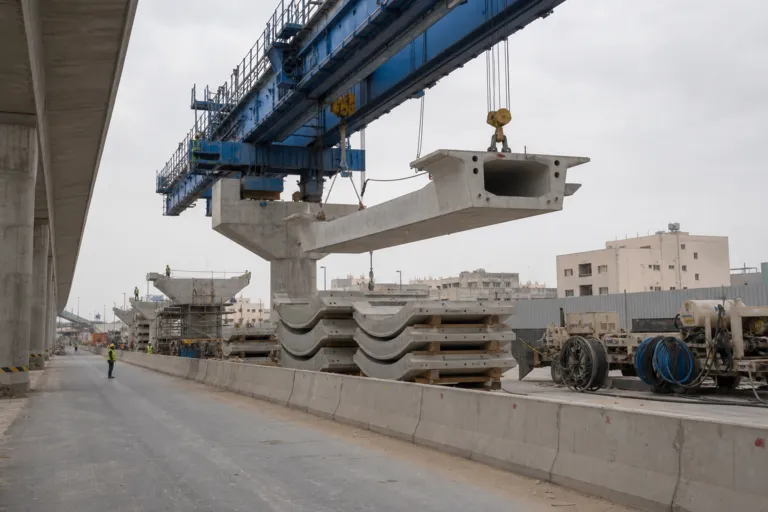
Urban flyovers have to be built while movement continues around them, so sequencing and quality control become as important as structural design. Global bridge-market research from Mordor Intelligence points to faster project outcomes from factory-controlled modules: FHWA pilot states report 20–50% faster completions and quality gains when modular approaches are used. The same source links performance improvements to joint technologies, noting that UHPC joints can extend spans by 30–40% while cutting lifecycle maintenance. While those figures are not Saudi-specific, they provide a relevant comparison point for why corridor owners may prefer repeatable segment casting, staged erection, and durable joints that reduce disruptive follow-on interventions.
Materials and jointing choices can be a decisive enabler for segmental systems because connections must transfer loads and resist aggressive service environments. DataIntelo’s UHPC joint grout report values the global UHPC joint grouts for bridges market at $1.48 billion in 2025 and projects $3.12 billion by 2034, with an 8.6% CAGR for 2026–2034. It describes UHPC joint grouts as preferred for bridging segmental and precast elements, citing compressive strength exceeding 150 MPa and rapid strength gain that supports accelerated bridge construction techniques. For Saudi corridor teams, those global trends reinforce how specifying high-durability jointing can complement industrialized fabrication and staged erection plans.
Finally, corridor bridge and flyover programs in the Kingdom are tied to the same Vision 2030 delivery pressures shaping the wider market. Mordor Intelligence highlights mega- and giga-project pipelines such as NEOM, Red Sea, Diriyah, and Qiddiya. It states NEOM’s green-hydrogen plant reached 80% completion in 2025 and requires four gigawatts of dedicated renewables, and that Red Sea Global awarded USD 3.9 billion in early 2026 for 16 island resorts using modular hotel blocks. Even when bridge scopes sit inside larger civil packages, these facts signal why industrialized methods and supplier ecosystems matter: they support repeat delivery across multiple sites, help manage schedule risk, and match owners’ preference for scalable procurement across urban corridors.
What market signals support precast segmental bridge construction in Saudi Arabia?
How fast is Saudi Arabia’s construction market expected to grow in the sources?
What do the sources say about modular or factory-controlled bridge components?
What UHPC performance facts are mentioned for segmental and precast bridge joints?
Which Vision 2030 pipelines in the sources suggest sustained corridor delivery pressure?
Talk to us for your needs in:
-
Sustainable Construction Solutions
-
Strategic Construction Planning
-
Customer-Centric Construction Services
-
Operational Excellence in Construction
-
Leadership and Change Management for Construction
-
Digital Transformation in Construction
-
Saudi Construction Market Research
-
In-Depth Market Study for Construction
-
Market Intelligence and Insights in Construction
-
Feasibility Study and Assessment in Construction
-
Saudi Construction Benchmarking