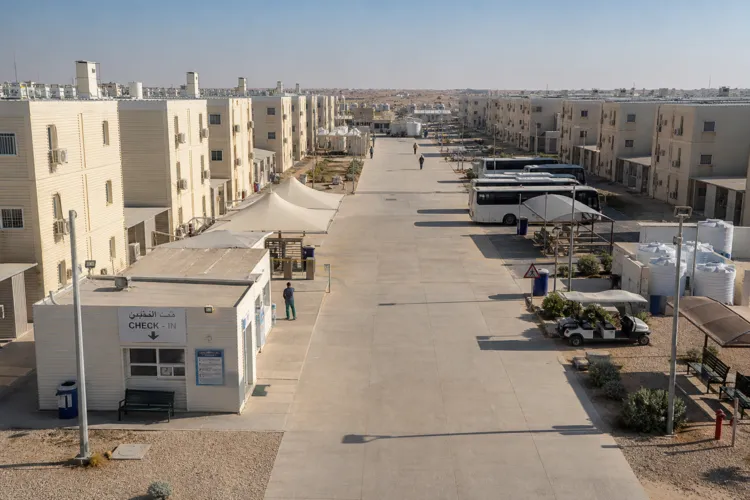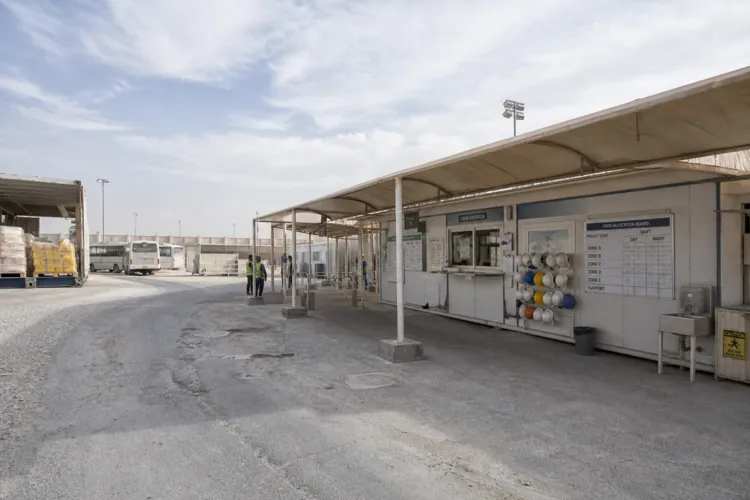
Remote sites in Saudi Arabia face the same basic constraint: water scarcity. Water supply and sanitation in Saudi Arabia is characterized by challenges and achievements, and one of the main challenges is water scarcity, which has driven substantial investments in seawater desalination, water distribution, sewerage, and wastewater systems. For a desert construction camp, the job is to turn that national reality into a practical, repeatable approach for safe drinking water and reliable process water for cleaning, curing, and operations. In this context, Saudi Arabia’s reliance on desalination is a core baseline, while on-site treatment and reuse can reduce logistical pressure on deliveries and protect continuity when conditions shift.
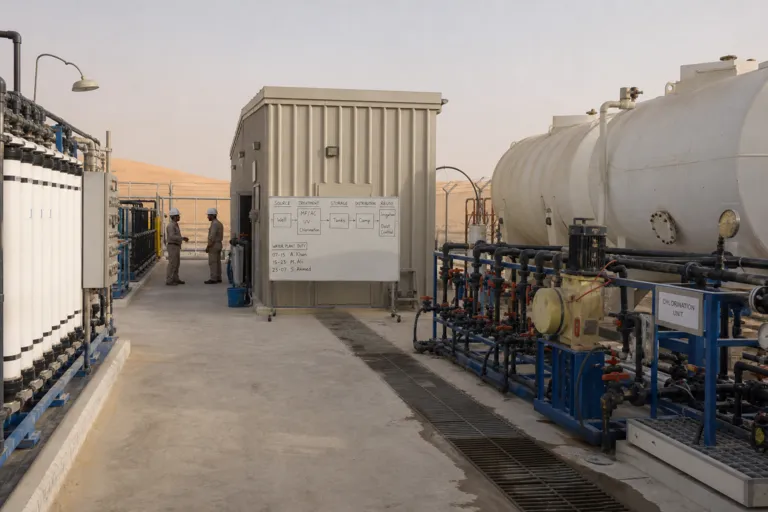
Market signals also point to a widening toolkit for temporary and mobile solutions. In the Middle East and Africa, the mobile water treatment market is expected to reach US$ 417.0 million by 2034, up from US$ 223.3 million in 2025, with a stated CAGR of 7.4% from 2026 to 2034. The same regional analysis names Saudi Arabia among the prime contributors to this market. That matters for remote construction camp water supply in Saudi Arabia because mobile units are built for fast deployment, shifting site footprints, and short project timelines. The report describes primary steps in mobile systems such as oil/water separation, sedimentation, and sand filtration, followed by secondary steps like membrane filtration (reverse osmosis) and ion exchange for demi-water production.
Designing Potable and Process Water for Desert Camps
A desert camp plan typically blends two objectives: potable-water safety and consistent process-water quality. Regional market commentary explicitly links mobile treatment demand to extreme aridity and water scarcity, noting that portable desalination and purification are used for remote construction and industrial outposts. For camp operators, the implication is sequencing and fit-for-purpose quality. Filtration and clarification steps can manage suspended solids, while reverse osmosis and ion exchange support higher-grade requirements, including demi-water production when needed. In parallel, desalination is widely positioned as rainfall-independent supply for cities and industries, and global desalination market analysis highlights small modular plants as an option for remote communities, emergency response, and industrial sites that cannot support large centralized facilities.
Saudi Arabia’s broader treatment and reuse momentum is another lever for camp supply strategies. A Saudi-focused industry outlook citing Renub Research states the Saudi Arabia water and wastewater treatment market is set to grow from US$ 4.03 billion in 2024 to US$ 7.43 billion by 2033, reflecting a 7.05% CAGR between 2025 and 2033. The same source states that treated wastewater is now widely reused for agricultural irrigation, landscaping, industrial cooling, construction, and certain urban applications. For remote construction camps, that reuse framing supports a practical concept: treat and recycle suitable streams for non-potable needs to preserve higher-quality water for drinking and critical processes, while aligning with an investment climate focused on advanced treatment infrastructure.
Delivery models and project structures can shape how camps procure water and treatment services. Wikipedia’s overview notes that in the early 2000s, the government decided to involve the private sector not only in construction of infrastructure, but also in financing and operation through Build-Operate-Transfer (BOT) projects, while the Water & Energy Company created in 2003 acts as an off-taker for desalinated water produced by privately operated plants and is jointly owned by SWCC and the Saudi Electricity Company (SEC). Separately, global desalination analysis emphasizes public-private partnerships, long-term water purchase agreements, and improvements in reverse osmosis technology as mechanisms to share investment, construction, technology, and operating responsibilities. For remote camps, these approaches can translate into clearer contracting for temporary hire, emergency rental, or longer-term service packages as project needs evolve.
What technologies support potable and process water in remote Saudi construction camps?
What does the Middle East and Africa mobile water treatment market forecast suggest for remote sites?
How is Saudi Arabia’s water and wastewater treatment market expected to change?
Is treated wastewater reuse relevant to construction operations in Saudi Arabia?
How do partnerships and contracting models affect remote construction camp water supply in Saudi Arabia?
Talk to us for your needs in:
-
Sustainable Construction Solutions
-
Strategic Construction Planning
-
Customer-Centric Construction Services
-
Operational Excellence in Construction
-
Leadership and Change Management for Construction
-
Digital Transformation in Construction
-
Saudi Construction Market Research
-
In-Depth Market Study for Construction
-
Market Intelligence and Insights in Construction
-
Feasibility Study and Assessment in Construction
-
Saudi Construction Benchmarking