Plans for Riyadh Metro’s seventh line are progressing as Saudi Arabia prepares to begin the first phase in 2026, according to statements cited by local and regional reporting. The Royal Commission for Riyadh City (RCRC) has already received design-and-build bids, underlining that the programme is moving from concept into procurement. This expansion comes as Riyadh’s automated metro network continues to evolve after the phased rollout of the existing metro lines, and as the city aligns public transport with large-scale developments across the capital.
For the Line 7 first phase, multiple sources describe a planned alignment of about 65 km. The line is intended to link King Khalid International Airport in the north to Qiddiya in the west or southwest of Riyadh, with references also tying the scheme to New Murabba, King Salman Park, Misk City, Diriyah Gate, and King Abdullah International Gardens. This positioning frames Line 7 as a connector between high-profile destinations rather than a single corridor upgrade, with stations and interchange points designed to integrate it into the broader network as expansion proceeds.
Civil Works and Station Scope for Line 7’s First Phase
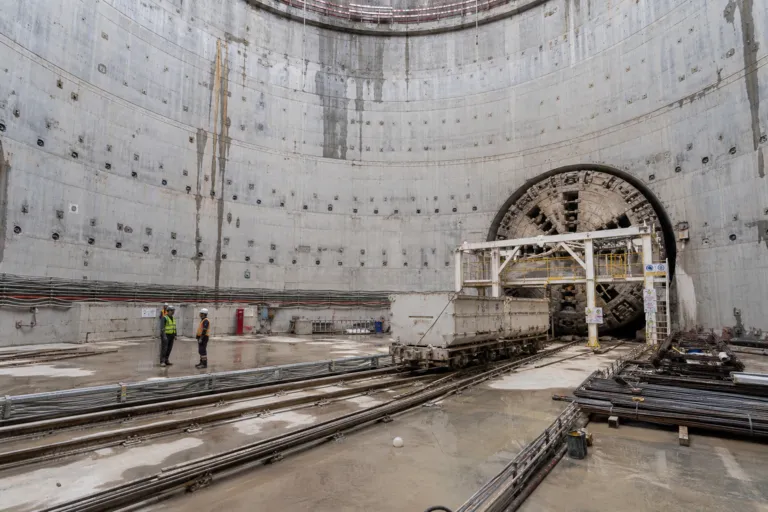
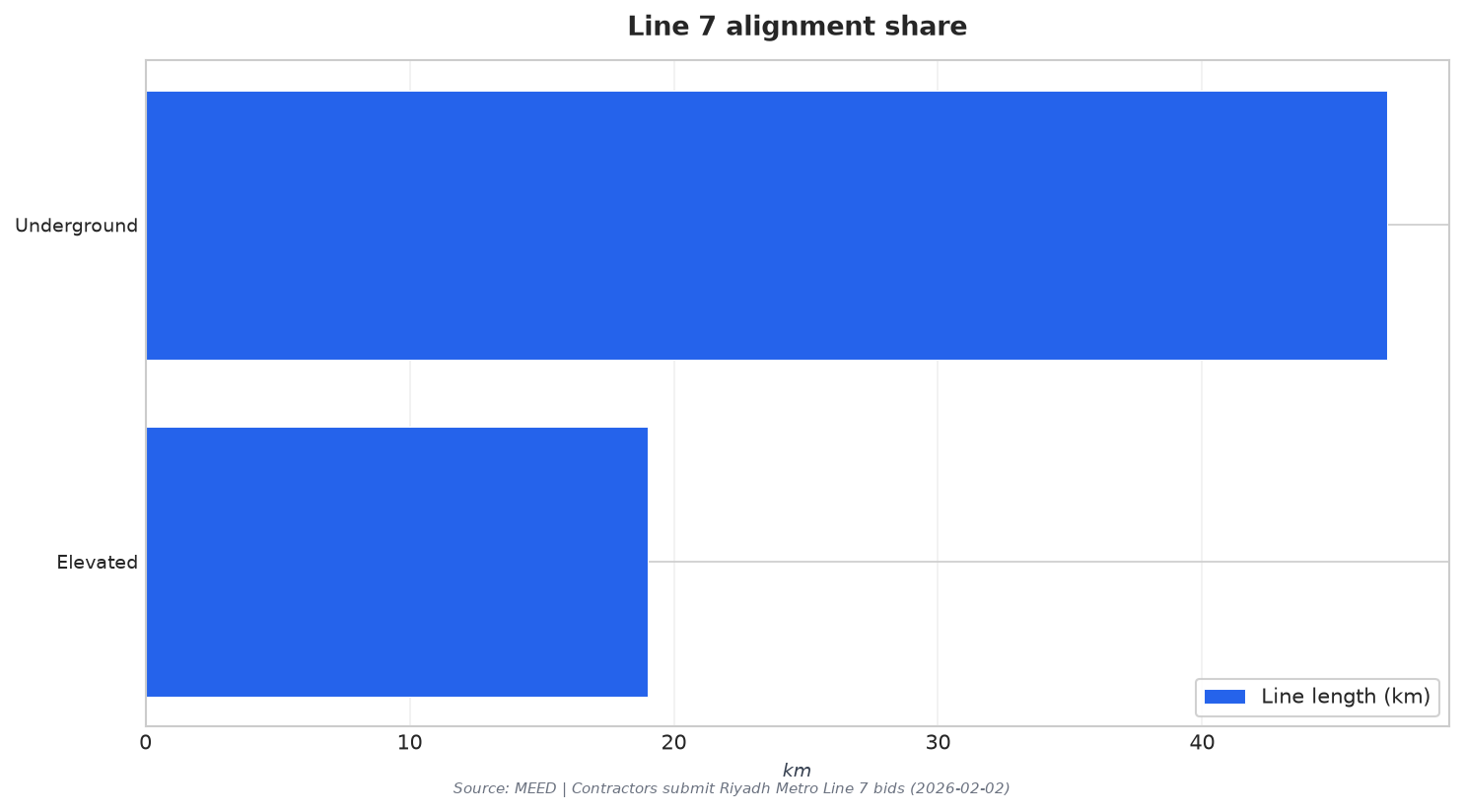
The civil construction profile is substantial. Reporting on the tendered scope indicates that, of the roughly 65 km first phase, 47 km would be underground and 19 km elevated. The same sources state the line would include 19 stations, with 14 underground and five above ground. This mix implies a heavy emphasis on tunnelling and underground station construction, alongside elevated viaduct sections that can move quickly across certain districts. The station count and split also signal significant systems integration needs for ventilation, safety, and operations across both underground and elevated environments.
Bidding for the design-and-build contract has attracted major international and local players in several consortium combinations. Named teams reported as planning to bid or having submitted offers include Alstom/Webuild/Nesma; Siemens/FCC/Freyssinet Contracting/Almabani; Hitachi Rail/Larsen & Toubro/Albawani/Kalyon/Cengiz; and CRRC/Mapa/Limak. Design roles were also attributed to firms including Typsa, Ayesa, Aecom, Idom, Dowha, Sener, and Jacobs, while Egis and Dar Al-Handasah were listed among consultants. This structure points to a packaged approach that combines civil delivery, rail systems, and specialist design capabilities.
Line 7 is being advanced alongside other Riyadh Metro expansion works. Railway reporting describes a US$2.75bn design-and-build contract awarded for an 8.4 km extension of the Red Line (Line 2), running west from King Saud University to the Diriyah Gate development area, adding 1.3 km on viaduct and 7.1 km in bored tunnel, with three of five stations underground. One station in the Diriyah development zone is planned as an interchange with the future Line 7. Together, these elements show how Riyadh Metro seventh line construction in Saudi Arabia is being positioned to connect emerging districts and major destinations through coordinated interchanges and phased delivery.
When is the first phase of Riyadh’s Metro Line 7 expected to be implemented?
How long is Riyadh Metro Line 7’s first phase, and how much is underground versus elevated?
How many stations are planned on Line 7, and how many are underground?
Which major destinations is Line 7 intended to link, including New Murabba and the airport?
What is happening now on Riyadh Metro seventh line construction in Saudi Arabia in terms of procurement?
Talk to us for your needs in:
-
Sustainable Construction Solutions
-
Strategic Construction Planning
-
Customer-Centric Construction Services
-
Operational Excellence in Construction
-
Leadership and Change Management for Construction
-
Digital Transformation in Construction
-
Saudi Construction Market Research
-
In-Depth Market Study for Construction
-
Market Intelligence and Insights in Construction
-
Feasibility Study and Assessment in Construction
-
Saudi Construction Benchmarking