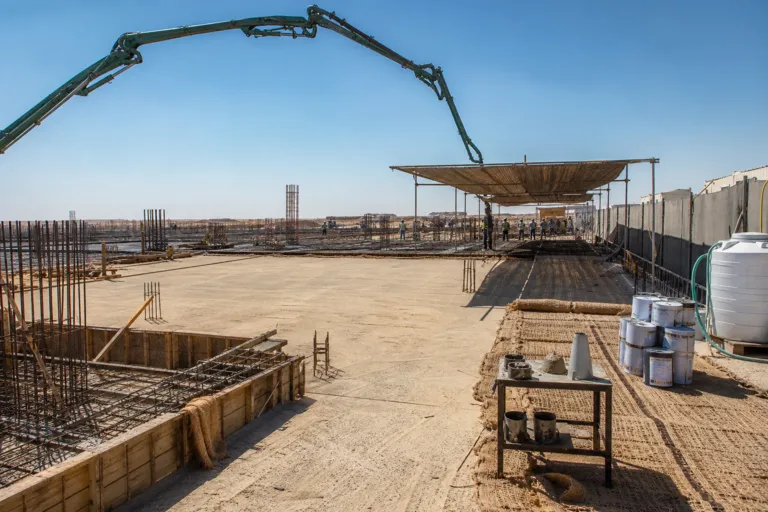
Saudi Arabia’s record summer heat has made “hot pours” feel like a new normal on many projects. Some regions see summer temperatures exceed 50°C, and that kind of exposure can turn a standard placement into a race against slump loss, shortened setting time, and surface drying. A recent review on hot-arid concreting explains why: higher air and material temperatures, low relative humidity, wind, and solar radiation increase water demand, accelerate setting, and raise evaporation from fresh surfaces. When the workable window shrinks, the field consequences can be practical and costly, including rejected truckloads, cold joints, surface cracking, reduced durability, and schedule disruption. In that context, the goal is simple: keep concrete temperature and evaporation rate under control, without losing compliance or production rhythm.
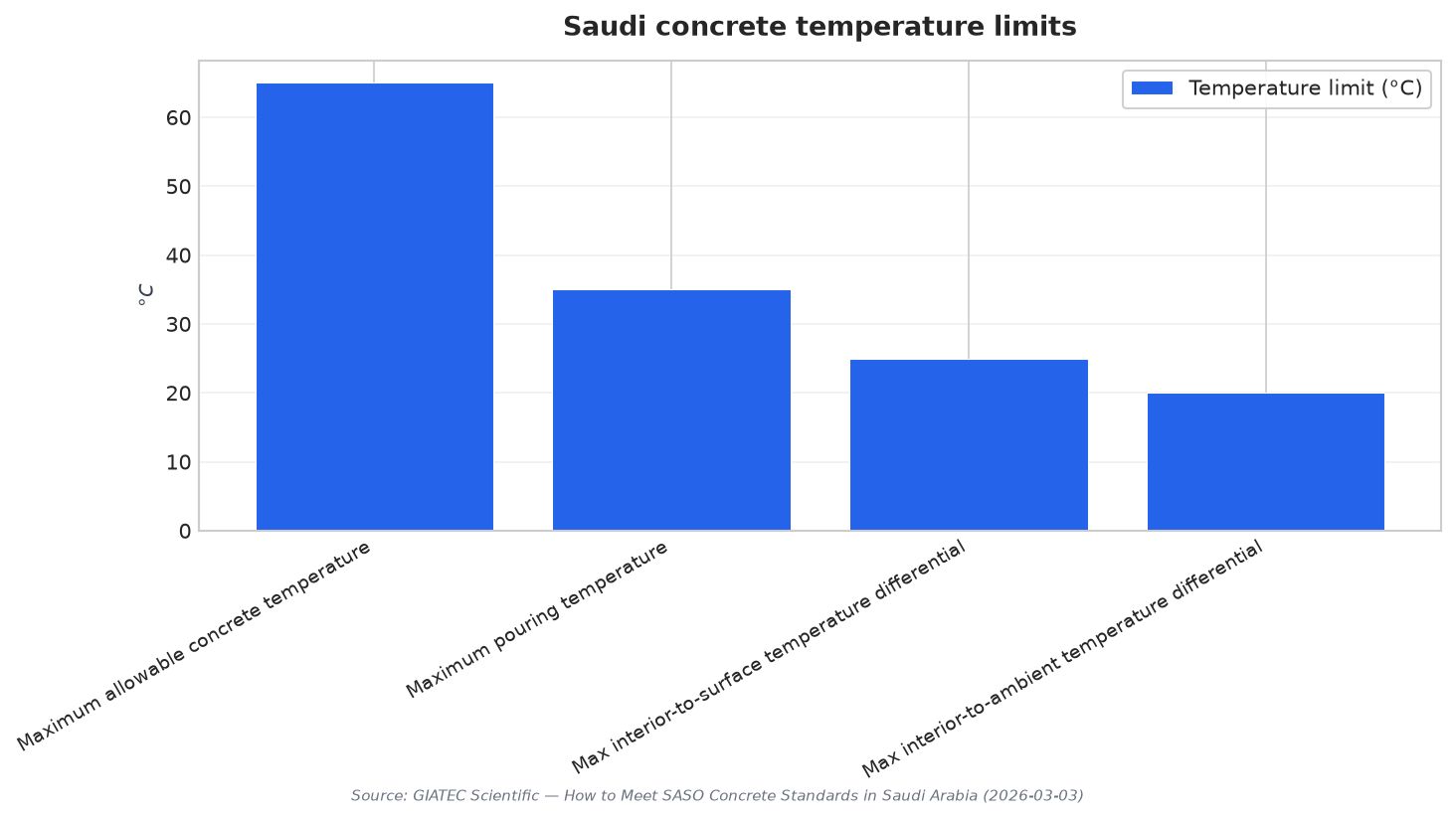
Compliance starts with the limits that Saudi specifications already define for placement and early-age thermal behavior. Guidance described for SASO and SBC 304 includes a maximum allowable concrete temperature of 65°C and a pouring temperature that must not exceed 35°C. To manage cracking risk after placement, the same source lists differential limits: the interior-to-surface temperature differential must be less than 25°C, and the interior-to-ambient differential must be less than 20°C. Quality verification is also explicit. For compressive strength testing, cube specimens of 150x150x150 mm are used (and grout cubes of 50x50x50 mm), with three samples tested for every 120 cubic meters of concrete per class. Curing conditions for these tests must remain at 20 ±2°C with humidity above 95%, establishing a controlled baseline for confirming that heat-mitigation measures are working.
Jobsite Controls That Target Heat and Evaporation Together
In practice, effective hot-weather concreting controls are the ones that reduce concrete temperature and evaporation rate at the same time. A field-focused guide emphasizes that summer pours fail most often when the mix gets too hot, dries out too fast, or both, because hydration reactions speed up and finishing becomes harder. On Saudi sites, a plain-language local guide describes common routines crews use in peak heat: pouring at dawn or at night to avoid the hottest hours, chilling the mix with iced water or crushed ice, and wetting rebar and formwork before placing so scorching steel does not “cook” the concrete on first touch. Where needed, it also notes using shade and windbreaks to cut direct sun and airflow across exposed surfaces. These steps are simple, but they directly address the same mechanisms—temperature rise and evaporation—that drive plastic shrinkage and early surface distress in hot-arid casting.
For larger elements, temperature control shifts from surface protection to managing internal heat and gradients. Mass concrete guidance highlights that the likelihood of thermal cracking increases as the inner core heats from hydration while the outer surface cools from heat dissipation. It lists cooling approaches before placement using chilled water, chipped or shaved ice, or liquid nitrogen, and cooling after placement using embedded non-corrosive cooling pipes that circulate cool water. Broader field guidance also points to embedded sensors and controlling the core-to-surface differential near 20°C in mass concrete work. Those ideas align with Saudi differential limits described under SASO and SBC 304, and they translate into a clear field priority: measure temperatures, control gradients, and treat thermal behavior as a design and scheduling input, not just a finishing problem.
Materials and planning choices are also tightening as Saudi construction scales under Vision 2030. One market analysis anticipates the Saudi Arabia concrete admixtures market will grow at a 9.34% CAGR from 2026 to 2031, and it links that demand to giga-project activity requiring high-performance concrete. The same source notes admixture providers are investing in hydration stabilizers, retarders, evaporation-control technologies, and advanced superplasticizers aimed at maintaining workability and strength development despite extreme heat. For teams formalizing hot weather concreting practices in Saudi Arabia, the takeaway is to connect three layers into one plan: follow SASO/SBC limits, deploy field controls that reduce heat and evaporation together, and specify materials and monitoring that can be validated through required testing and temperature checks.
What temperature limits do SASO and SBC 304 set for hot-weather concrete pouring in Saudi Arabia?
Which temperature differentials are used to help prevent thermal cracking on Saudi projects?
How is compressive strength testing structured under SASO-related requirements?
What field actions are commonly used in Saudi summers to reduce heat and evaporation during placement?
How do hot weather concreting practices in Saudi Arabia tie into admixture trends?
Talk to us for your needs in:
-
Sustainable Construction Solutions
-
Strategic Construction Planning
-
Customer-Centric Construction Services
-
Operational Excellence in Construction
-
Leadership and Change Management for Construction
-
Digital Transformation in Construction
-
Saudi Construction Market Research
-
In-Depth Market Study for Construction
-
Market Intelligence and Insights in Construction
-
Feasibility Study and Assessment in Construction
-
Saudi Construction Benchmarking