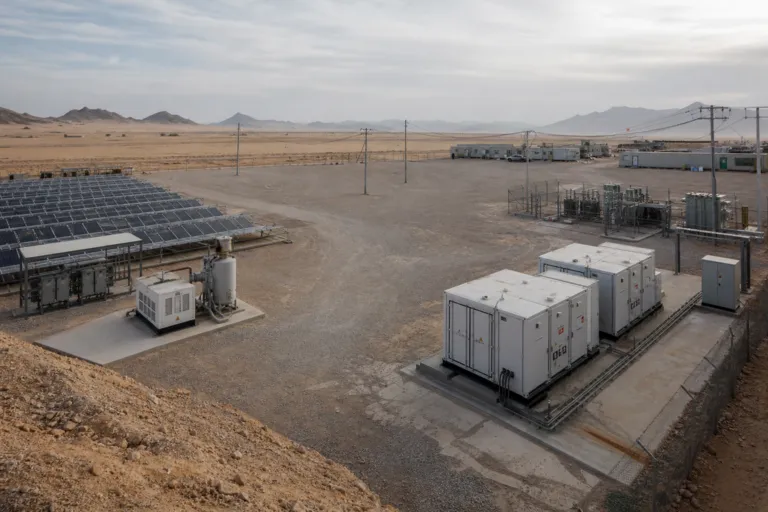
Remote construction camps need power that behaves like a utility, even when there is no utility nearby. In Saudi Arabia, hybrid renewable-and-diesel microgrids are shifting from pilot-scale demonstrations to commercial-scale deployment, a move tied to Vision 2030 industrialization and the practical need to displace diesel in remote operations. IndexBox estimates the total addressable market for hybrid renewable-diesel systems in Saudi Arabia at SAR 3.5–5.2 billion (USD 930 million–USD 1.4 billion) cumulative through 2035, with annual installations accelerating after 2028. For an off-grid construction camp microgrid in Saudi Arabia, this matters because the same fundamentals apply: run 24/7 loads, control fuel exposure, and keep critical systems steady under harsh site conditions.
Diesel cost is a central catalyst for hybridization. IndexBox reports diesel fuel prices for industrial off-grid users in Saudi Arabia ranging from SAR 0.45–0.70 per liter depending on sector and allocation. A typical Solar-Wind-Diesel-Battery (SWDB) configuration can reduce diesel consumption by 60–85%, and IndexBox links that reduction to payback periods of 3–6 years for mining and oil & gas sites. While a construction camp is not identical to a mine, it shares the operational logic of running generators for lodging, kitchens, lighting, IT, and site services. The same source also estimates system-level LCOE for an integrated SWDB system in Saudi Arabia at USD 0.12–0.19/kWh in 2026, compared with USD 0.18–0.30/kWh for diesel-only generation at current fuel prices.
What “Hybrid” Really Means on a Remote Camp Site
Hybrid systems are not only about adding solar PV. They are about orchestration: on-site generation, battery storage, and control software that balances loads and resources in real time. Saudi mining-focused analysis describes microgrid momentum being shaped by renewable integration and resilient decentralized power, with performance gains coming from battery storage, power electronics, and intelligent controllers that enable peak shaving, load shifting, and backup power in grid-connected or islanded modes. IndexBox also notes component bottlenecks that matter to camp schedules, including specialized hybrid controller/EMS software and hardware, skilled EPC firms with hybrid experience, and long lead times for medium-scale wind turbines. For storage-heavy builds, IndexBox highlights 6–12 month lead times for high-specification components such as liquid-cooled enclosures and high-voltage power conversion systems.
Procurement realities are a major design constraint for remote deployments. IndexBox states Saudi Arabia has no domestic manufacturing of advanced hybrid energy management systems (HEMS), lithium-ion battery cells, or medium-scale wind turbines. It estimates 70–85% of system CAPEX is sourced from China, South Korea, Europe, and the United States, creating exposure to logistics lead times and currency fluctuations. On the demand side, multiple forecasts point to rapid scaling inside the Kingdom. IMARC values the Saudi Arabia microgrid market at USD 386.5 million in 2025 and projects it to reach USD 1,638.1 million by 2034 at a CAGR of 17.40% (2026–2034). In parallel, Straits Research values the Saudi Arabia hybrid power systems market at USD 1.18 billion in 2025, reflecting growing interest in hybrid architectures that combine renewables, storage, and backup generation.
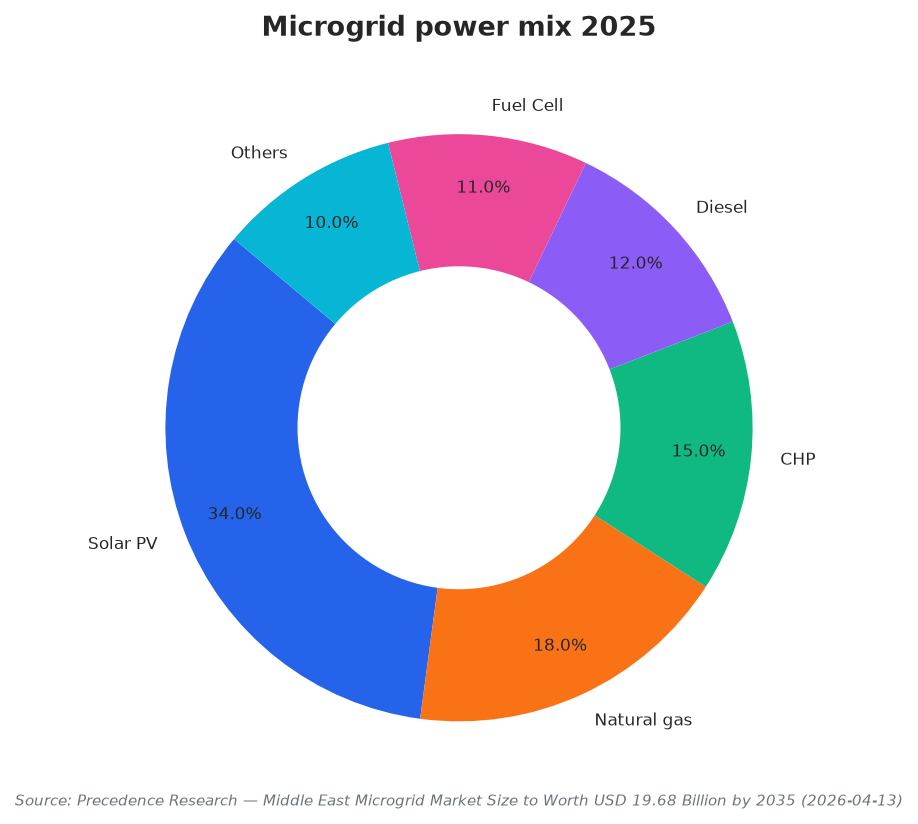
Regional context also signals why remote use cases are prominent. Precedence Research estimates the Middle East microgrid market at USD 7.45 billion in 2025 and says remote systems dominate with a 40% share; by power source, solar PV holds 34%, while diesel remains part of many systems at 12% for backup and remote generation. Saudi Arabia-specific policy and regulation are also evolving. IndexBox notes that SERA and the Ministry of Energy are developing a dedicated mini-grid and off-grid renewable framework, with licensing and tariff approval still being codified as of 2026, while pilots under KACARE and the Saudi Industrial Development Fund (SIDF) have established technical precedents. For construction contractors, this combination of economics, architecture, and emerging rules is the practical path to “power without a grid.”
What makes an off-grid construction camp microgrid in Saudi Arabia “hybrid”?
What diesel savings can hybrid systems achieve in Saudi Arabia?
How do the 2026 LCOE estimates compare between hybrid and diesel-only generation?
What supply chain constraints can delay remote microgrid builds?
How large is the Saudi Arabia microgrid market expected to become?
Talk to us for your needs in:
-
Sustainable Construction Solutions
-
Strategic Construction Planning
-
Customer-Centric Construction Services
-
Operational Excellence in Construction
-
Leadership and Change Management for Construction
-
Digital Transformation in Construction
-
Saudi Construction Market Research
-
In-Depth Market Study for Construction
-
Market Intelligence and Insights in Construction
-
Feasibility Study and Assessment in Construction
-
Saudi Construction Benchmarking