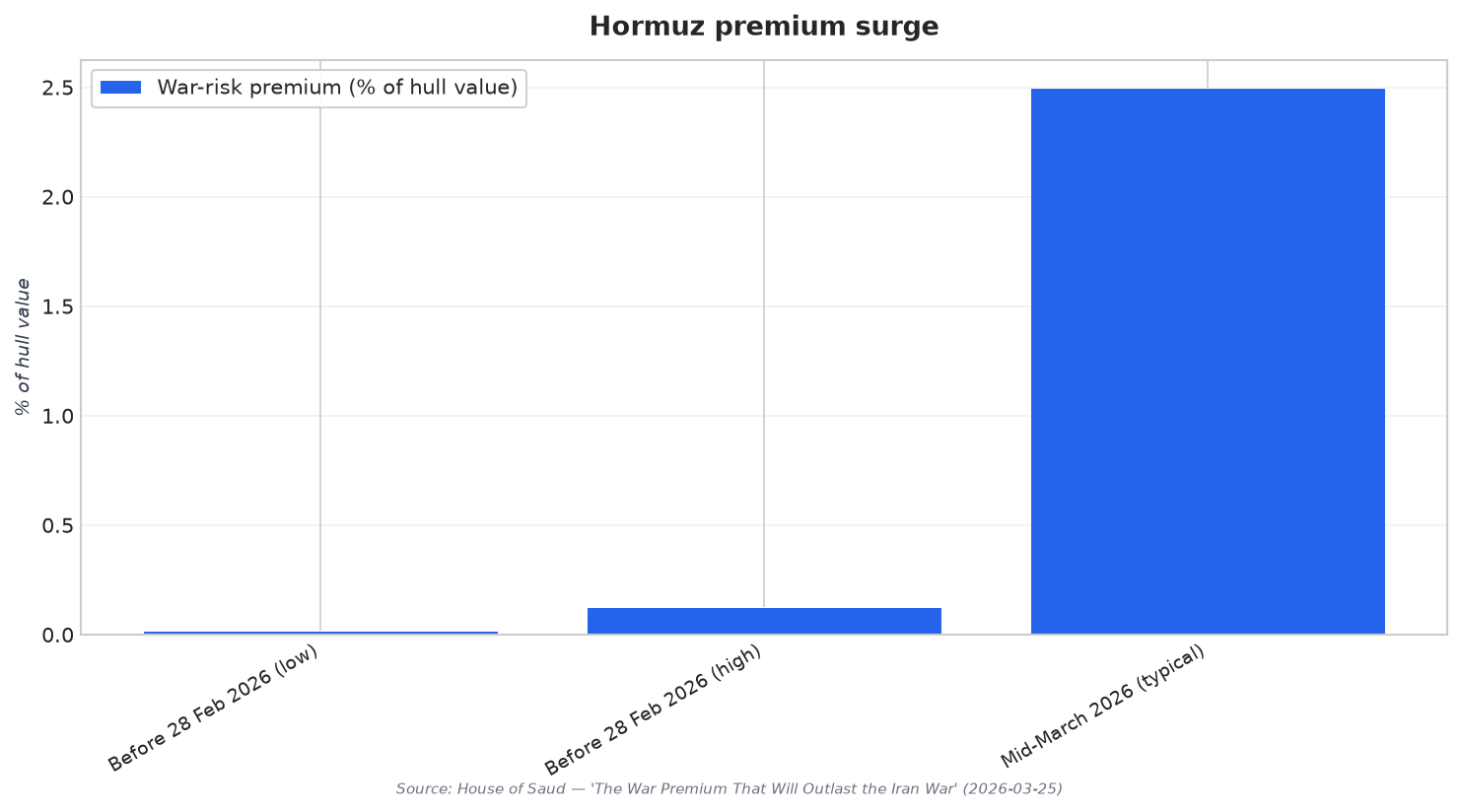
In 2026, war risk insurance is described as “extreme volatility,” driven by exposures in the Red Sea, Bab al-Mandeb, and the Strait of Hormuz. Nautilus Shipping notes that premiums in key corridors range from approximately 0.5% to over 10% of hull value, depending on route, timing, and vessel type. For Saudi-bound construction cargo, that volatility matters because the premium is not only an owner problem; it often becomes a freight and landed-cost problem. House of Saud reports that before 28 February 2026, the standard war risk premium for a vessel transiting the Strait of Hormuz ranged from 0.02% to 0.125% of hull value, but by mid-March it had risen to 2.5% of hull value. This is the background for war risk insurance construction material imports Saudi stakeholders must plan for in 2026.
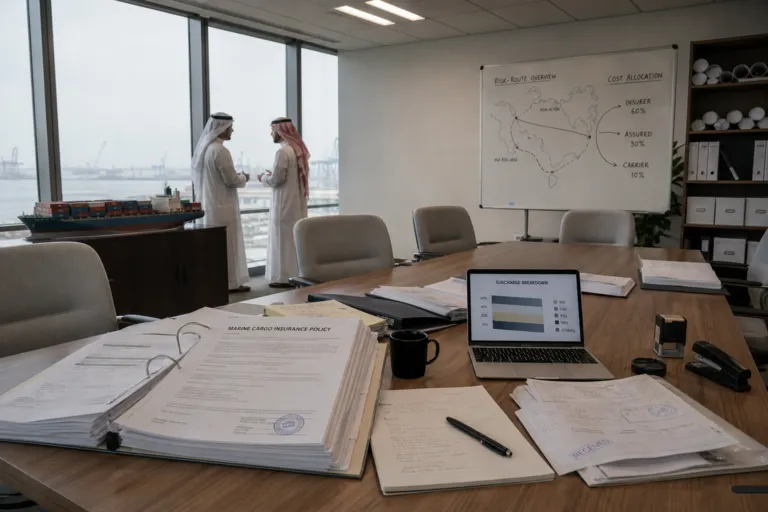
Cost allocation starts with knowing which “war risk” you are paying for. Nautilus Shipping explains that war risk insurance refers to separate covers—hull and machinery, P&I liability, and cargo—responding to acts of war, terrorism, piracy, and political violence, and that these perils are explicitly excluded from standard marine policies. SeaRates adds that marine cargo insurance is a basic safety net for goods in transit, but it usually does not cover war-related risks unless specifically extended. That means an importer can face two distinct war-related costs: a carrier-side war cost embedded in freight (or applied as a surcharge) and a shipper-side cost to extend cargo coverage for war perils. Treating them as the same line item is one of the fastest ways to misprice a Saudi construction import budget in 2026.
Where the Premium Gets Passed Through: WRS, Routes, and Contract Ambiguity
In practice, many freight-paying parties see the war premium first as a carrier War Risk Surcharge (WRS). TTL-Co reports that with coverage cancelled or available only at dramatically higher premiums, war risk insurance premiums spiked from approximately 0.2% of vessel value to over 1.0% within 48 hours, and carriers “had no choice” but to pass those costs through to shippers via WRS. TTL-Co also states that the WRS was effective 2 March 2026, active until further notice, and scoped to cargo to and from several countries and locations, including Saudi Arabia (Dammam and Jubail). It adds that WRS reached up to USD 3,500 per container within days. TTL-Co’s importer warning is direct: standard cargo policies may not cover war risk in a designated area, and cargo war cover is a separate cost from carrier surcharges—both are payable.
The scale of the ship-side war premium helps explain why surcharges get aggressive. The Economist Intelligence Unit cites Marsh McLennan: premiums that previously averaged 0.2–0.25% of a vessel’s value climbed to 1–1.5% in recent days. It adds that most tankers are valued between USD 200m and USD 300m, and that if premiums approach 1%, the cost per voyage could exceed USD 2m; at 3% (an “extreme but plausible” scenario), a single transit could reach as high as USD 7m. Corporate INTL, citing Al Jazeera (14 September 2026), reports additional premiums of 3% to 10% of hull value per transit, versus about 0.25% before the war, and gives an example that a USD 100 million tanker could pay USD 3 million to USD 10 million for one transit. Separately, House of Saud describes mid-March Hormuz transit premiums at 2.5% of hull value, and notes that a USD 120 million tanker may face USD 600,000 to USD 1.2 million for a single voyage.
“Who pays” is ultimately decided less by headlines and more by contract wording and claims mechanics. Corporate INTL stresses the importance of certainty in allocating the premium in charters, and highlights a key practical risk: allocating the premium is not the same as allocating the loss. It warns that if a vessel is seized in the Gulf, cargo can still face a general average contribution unless the contract clearly says otherwise. For Saudi construction importers, this means cost allocation should address (1) carrier WRS and rerouting impacts, (2) whether cargo war-risk extensions are purchased, and (3) how any extraordinary contributions are handled if an incident occurs in a Joint War Committee listed or reporting area. In a year when Joint War Committee designations can quickly change trading conditions, clarity is a cost-control tool.
Why are war-risk costs showing up on Saudi construction import invoices in 2026?
Does standard marine cargo insurance cover war-related damage to construction materials?
What war-risk surcharge levels were reported for Gulf shipments, including Saudi Arabia?
How high did war-risk premiums get on Hormuz-related transits in 2026?
What is the contract trap in war risk insurance for construction material imports into Saudi Arabia?
Talk to us for your needs in:
-
Sustainable Construction Solutions
-
Strategic Construction Planning
-
Customer-Centric Construction Services
-
Operational Excellence in Construction
-
Leadership and Change Management for Construction
-
Digital Transformation in Construction
-
Saudi Construction Market Research
-
In-Depth Market Study for Construction
-
Market Intelligence and Insights in Construction
-
Feasibility Study and Assessment in Construction
-
Saudi Construction Benchmarking