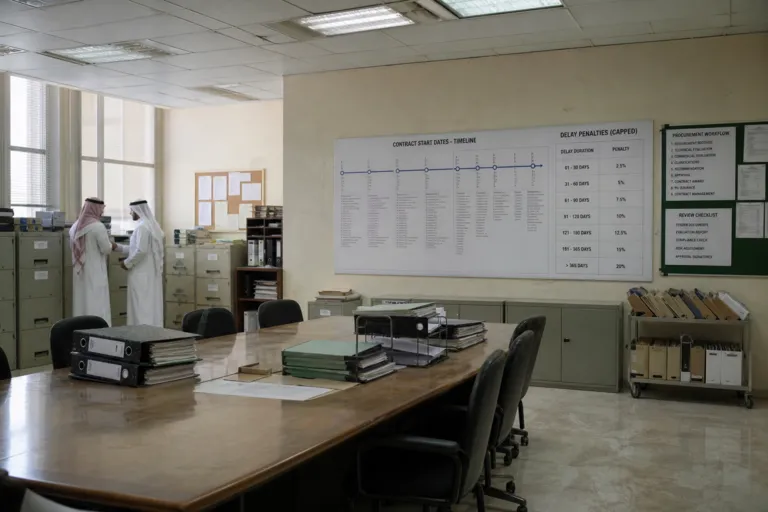
Saudi Arabia issued a new Government Tenders and Procurement Law under Royal Decree No. M/76 dated 27/2/1448 AH. It was published in Umm Al-Qura on 4 September 2026 and, under Article 101, it enters into force 120 days after publication, which multiple guides frame as around early January 2027. The law replaces the previous regime issued by Royal Decree No. M/128 dated 13/11/1440 AH. For delay risk, the practical issue is timing: tenders floated while the previous law was in force remain governed by it, with the tender date being the key trigger described in commentary. So a package tendered late in 2026 can still carry the prior delay framework even if the contract is signed after the new law’s effective window.
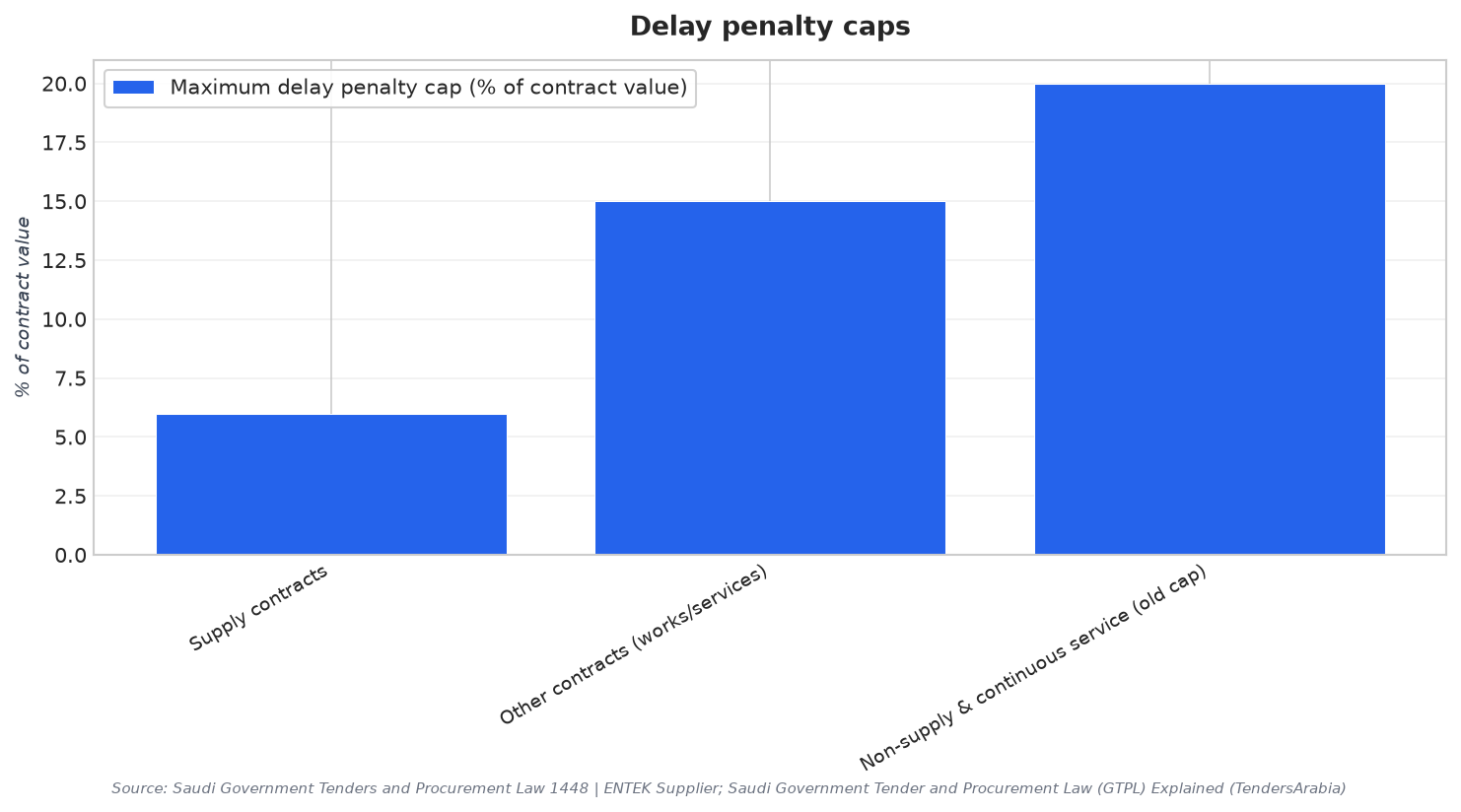
The center of the “capping the penalty” story is Article 70, which sets explicit ceilings for delay penalties on government contracts. Sources describing Article 70 state that delay penalties are capped at 6% of a supply contract and 15% of other contracts. Another explanation of the amendments notes that delay penalties for non-supply contracts and continuous service contracts have been reduced from 20% to 15% of contract value, while supply contract penalties are capped at 6%. Article 70 also appears with an important condition: higher rates require the Minister’s prior approval and must be stated to bidders before they submit. In other words, the cap is a baseline that shapes the standard risk allocation, but bidders should still read the tender package for any disclosed, approved exception.
What the Cap Really Means for Delay Exposure and Claims
When teams discuss a liquidated damages cap in a Saudi construction contract under the new procurement rules, it helps to separate two questions: what the tender documents can impose, and what may happen later in a dispute. The procurement side is clearer now because Article 70 publishes the ceiling (15% for non-supply and 6% for supply) and indicates that any higher rate needs prior approval and pre-bid disclosure. But Saudi Arabia’s Civil Code also matters for how liquidated damages behave in practice. Commentary on the Civil Code explains that parties may pre-determine damages in the contract, yet courts are empowered to adjust liquidated damages to reflect actual losses depending on the circumstances. It gives an example where a claim could be reduced or set aside if the contractor proves liquidated damages were not levied up the contractual line, because the claimed amount would not reflect actual delayed-performance losses.
Bid and contract administration discipline becomes more valuable because the new framework compresses some decision windows and formalizes submission mechanics. One guide notes that bids are submitted encrypted through the unified portal, and total prices (including fees and taxes) must be stated in the bid itself, while any discount in a separate letter is disregarded. The same source describes short grievance deadlines: a bidder may grieve a pre-award decision within 5 working days, the entity must decide within 15 working days (silence counts as rejection), escalation to the review committee must occur within 3 working days, and the committee decides within 15 working days, extendable once. For contractors, these timelines influence how fast you must react when tender terms, delay provisions, or disclosed penalty exceptions raise bankability concerns.
Finally, contractors should connect delay exposure to scope-change controls, because schedule risk often follows variations. Under Article 67 commentary, variations now have two limits: new items may be added up to 10% of contract value with contractor consent, increases to existing items may reach up to 20% (with consent needed above 10%), and the total increase may not exceed 20% of contract value; existing items may be reduced by up to 20% without consent. Guidance emphasizes tracking both running totals so teams can see remaining headroom. In practice, tighter variation governance supports better time impact documentation, which is essential when delay penalties are capped but still meaningful, and when a court may later examine whether claimed liquidated damages reflect actual losses and whether the harmed party contributed to the harm.
What is the delay penalty cap under Saudi Arabia’s 2026 procurement law?
Can a government tender set delay penalties above the standard cap?
When will the new procurement law start applying to tenders and contracts?
How does the Civil Code affect a liquidated damages cap in a Saudi construction contract?
What are the key grievance time limits bidders should watch during procurement?
Talk to us for your needs in:
-
Sustainable Construction Solutions
-
Strategic Construction Planning
-
Customer-Centric Construction Services
-
Operational Excellence in Construction
-
Leadership and Change Management for Construction
-
Digital Transformation in Construction
-
Saudi Construction Market Research
-
In-Depth Market Study for Construction
-
Market Intelligence and Insights in Construction
-
Feasibility Study and Assessment in Construction
-
Saudi Construction Benchmarking