Iran’s de facto closure of the Strait of Hormuz since early March 2026 has created a fast-moving disruption that reaches deep into Saudi construction supply chains. Ontier notes acute shortages as steel, aluminium, and prefabricated components from East Asia are stranded at sea, while port congestion is affecting Gulf-facing ports including Dammam and Jubail. The same source highlights that the strait ordinarily handles about 20 million barrels of oil per day, described as around 20% of global petroleum liquids consumption, and roughly one-fifth of global LNG trade. In parallel, Saudi Arabia’s East–West pipeline to Yanbu is operating near capacity but cannot absorb full volumes ordinarily routed through Hormuz, underscoring that workarounds can still leave projects exposed.
It is tempting to treat every delay as a force majeure problem, but Saudi-law-linked analysis draws a sharper line between “impossible” and “excessively onerous.” DWF Group explains that a complete closure preventing delivery of essential equipment may fit force majeure or other exceptional event provisions and justify an extension of time, while diversion or longer routes are less likely to entitle relief if completion is not delayed. Under Saudi Arabia’s Civil Transaction Law (CTL), Article 110 frames force majeure as impossibility beyond the debtor’s control, extinguishing reciprocal obligations. By contrast, BD Law summarises Article 97 as hardship: extraordinary unforeseeable events that make performance excessively onerous, triggering an invitation to negotiate without undue delay, and potentially adaptation or termination if renegotiation fails.
Hardship, Change-in-Law, and EOT: Picking the Route That Fits
Cost pressure alone can push contractors toward hardship rather than force majeure. Ontier estimates the landed cost of imported construction materials in Saudi Arabia has risen by 25–40% since late February 2026, while it also reports Brent crude has surged past US$126 per barrel and that Gulf-bound hull war premiums have quadrupled to about 1% of vessel value for seven days’ cover. Yet Pinsent Masons cautions that, in practice, Middle East construction contracts often allocate general inflation and commodity volatility risk to the contractor, especially under lump-sum models, and many amended force majeure clauses explicitly exclude economic hardship. That combination makes it critical to frame claims around the contract’s actual relief mechanism—hardship renegotiation where performance remains possible, and EOT where delay to completion can be shown.
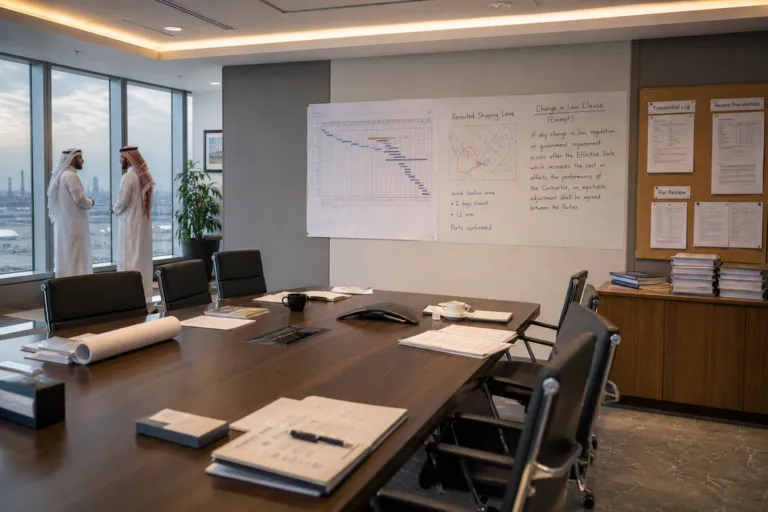
Change-in-law is another route, but it is narrower than many teams assume. Pinsent Masons notes that change in legislation clauses typically grant relief if a new law or regulation after contract execution affects costs, and that the current oil price spike is driven by geopolitical events rather than a change in law in the project’s country. Even where war-related government orders or directions exist, whether they qualify depends on drafting. Bird & Bird similarly advises Saudi-facing projects to test disruption against force majeure, hardship, change-in-law, extension-of-time, and cost provisions, because many real problems sit in a “middle ground” like supply-chain rerouting, customs issues, sanctions exposure, and increased insurance costs. The practical message is procedural: choose the best-fitting route early, because missed notices, weak records, or continuing performance without reservation can erode rights.
For extension-of-time claims, causation remains the centre of gravity. DWF Group stresses that entitlement depends on whether disruption actually delayed completion of the works, not just whether logistics became harder or more expensive. Rajah & Tann makes a similar point: an extension of time may be granted where delay is caused by an event beyond reasonable control, but in practice this tends to arise in extreme situations where legal or physical constraints prevent the works, such as prohibitions on export of essential materials or closure of critical routes with no viable alternatives. Against that backdrop, the keyword topic—force majeure, hardship, and Saudi construction contracts in 2026—should be treated as a menu of routes, with evidence-led mapping from event, to clause, to notice, to demonstrable impact on programme.
When does the Hormuz disruption support a force majeure claim on a Saudi project?
What is “hardship” under Saudi law, and what does it allow a contractor to do?
How should contractors think about change-in-law claims after the conflict-driven price spike?
What project impacts are in the “middle ground” beyond classic force majeure?
How should contractors approach the force majeure-hardship landscape in Saudi construction contracts in 2026?
Talk to us for your needs in:
-
Sustainable Construction Solutions
-
Strategic Construction Planning
-
Customer-Centric Construction Services
-
Operational Excellence in Construction
-
Leadership and Change Management for Construction
-
Digital Transformation in Construction
-
Saudi Construction Market Research
-
In-Depth Market Study for Construction
-
Market Intelligence and Insights in Construction
-
Feasibility Study and Assessment in Construction
-
Saudi Construction Benchmarking