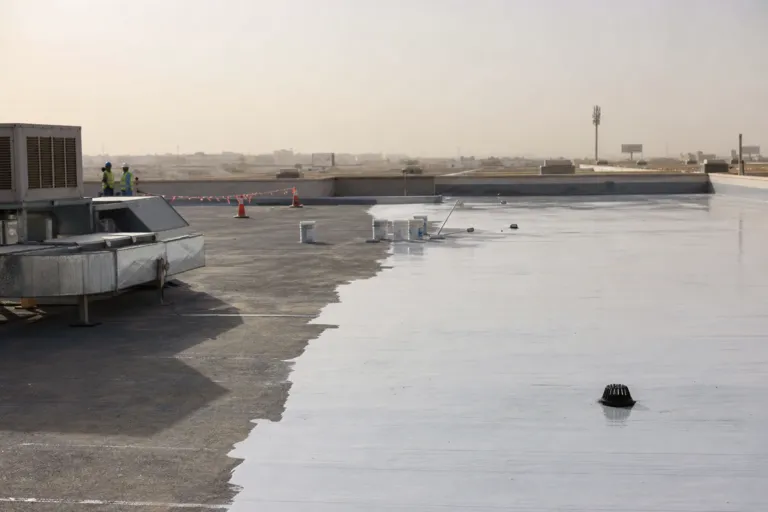
In hot climates, the roof is a direct lever on indoor comfort and cooling demand. Cool-roof coatings are liquid-applied treatments designed to increase solar reflectance and thermal emittance, so more incoming solar radiation is reflected rather than absorbed as heat. In Saudi Arabia, this lines up with a wider push for energy-efficient construction under Vision 2030 and the Saudi Building Code (SBC). One market study valued the Saudi Arabia heat reflective roof coatings market at USD 39.7 million in 2025 and projected growth to USD 64.5 million by 2034, at a 5.52% CAGR during 2026–2034. That demand narrative is tied to building efficiency goals, retrofit activity, and the economics of reducing cooling loads.
Policy signals matter because they convert “nice to have” upgrades into procurement requirements. The SBC implementation is described as demonstrating energy savings of 20–25% in specific climate zones through mandatory thermal performance standards. In parallel, the Kingdom’s net-zero ambition by 2060, with an interim target of 278 MtCO₂e emissions reduction by 2030, supports systematic demand for measures that can reduce cooling loads. Large developments such as NEOM, The Line, Red Sea Global, and Qiddiya are also cited as incorporating green building standards that specify high-performance reflective coatings. As building teams review specifications, reflectance testing and documented performance become central to selection, not just the upfront material price.
Payback Under Regional Energy-Efficiency Pressures
Payback is where many roof-coating decisions either stall or scale. A Middle East-focused analysis links the business case to both cooling economics and the trajectory of subsidies, noting that cooling loads can account for 40–60% of building electricity costs. In that same regional context, it cites payback periods of 2–4 years for standard-grade roof heat insulation coatings, and it notes that mandatory cool-roof reflectance requirements can push specifiers toward certified coatings with Solar Reflectance Index (SRI) values above 80. For additional perspective from hot-climate research summaries, reflective roof coatings are associated with rooftop surface temperature reductions of up to 50°F (28°C) versus conventional dark roofs, and air-conditioning energy reductions of 10% to 30% in commercial buildings and 15% to 40% in residential applications in hot climates (cited to U.S. DOE and Lawrence Berkeley National Laboratory in one report). Those figures are not Saudi-specific, but they help explain why payback discussions are often favorable in high-irradiance regions.
Execution and supply-chain realities can still reshape schedules and ROI. One regional report states import dependence remains above 70% across the Middle East for formulated roof heat insulation coatings, with supply flows from East Asia, Europe, and the United States, while local compounding capacity is growing in Saudi Arabia and the UAE but still meets less than half of total demand. It also warns that variability in building-code enforcement and testing lab accreditation can complicate qualification; coatings approved in Dubai may not be recognized in Saudi Arabia without duplicative SRI testing, potentially delaying specification by 3–6 months. Meanwhile, AI-driven approaches are being positioned as a way to improve lifecycle outcomes, including predictive performance monitoring and formulation optimization, with one Saudi-market source describing targets such as 90% UV reflection and 80% infrared reduction through advanced pigment and ceramic microsphere technology. In practice, for cool roof coatings Saudi Arabia buildings teams, payback depends on proven performance, compliant documentation, and an install-and-maintain plan that prevents early degradation.
Looking beyond Saudi Arabia, global market indicators show expanding adoption, which can influence product availability and competition. One report valued the global cool roof coatings market at USD 4,970.82 million in 2025 and projected a 7.1% CAGR from 2026 to 2034; it also reported North America holding a 39.2% share in 2025 and elastomeric/white coatings holding a 57.6% share in 2025. Another market source valued the global cool roof coating market at $3.18 billion in 2025, projecting $6.14 billion by 2035 at a 6.8% CAGR from 2026 to 2035, while also arguing that extreme solar irradiance in the Arabian Peninsula makes cool roofs among the highest-return building energy upgrades in the region. For Saudi stakeholders, the practical takeaway is simple: align coating selection with SBC expectations, demand credible reflectance documentation, and treat testing and approvals as part of the schedule, not an afterthought.
How do cool roof coatings fit Saudi Arabia’s building efficiency direction under the SBC?
What payback ranges are cited for roof heat insulation or reflective coating upgrades in the region?
What reflectance-related requirement is highlighted for code-driven specification in the Middle East?
What delays can happen when qualifying coatings for projects in Saudi Arabia?
What is one cited performance benchmark for advanced reflective coating formulations using AI optimization?
Talk to us for your needs in:
-
Sustainable Construction Solutions
-
Strategic Construction Planning
-
Customer-Centric Construction Services
-
Operational Excellence in Construction
-
Leadership and Change Management for Construction
-
Digital Transformation in Construction
-
Saudi Construction Market Research
-
In-Depth Market Study for Construction
-
Market Intelligence and Insights in Construction
-
Feasibility Study and Assessment in Construction
-
Saudi Construction Benchmarking