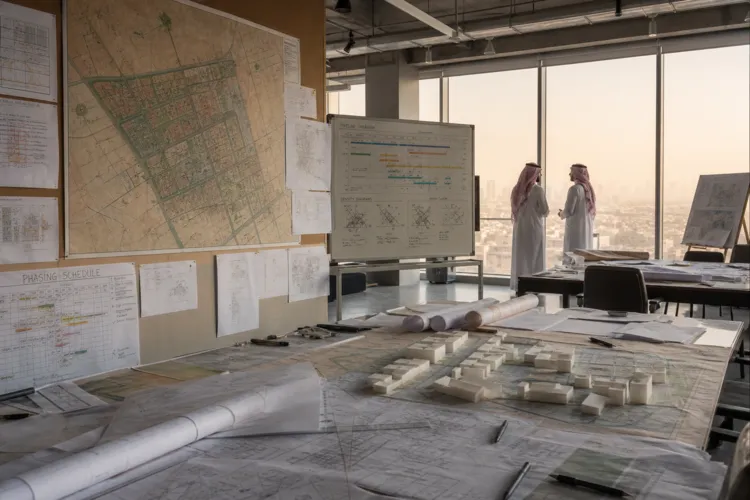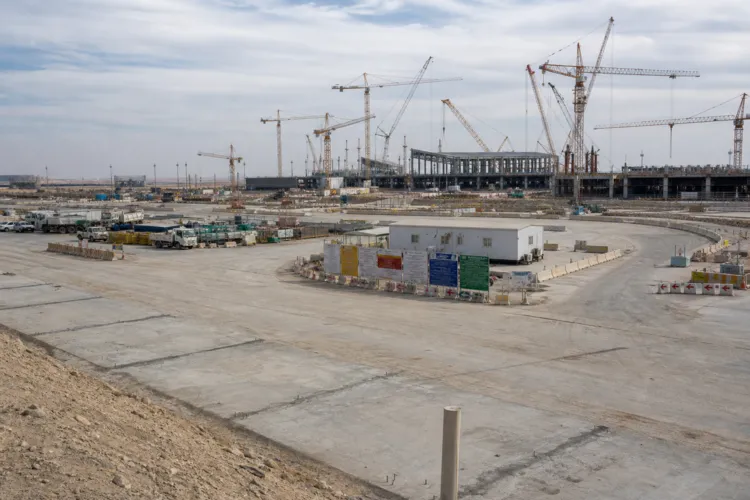
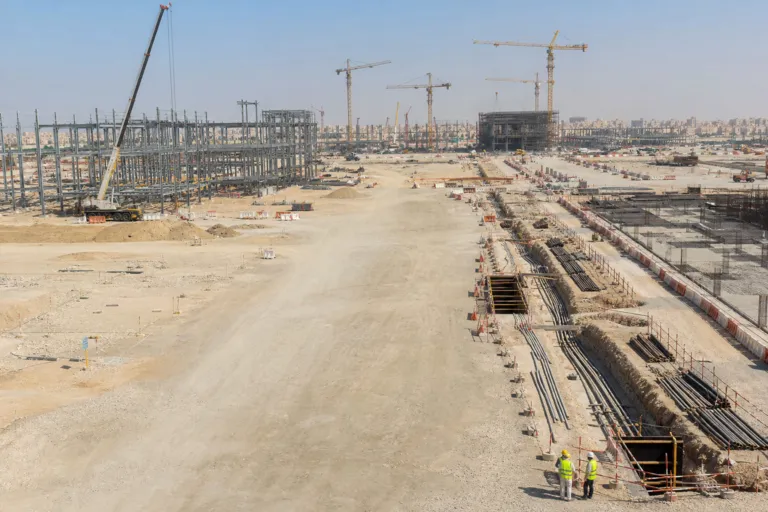
Expo 2030 Riyadh is scheduled to run from 1 October 2030 to 31 March 2031. The plan described across sources is large and time-bound: a 6 million square metre masterplan site in northwest Riyadh, near the future King Salman International Airport, structured around five districts and a pavilion program of more than 226 pavilions to host 197 participating countries and 29 international organisations. The visit forecasts cited range from 40 million to more than 42 million across the six-month event. That scale is shaping both construction sequencing and procurement, because hundreds of distinct national builds must be delivered alongside site-wide utilities, transport connectivity, and visitor operations.
The host delivery entity, Expo Riyadh 2030 Company (ERC), is advancing the platform that pavilions will connect into. MEED reports that bulk earthworks have been completed by local contractor Binyah, after millions of cubic metres were cut, filled, and levelled to reach design level. Utility infrastructure has been split into two packages. Nesma is constructing primary utility networks around the site, carrying high-voltage power lines, water mains, sewerage, and communications, while Al-Yamama is delivering secondary networks into the central event area, with construction expected to commence that month. Power readiness is being staged too, with an initial 25MW supply installed for site operations and an agreement for permanent supply signed, targeting 400MW about 18 months before the event.
Procurement Splits: Host Infrastructure vs. Country-Led Pavilions
The pavilion procurement model outlined in the Expo 2030 Tender & Procurement Guide is distributed. ERC handles event-specific assets such as thematic districts, the public realm, visitor facilities, and operational fit-out. Each participating country procures its pavilion independently, using channels that can include ministries of foreign affairs, culture, or trade, national Expo committees, or government procurement agencies. The same guide frames this as consistent with previous World Expos such as Dubai 2020 and Osaka 2025, where delivery responsibility is split between the host’s master developers, national participants, and corporate partners, with the Royal Commission for Riyadh City (RCRC) and ERC jointly shaping the core delivery framework. In practice, that means pavilion design-build choices, tender timing, and contractor selection can vary widely from one nation to the next.
Schedules in the sources point to mid-2026 as a key inflection point for the pavilion wave. Construction Week Online says ERC plans to begin construction on key buildings in Q3 2026 and that work on participating country pavilions will begin by the middle of the year. Riyadh2030.ai similarly states that groundbreaking for participating country pavilions is scheduled to commence in mid-2026. As vertical packages begin, ERC is also moving to award first major vertical contracts, while keeping an eye on site-wide resourcing that MEED says will eventually require between 50,000 and 70,000 workers at peak. For national teams planning Expo 2030 country pavilion construction in Riyadh, that overlap implies tight coordination with infrastructure handovers, access rules, and commissioning windows.
Legacy planning sits inside today’s procurement choices, not after them. MEED reports that ERC intends to transform the Expo site into a global village combining retail, food and beverage, and an international residential community after the event closes, and notes that every asset is being designed with a post-Expo purpose in mind. The same source says ERC expects the construction phase and legacy development to contribute around $64bn to Saudi GDP and generate approximately 171,000 direct and indirect jobs, with the live event contributing a further $5.6bn. Another source also references 171,000 direct and indirect jobs and adds a commitment to support over 100 developing countries with $353 million to enable participation, including pavilion construction and maintenance and other support lines. Together, these signals suggest pavilion procurement will be judged not only on opening-day impact, but also on how assets fit the long-term district plan.
Who procures the country pavilions for Expo 2030 Riyadh?
When is pavilion construction expected to start on the Expo 2030 Riyadh site?
How big is the Expo 2030 Riyadh pavilion program?
What power capacity is targeted for the Expo 2030 Riyadh site?
What should teams planning Expo 2030 country pavilion construction in Riyadh watch first?
Talk to us for your needs in:
-
Sustainable Construction Solutions
-
Strategic Construction Planning
-
Customer-Centric Construction Services
-
Operational Excellence in Construction
-
Leadership and Change Management for Construction
-
Digital Transformation in Construction
-
Saudi Construction Market Research
-
In-Depth Market Study for Construction
-
Market Intelligence and Insights in Construction
-
Feasibility Study and Assessment in Construction
-
Saudi Construction Benchmarking