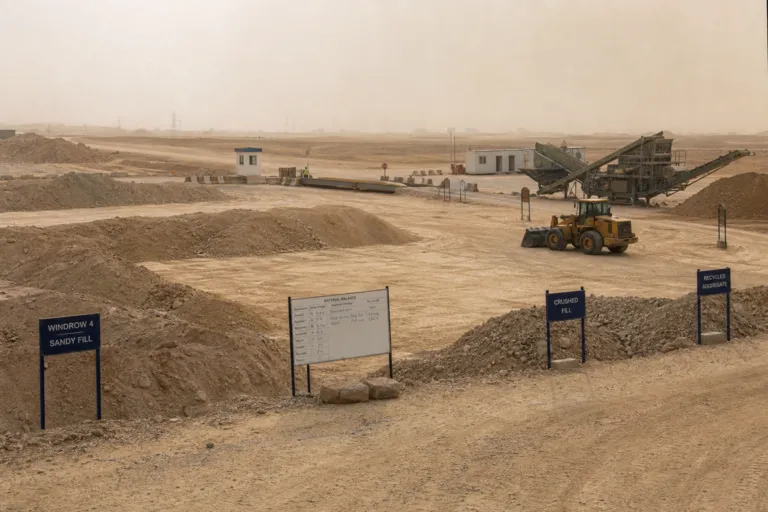
Earthworks is where schedules and ground realities collide. A single decision to pause a megaproject can strand excavation progress while leaving stockpiles, haul plans, and backfill sequences in limbo. That is why excavated soil reuse for construction in Saudi Arabia has become a practical discussion, not just a sustainability slogan. On major infrastructure jobs, engineers can be dealing with millions of cubic metres of material moved around, alongside soil stabilisation and on-site improvement choices that can reduce the need to excavate and replace weak or wet soils. When a project’s downstream construction slows, the ability to rebalance cut-and-fill and to reuse material becomes central to controlling disruption and waste.
Saudi Arabia has recently shown how quickly flagship plans can shift. Reuters reported that work on the Mukaab, a cube-shaped skyscraper at the center of the New Murabba district in Riyadh, was suspended while financing and feasibility were reassessed, with work beyond soil excavation and pilings paused. The same report cited a Knight Frank estimate that the New Murabba district would cost about USD 50 billion, with projects commissioned so far valued at around USD 100 million. Separately, Click Oil and Gas reported that active construction fronts of The Line were stopped by the Public Investment Fund on September 16, 2025 as a technical pause for re-evaluation, and described machines being removed and teams demobilised. In both cases, the early-stage nature of some works makes excavated spoil and temporary works a key issue.
Earthworks Balancing Meets Market Pressure
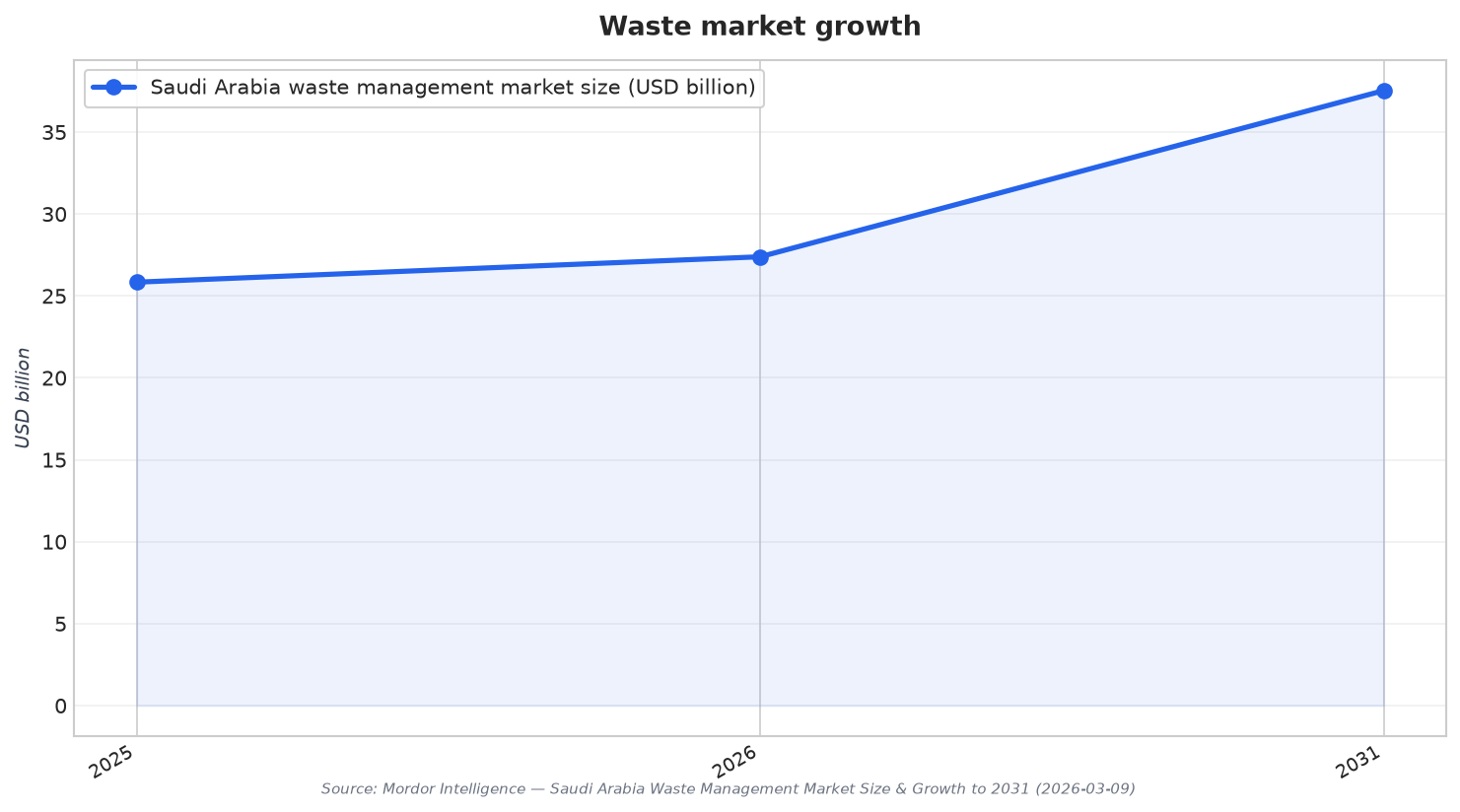
These pauses land inside a wider construction and waste-management pipeline that is still moving. Mordor Intelligence valued the Saudi Arabia construction market at USD 78.60 billion in 2025 and estimated it would rise from USD 82.80 billion in 2026 to USD 101.83 billion by 2031, at a 4.22% CAGR for 2026–2031; infrastructure led with 60.13% of 2025 revenue. GlobalData, in a separate outlook, estimated the construction industry in Saudi Arabia would grow by 3% in real terms in 2026. At the same time, Mordor Intelligence valued the Saudi Arabia waste management market at USD 25.84 billion in 2025 and estimated it would grow from USD 27.39 billion in 2026 to USD 37.53 billion by 2031, at a 6.5% CAGR. For earthworks teams, that combination means scrutiny on how spoil becomes a resource rather than a disposal problem.
Reuse and balancing strategies sit close to construction-and-demolition flows, because paused sites still generate material that must be handled. Mordor Intelligence noted that large construction programs such as NEOM and the Red Sea Project are accelerating C&D waste output and driving demand for mobile crushers, material recovery facilities, and refuse-derived-fuel plants. The same source said Saudi Investment Recycling Company (SIRC) alone recycled 16 million tons of C&D waste in 2025, and that SIRC, Veolia, SUEZ, Averda, and BEEAH collectively managed more than 50% of treated volumes in 2025. In parallel, policy signals also matter: the report described stricter penalties under Royal Decree M/3, including fines up to USD 8 million and prison terms for non-compliance, alongside technical guidelines released in 2024 requiring on-site segregation for projects larger than 10,000 square metres.
When megasites suspend or resequence, earthworks balancing becomes about preserving options. Stabilisation can let teams upgrade soils in-situ rather than excavate and replace them at great cost, which can reduce spoil volumes that need to be transported or stored. The practical goal is to keep material in productive loops: using suitable excavated soils for engineered fill where specifications allow, segregating streams early, and aligning with the growing service ecosystem around recycling and treatment. In Saudi Arabia, where Riyadh accounted for 38.5% of the waste management market size in 2025, and where Vision 2030-linked programs are still anchoring multi-year pipelines, the projects that manage spoil intelligently can be better positioned to restart quickly when the pause ends.
Why does a megaproject pause make earthworks balancing harder?
What did Reuters say was suspended at the Mukaab site?
How does excavated soil reuse in Saudi Arabia’s construction sector connect to waste-market trends?
What are the key market figures shaping Saudi Arabia’s construction and waste planning?
Talk to us for your needs in:
-
Sustainable Construction Solutions
-
Strategic Construction Planning
-
Customer-Centric Construction Services
-
Operational Excellence in Construction
-
Leadership and Change Management for Construction
-
Digital Transformation in Construction
-
Saudi Construction Market Research
-
In-Depth Market Study for Construction
-
Market Intelligence and Insights in Construction
-
Feasibility Study and Assessment in Construction
-
Saudi Construction Benchmarking