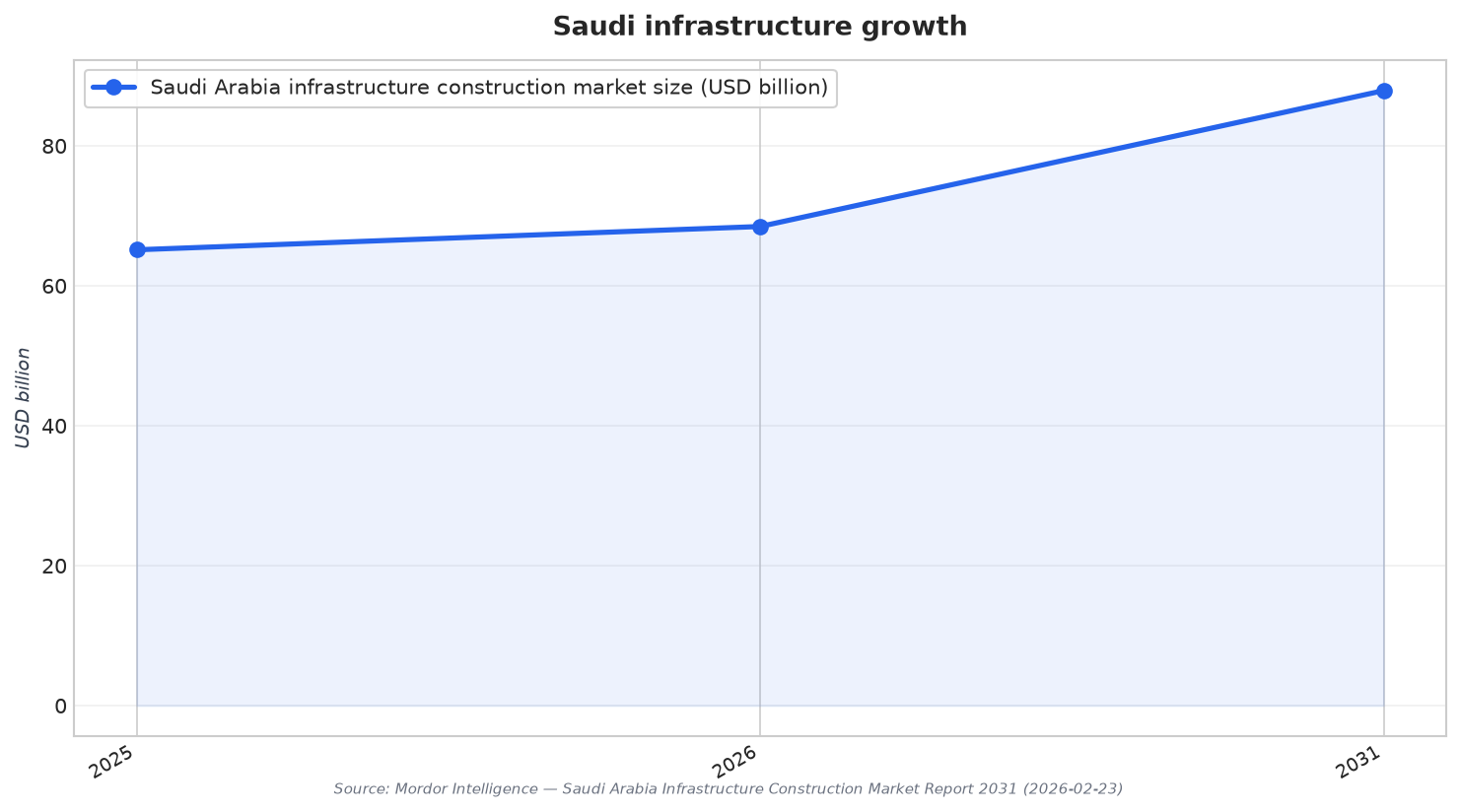
Saudi Arabia’s infrastructure construction market is expanding in 2026, but it is also getting more selective about delivery speed, risk allocation, and value for money. Mordor Intelligence values the Saudi Arabia infrastructure construction market at USD 65.14 billion in 2025 and estimates growth from USD 68.47 billion in 2026 to USD 87.89 billion by 2031, at a 5.12% CAGR for 2026–2031. Transportation already accounts for 46.3% of the market’s 2025 share, aligning directly with the airport and metro work that dominates today’s headline programs. As the Kingdom pushes diversification into logistics and industrial capacity, EPC capability becomes a differentiator, not a nice-to-have.
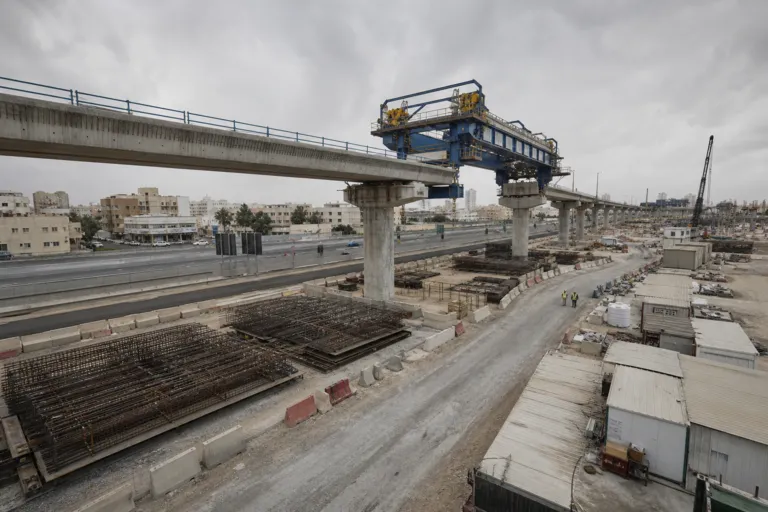
This is where the China factor shows up in the Chinese contractors Saudi Arabia construction market 2026 discussion. An intelligence assessment published in March 2026 estimates Chinese state-owned contractors and subsidiaries control roughly 35% to 40% of the Kingdom’s active mega-project construction value. The same source maps about USD 30 billion in active Chinese contract value against an estimated USD 85 billion in active mega-project construction, or approximately 36%. It also frames this as a sharp multi-year gain, rising from around 12% in 2020 and about 22% in 2023. In practice, this reach spans marquee projects and the enabling layers underneath them, from utilities to transport systems.
Why EPC Packaging and Pricing Keep Beating the Field
Two practical advantages are repeatedly cited: pricing and the ability to package delivery with financing strength. The March 2026 intelligence brief says Chinese contractors consistently bid 15% to 30% below Western competitors on comparable work packages. Separately, Mordor’s GCC construction industry analysis notes that Chinese majors, including China State Construction, leverage larger balance sheets and EPC financing packages to clinch signature towers and infrastructure corridors. That combination matters when procurement teams are balancing cost pressures and risk-sharing structures. Mordor also points to a growing role for PPP-style arrangements in Saudi Arabia, with public funding at 69.1% of 2025 spend but private capital routed through PPPs projected to grow at a 6.81% CAGR between 2026 and 2031.
Sector mix helps explain why airports, metros, and mining-linked enabling works are especially contested. Mordor highlights PIF-backed flagships such as King Salman International Airport, plus long-dated order books for tunneling, signaling, and rolling stock that extend through 2030. It also notes that PIF priorities are shifting more capital toward critical minerals, artificial-intelligence infrastructure, and tourism assets, which can tilt workloads toward extraction and industrial-support builds alongside transport. Metastat Insights similarly frames expansion through metro corridors, industrial zones, logistics parks, and airport upgrades, valuing the infrastructure construction segment at USD 68.2 billion in 2026 and projecting USD 107.0 billion by 2033 at a 6.7% CAGR. For EPC firms, these are multi-package programs where integrated procurement and schedule control can win the commercial argument.
Chinese contractors also arrive with a deep domestic reference market that is still scaling, not shrinking. Mordor estimates China’s construction market will grow from USD 4.85 trillion in 2025 to USD 5.03 trillion in 2026, with infrastructure forecast to expand at a 5.41% CAGR through 2031. The same report points to fast technology adoption, including building information modeling (BIM), robotics, and modular manufacturing, plus rising prefabrication adoption at a 6.05% CAGR. While these figures are China-specific, they provide context for why Chinese EPC organizations can industrialize delivery and replicate methods abroad. In the GCC, Saudi Arabia leads regional spending with a 40.60% share of total activity in 2026, making the Kingdom the biggest prize in a USD 350.79 billion GCC construction market that year.
How big is Saudi Arabia’s infrastructure construction market in 2026?
What share of Saudi mega-project value do Chinese contractors control in early 2026?
Why are Chinese EPC contractors winning more airport and metro packages?
How does transportation shape the 2026 opportunity set in Saudi Arabia?
What is changing in the Chinese contractors Saudi Arabia construction market 2026 landscape?
Talk to us for your needs in:
-
Sustainable Construction Solutions
-
Strategic Construction Planning
-
Customer-Centric Construction Services
-
Operational Excellence in Construction
-
Leadership and Change Management for Construction
-
Digital Transformation in Construction
-
Saudi Construction Market Research
-
In-Depth Market Study for Construction
-
Market Intelligence and Insights in Construction
-
Feasibility Study and Assessment in Construction
-
Saudi Construction Benchmarking