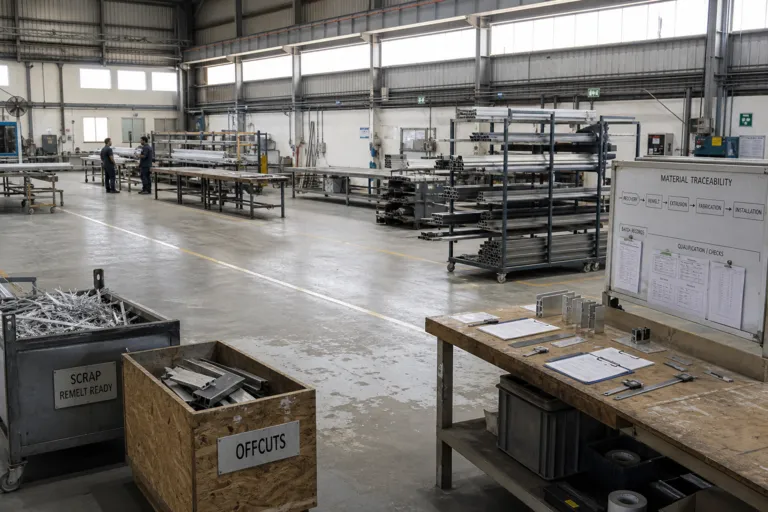
When 2026 brings material price pressure or delivery disruption, façade packages are exposed because they depend on stable metal supply and tight installation timelines. Circular design reframes that risk. In the UK context, Architecture Today describes aluminium as “infinitely recyclable without loss of quality,” meaning the same material can be repeatedly remelted while maintaining properties. That recyclability becomes more than a carbon story. It is a procurement strategy, because a closed loop can recover end-of-life windows, doors, and facades, then sort and remelt them and reintegrate them into a supply chain. The same source highlights that this recovery pathway can be fully traceable and can avoid downcycling, so aluminium remains within the construction sector and retains full material value.
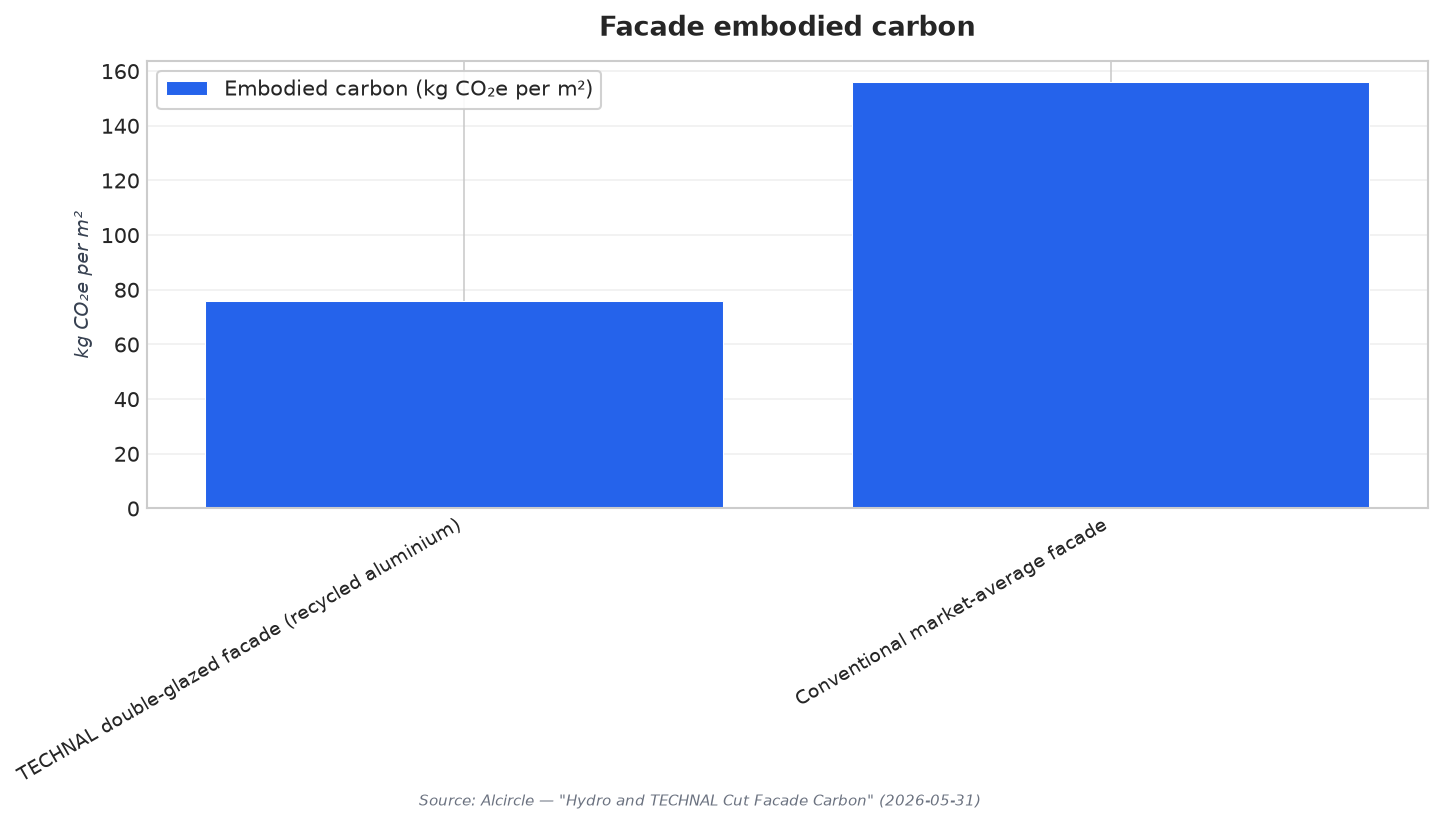
Recycled-content specifications also translate into measurable embodied-carbon reductions at the system level. A case study on Hydro Building Systems and TECHNAL reports that a double-glazed TECHNAL aluminium façade system can achieve around 76 kg CO₂e per square metre, compared with about 156 kg CO₂e per square metre for a conventional market-average façade. The same case study links that reduction to circular design choices and to aluminium sourcing, noting that TECHNAL began addressing sourcing directly in 2018 by moving towards Hydro CIRCAL recycled aluminium. It also states that Hydro CIRCAL 100R, available for selected applications, uses 100% post-consumer recycled aluminium and has a footprint below 0.5 kg CO₂e per kg.
Why Closing the Loop Is Also a 2026 Risk Hedge
For decision-makers thinking about recycled aluminium facade systems for Saudi construction, the “hedge” is less about predicting a single number and more about reducing exposure to primary-metal volatility. Mordor Intelligence explains why: secondary production consumes only 5% of the energy required for virgin smelting while preserving material properties indefinitely, and secondary smelting cuts energy use by 95% compared with electrolytic processes. The same report notes that energy costs and circular-economy legislation are pushing manufacturers to favour recycled over primary metal. It also provides market context: the global aluminum recycling market size in 2026 is estimated at 41.14 million tons, up from 39.35 million tons in 2025, with 2031 projections of 51.36 million tons.
Supply security improves further when closed-loop arrangements preserve alloy value and bypass mixed scrap streams. HTF Market Intelligence describes closed-loop setups as offering better material security because valuable alloy-specific production scrap can be returned directly to qualified recycling facilities, “preserving alloy value,” lowering transport requirements, and improving supply-chain security. That type of chain-of-custody thinking is echoed in the UK façade narrative, where closed-loop recovery is described as fully traceable and designed to avoid downcycling. Together, these points matter in 2026 planning because they shift façade procurement from a one-way purchase into a repeatable materials cycle that can be specified, audited, and replenished.
There are also specification levers that reduce “green premium” fears while keeping performance intact. Architecture Today reports TECHNAL systems are manufactured using Hydro CIRCAL 75R aluminium as standard, made with a minimum of 75% recycled post-consumer material, and designed to be 95% recyclable at end of life. It adds that this standardized approach means there is no additional cost to specify low-carbon circular materials and products, and that the result is an 81% reduction in embodied carbon compared with the average impact of primary aluminium consumed in Europe (a Europe-scoped comparison, not a Saudi baseline). The same source emphasizes that circular façade solutions can still deliver slim sightlines, precision detailing, and high-performance envelopes expected in contemporary architecture.
How can recycled aluminium facade systems support Saudi construction planning for 2026 volatility?
What embodied-carbon figures are reported for a recycled-content aluminium façade system?
What recycled content levels are cited for Hydro CIRCAL aluminium used in façade systems?
How much energy can secondary aluminium production save versus primary production?
What does Mordor Intelligence estimate for the global aluminum recycling market size in 2026?
Talk to us for your needs in:
-
Sustainable Construction Solutions
-
Strategic Construction Planning
-
Customer-Centric Construction Services
-
Operational Excellence in Construction
-
Leadership and Change Management for Construction
-
Digital Transformation in Construction
-
Saudi Construction Market Research
-
In-Depth Market Study for Construction
-
Market Intelligence and Insights in Construction
-
Feasibility Study and Assessment in Construction
-
Saudi Construction Benchmarking