Digital twin giga projects Saudi Arabia are changing how teams plan, build, and run major assets. In Saudi Arabia, digital twin and 3D visualization give planners and engineers immediate access to data, improved design, and the ability to predict potential outcomes. They also help teams discover issues at the earliest stage, which supports smarter, safer, and more sustainable infrastructure. For giga-programs, this matters because decisions made early can affect delivery, handover, and operations for years.
A key shift is that digital twins are moving well beyond polished 3D visuals. The value comes from connecting BIM, GIS, IoT, operational data, and governance controls into one working environment. A BIM model shows what is designed and built. A digital twin adds live context such as progress updates, sensor feeds, utility performance, maintenance signals, and operational conditions. That turns the model into a decision-support layer that can keep delivering value through construction, handover, and operations.
In the design phase, 3D visualization helps teams see what a property would be like before construction starts. Developers, investors, and buyers can enter a virtual environment and review selectable layouts, materials, and aesthetics. This reduces inconsistent interpretations before approvals and inspections, which helps prevent completion delays and saves time and cost later. Architects also use 3D modeling tools in all stages of the design process, supporting compliance, safety assurances, and functionality.
From Construction Visibility to Handover and O&M Readiness
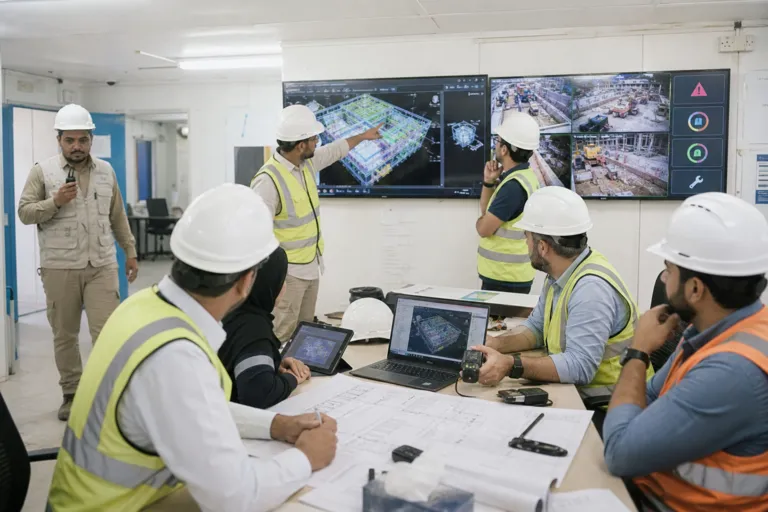
During construction, the strongest digital twin programs do not stop at design coordination. They extend into schedule tracking, issue management, and site visibility. In the GCC, teams are now focused on execution outcomes. The outcomes buyers want include better progress tracking, earlier delay detection, stronger handover quality, predictive maintenance support, clearer asset lifecycle visibility, and reliable data governance.
For NEOM and similar programs, digital twins can support facilities teams by validating as-built versus as-designed. They can also attach O&M manuals and sensor IDs, and capture asset lineage. Digital twins can stream IoT/SCADA/BMS into the twin for real-time status, anomaly detection, and predictive maintenance. This approach supports long-term operations by keeping asset data usable after handover, not trapped in separate files and systems.
For Qiddiya and other developments, sources describe digital twins being used to simulate layouts, energy efficiency, and sustainability. Saudi smart-city work also points to integrated sensor networks and modular systems, along with advanced installation techniques that can support robotic construction. Together, these capabilities fit the goal of using digital twins to improve delivery visibility and operational performance, aligned with Saudi Vision 2030 goals.
What does “digital twin” mean for giga-project delivery, not just visuals?
How can digital twin giga projects Saudi Arabia help NEOM and Qiddiya in the design phase?
What outcomes do mega-project owners expect from digital twins in 2026?
How do digital twins support operations and maintenance (O&M) after handover?
Talk to us for your needs in:
-
Sustainable Construction Solutions
-
Strategic Construction Planning
-
Customer-Centric Construction Services
-
Operational Excellence in Construction
-
Leadership and Change Management for Construction
-
Digital Transformation in Construction
-
Saudi Construction Market Research
-
In-Depth Market Study for Construction
-
Market Intelligence and Insights in Construction
-
Feasibility Study and Assessment in Construction
-
Saudi Construction Benchmarking