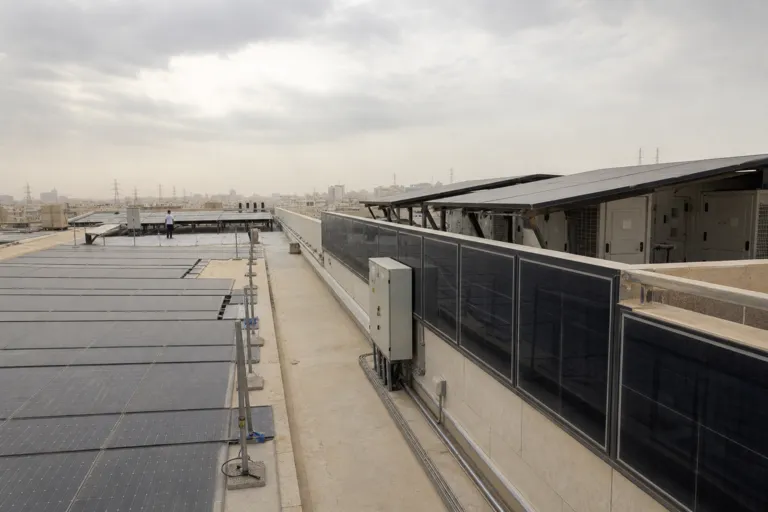
Building-integrated photovoltaics (BIPV) integrates solar cells directly into architectural elements such as facades and roofs, so the envelope becomes both a functional building component and an on-site generator. A comprehensive Saudi-focused review describes BIPV as a cornerstone technology for the country’s transition from historical reliance on fossil fuels, tying it explicitly to Vision 2030 and the Saudi Green Initiative (SGI). It also notes that, while the BIPV market in Saudi Arabia is still nascent, momentum is supported by the National Renewable Energy Program (NREP) and energy conservation mandates in the Saudi Building Code (SBC 601). That combination matters for designers. It shifts solar from an “add-on” to a requirement-driven design choice, where facade and roof decisions increasingly influence long-term operational outcomes.
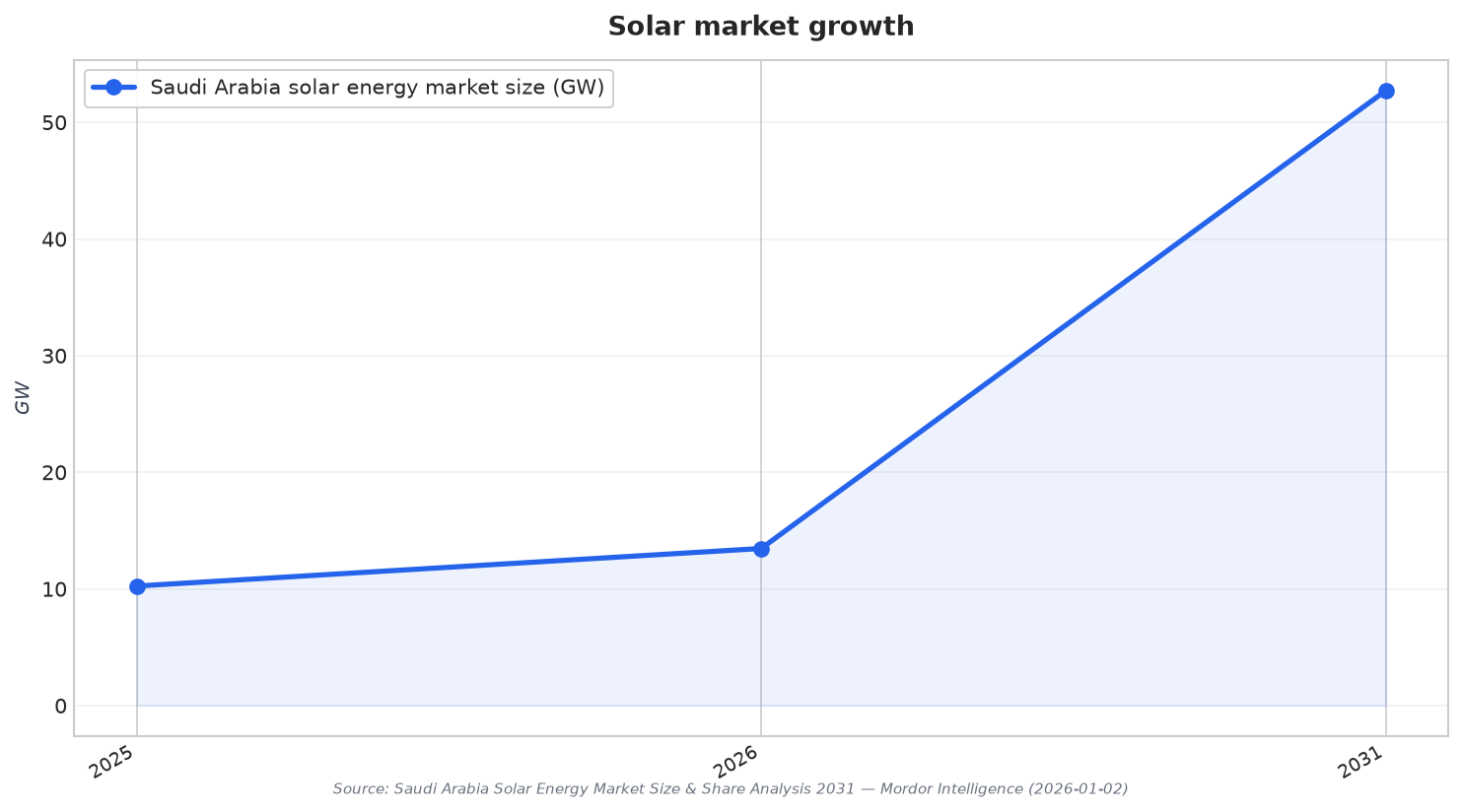
Broader solar-market signals also show why “solar-ready by design” is gaining urgency. Mordor Intelligence estimates Saudi Arabia’s solar energy market size at 10.25 GW in 2025 and 13.47 GW in 2026, with a projection of 52.72 GW by 2031 (using its proprietary estimation framework). In 2025, solar PV held 98.55% of market share by technology, and on-grid installations held an 89.85% share by grid type, while utility-scale accounted for 65.05% by end-user. The same source describes a pivot toward distributed applications, with commercial and industrial installations forecast to expand at a 38.9% CAGR to 2031. For architects and owners, those market dynamics frame BIPV as part of a larger shift: buildings are becoming a deployment channel, not just a load.
What Riyadh Performance Data Says About Facade-Integrated PV
Local performance evidence helps move BIPV from concept to specification. A Frontiers study evaluated a 5.6 kWp facade-integrated PV system in Riyadh using PVsyst with site-specific climatic data, 3D shading analysis, thermal modeling, and system loss assessment. The simulation results indicated approximately 8,200 kWh of electricity annually, with a performance ratio between 0.78 and 0.83 despite challenging thermal conditions. The study attributes part of that resilience to a ventilated facade configuration that reduces temperature-related efficiency losses. It also notes that the near-vertical installation can minimize dust accumulation compared with conventional rooftop PV systems. The same article situates this in Riyadh’s hyper-arid climate, where summers frequently exceed 45 °C and the city receives around 2,100 kWh/m2 of global horizontal irradiance annually.
Design integration also responds to how and where energy is consumed in hot-arid cities. The Riyadh study states that approximately 60%–70% of total household energy is driven by cooling needs, framing the building envelope as a strategic intervention point. Meanwhile, the Saudi-focused review emphasizes that BIPV can be deployed on urban multi-story buildings and residential homes, connected to the grid or used off-grid, and highlights opportunities emerging from the construction sector’s shift toward sustainability and smart-city concepts, including large-scale projects such as NEOM. At the same time, it groups barriers into technical and climatic challenges, economic and market barriers, and institutional and regulatory limitations—meaning “solar-ready” detailing must address not only aesthetics and yield, but also procurement maturity, compliance pathways, and market readiness.
Globally, policy and code trends show why early envelope decisions matter. A U.S. Department of Energy explainer defines BIPV as solar that replaces conventional building materials in parts of a structure, including the roof, skylights, facades, or windows, distinguishing it from conventional rooftop modules placed on top of a roof. Separately, a global BIPV market report describes developers specifying solar-ready curtain walls at the concept stage and cites Europe’s Energy Performance of Buildings Directive 2024/1275 requiring solar-ready roofs on all new structures by 2030, with phased retrofits for public buildings above 250 square meters beginning in 2027. Those examples are not Saudi requirements, but they illustrate the direction codes can take. In Saudi Arabia, aligning BIPV choices with Vision 2030, SGI, SBC 601, and NREP can help facades and rooftops be designed for compliance and performance, not retrofitted under pressure.
What is building-integrated photovoltaics (BIPV) in the context of Saudi building design?
What performance did a Riyadh BIPV facade study report?
Why are facade-integrated PV systems discussed as a fit for hot-arid environments like Riyadh?
How does Saudi Arabia’s solar market trend support more solar on buildings?
How does the topic of building integrated photovoltaics, solar buildings, and Saudi Arabia connect to codes and policy?
Talk to us for your needs in:
-
Sustainable Construction Solutions
-
Strategic Construction Planning
-
Customer-Centric Construction Services
-
Operational Excellence in Construction
-
Leadership and Change Management for Construction
-
Digital Transformation in Construction
-
Saudi Construction Market Research
-
In-Depth Market Study for Construction
-
Market Intelligence and Insights in Construction
-
Feasibility Study and Assessment in Construction
-
Saudi Construction Benchmarking