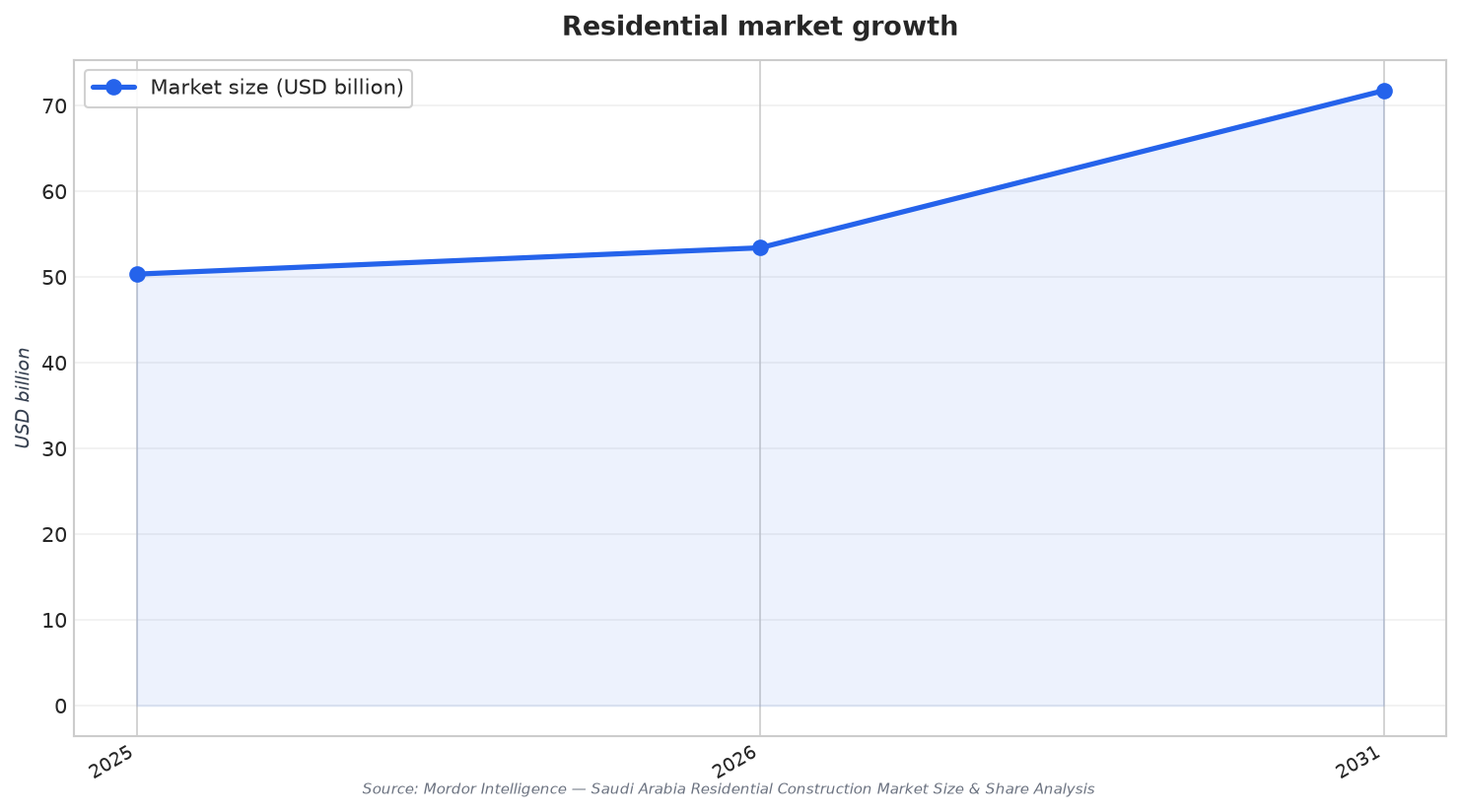
Saudi Arabia’s construction pipeline is still dominated by new-build, but the renovation lane is expanding fast. In Mordor Intelligence’s Saudi Arabia Construction Market analysis, new construction held an 81.2% share in 2025, while renovation is forecast to advance at a 6.91% CAGR over 2026–2031. In residential, Mordor’s separate market view shows new-build schemes at 84.5% share in 2025, with renovation activity forecast to grow at a 6.41% CAGR to 2031. That mix matters for any Tarshid building energy retrofit Saudi Arabia discussion because retrofit-ready contractors are competing for a growing slice of work inside an overall market projected at USD 133.79 billion in 2025 and USD 186.13 billion by 2031 (Mordor, construction market).
The contractor opportunity becomes clearer when you connect renovation growth to the tools that make retrofits measurable. A market view shared via Vocal.media cites IMARC Group research that Saudi Arabia’s building energy efficiency systems market reached USD 3.0 billion in 2025 and is projected to reach USD 8.0 billion by 2034, at a CAGR of 11.44% during 2026–2034. The same source describes AI use cases that can shape retrofit scopes and O&M handover: predictive maintenance to minimize downtime by up to 40%, intelligent HVAC and lighting automation that can reduce energy consumption by 25–30%, and real-time analytics that can reduce electricity bills by 15–20% on average. For contractors, these figures frame why retrofit packages increasingly bundle controls, sensors, and commissioning, not just hardware replacement.
Where Retrofit Demand Shows Up First: Corporate Campuses, Stadiums, and Standards
Demand signals are visible in how owners and authorities are treating existing assets. Mordor’s infrastructure report notes that retrofitting corporate headquarters for LEED Gold compliance—like SABIC’s Riyadh campus—can require solar façades, grey-water loops, and smart-glass panels, and adds that as buildings approach mid-life, facility managers prioritize energy-efficiency upgrades. The same source also points to delivery models that suit retrofit specialists, citing AECOM’s appointment in March 2025 to manage the King Fahd International Stadium retrofit. Alongside these examples, MarkWide Research notes that Saudi Building Code and NHC mandates are tightening material specifications and energy-efficiency thresholds, which can pull retrofit work into more formal, compliance-driven procurement rather than purely discretionary capex.
Winning retrofit work also depends on how contractors position against broader market dynamics. Mordor’s construction outlook shows rivalry intensifying as local champions form joint ventures with global majors to secure technology and balance-sheet strength for large awards. In residential construction, private capital accounted for 70.1% of 2025 spending (Mordor, residential), while Mordor’s construction market view places public spending at 71.5% of 2025 activity. Meanwhile, GlobalData reports Saudi Arabia attracted a net FDI inflow of SAR 72.3 billion ($19.3 billion) in the first nine months of 2025, up 32.7% year on year versus the same period of 2024. For retrofit contractors, the implication is straightforward: build credibility through certified green practices, partner for specialist systems integration, and be ready for both public and private procurement pathways.
Execution capability is the differentiator, because retrofit jobs are often constrained by live operations and faster timelines. Mordor’s residential market shows conventional on-site work still held 87.1% share in 2025, yet modern modular systems are expected to post a 6.55% CAGR over 2026–2031, a signal that industrialized methods are becoming more accepted where they reduce disruption. Mordor’s infrastructure report adds that contractors combining advanced construction technology with certified green practices are winning work as authorities tighten carbon-reduction mandates before Riyadh Expo 2030 and the FIFA World Cup 2034. For retrofit teams, this points to a practical playbook: package energy-efficiency upgrades with digital controls, manage interfaces with building users, and document performance outcomes in a way that aligns with tightening standards.
How fast is renovation expected to grow in Saudi Arabia’s construction market?
What market signals support a Tarshid building energy retrofit focus in Saudi Arabia?
Which energy-efficiency technologies are highlighted as part of retrofit delivery?
Are there examples of major retrofit projects in Saudi Arabia?
What financing and investment context matters for retrofit contractors?
Talk to us for your needs in:
-
Sustainable Construction Solutions
-
Strategic Construction Planning
-
Customer-Centric Construction Services
-
Operational Excellence in Construction
-
Leadership and Change Management for Construction
-
Digital Transformation in Construction
-
Saudi Construction Market Research
-
In-Depth Market Study for Construction
-
Market Intelligence and Insights in Construction
-
Feasibility Study and Assessment in Construction
-
Saudi Construction Benchmarking