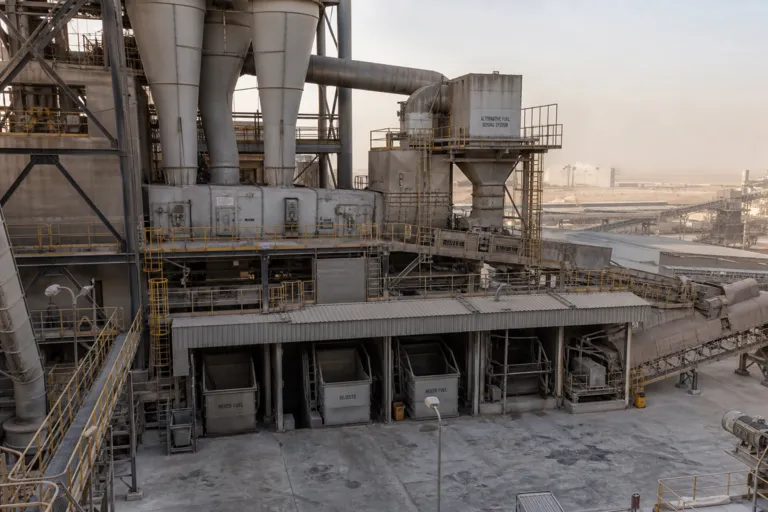
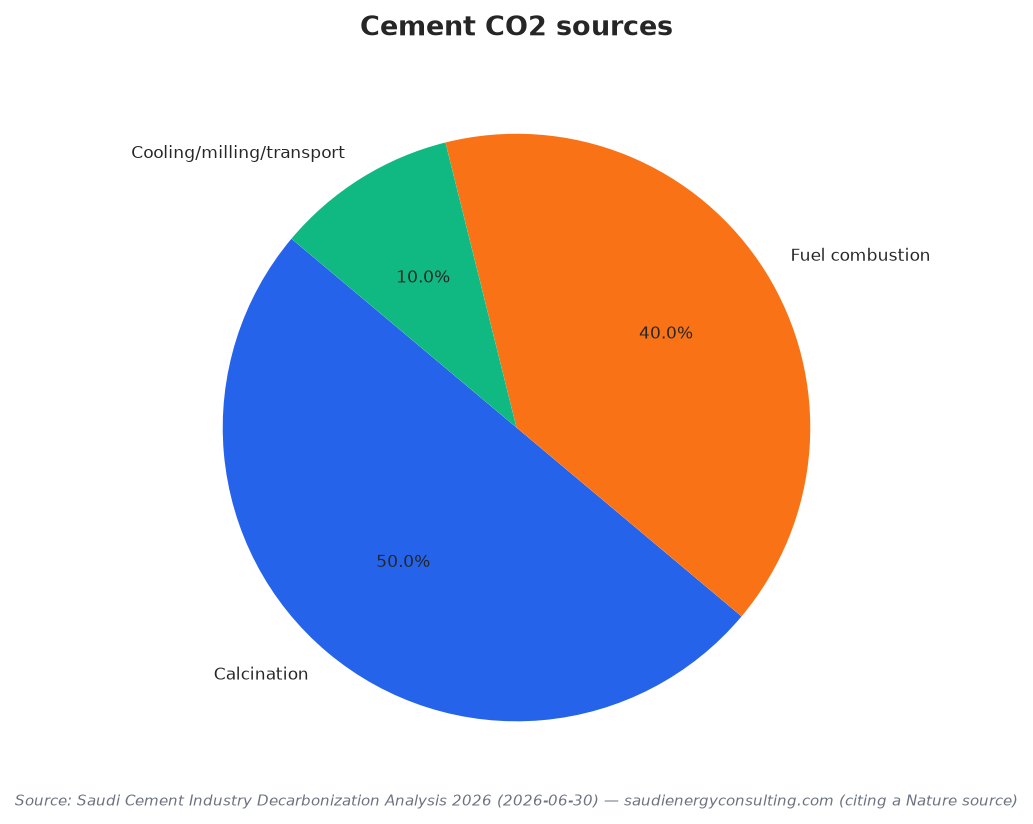
Decarbonizing cement is difficult because emissions are split between chemistry and heat. One analysis breaks cement CO2 into three buckets: about 50% from calcination, about 40% from fuel combustion, and about 10% from cooling, milling, and transportation. The same framing matters for Saudi Arabia because the combustion slice is still dominated by fossil inputs. A cited figure puts around 82% of combustion fuels as fossil fuels, mostly coal and pet coke, burned to reach around 1500°C for production. That is why the debate around cleaner kilns is not only about electricity. It is also about replacing coal and pet coke while acknowledging that calcination emissions do not disappear even when power gets cleaner.
Energy intensity adds urgency to practical changes inside the plant fence line. One source notes cement manufacturing at about 3.6 GJ per ton. A Saudi-focused statistics compilation also estimates Saudi cement plants consume approximately 350–400 kWh of energy per ton of cement. These pressures are arriving as producers manage costs amid energy subsidy reforms. Technavio flags escalating production costs driven by ongoing reforms, while the same statistics set says fuel subsidy reforms in 2024 increased production costs by 10–15%. In this context, alternative fuels and efficiency become both emissions tools and cost-control measures, aligning with producer communications and regulatory commentary that emphasize kiln efficiency, alternative fuel use, and environmental reporting practices.
Alternative-Fuel Co-Processing: From Waste Problem to Kiln Solution
Co-processing aims to substitute conventional fossil fuels with waste- and biomass-derived options, turning disposal streams into a controlled kiln input. IndexBox describes alternative fuels derived from waste and biomass as becoming strategic for cement decarbonization, listing fuel types such as refuse-derived fuel, industrial sludges, waste solvents, biomass residues, used tires, non-recyclable plastics, animal fats, and processed sewage sludge. Globally, IndexBox projects the cement kiln co-processing fuels market to grow at a CAGR of approximately 6.8% from 2026 to 2035, with a market index rising from 100 in 2025 to around 190 by 2035. For Saudi Arabia, adoption is already visible in policy and approvals: a Saudi statistics source says the use of alternative fuels like scrap tires has been approved for 5 major plants, and it adds that waste-to-energy projects in cement kilns could replace 5% of fossil fuels.
Cleaner firing also benefits from modernization beyond fuel substitution. Technavio states success hinges on implementing carbon capture in cement kilns and using alternative fuels in cement manufacturing, while also highlighting waste heat recovery systems as investment targets when rising energy costs pressure kiln efficiency. In Saudi Arabia, a statistics source says digital twin technology has improved kiln efficiency by 5% in modern plants, and that use of Vertical Roller Mills (VRM) has reduced electricity consumption by 20%. Financing and institutional momentum are also part of the decarbonization toolkit. Technavio reports that in January 2025, King Abdullah University of Science and Technology launched the Future Cement Initiative with the Ministry of Industry, and that in March 2025, Eastern Province Cement Company secured an USD 80 million financing agreement with the Saudi Industrial Development Fund for a new, modernized production line.
Fuel switching alone is not enough because most cement emissions are tied to calcination plus the heat required for calcination and clinkering. A cited Nature framing in one analysis states about 85% of cement CO2 emissions come from inherent process emissions from calcination plus the heat required to reach calcination and clinkering temperatures, and that this share cannot be decarbonized by external effects such as a green grid. That is where lower-clinker strategies and deeper kiln measures come in. A Saudi statistics source notes that use of “Green Cement” with 30% lower clinker content is rising in NEOM, and it also states Saudi cement industry aims for a 10% reduction in CO2 emissions by 2030. CCS is being explored too: the same statistics source says CCS pilot programs are being tested in the Eastern Province. Together, these steps define the core of the cement plant alternative fuel Saudi Arabia decarbonization pathway: reduce fossil firing, improve kiln and grinding efficiency, and shrink clinker dependence while pilots address the hardest process emissions.
Why is cement decarbonization so hard in Saudi Arabia?
What alternative fuels are being discussed for kiln co-processing?
What is the outlook for the global cement kiln co-processing fuels market?
How do efficiency upgrades support the cement plant alternative fuel Saudi Arabia decarbonization push?
What major Saudi initiatives and financing moves support cement decarbonization?
Talk to us for your needs in:
-
Sustainable Construction Solutions
-
Strategic Construction Planning
-
Customer-Centric Construction Services
-
Operational Excellence in Construction
-
Leadership and Change Management for Construction
-
Digital Transformation in Construction
-
Saudi Construction Market Research
-
In-Depth Market Study for Construction
-
Market Intelligence and Insights in Construction
-
Feasibility Study and Assessment in Construction
-
Saudi Construction Benchmarking