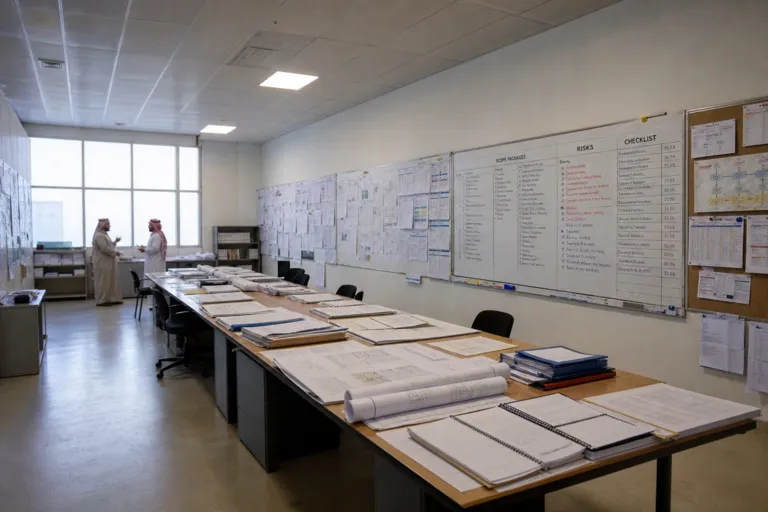
Saudi contractors are walking into 2026 with two pressures that collide inside the bid room: cost volatility and tighter scrutiny on documentation. Industry commentary on the Saudi construction outlook for 2026 flags rising construction costs and longer payment waits for consultants and contractors in the Kingdom. It also points to a more cautious project environment, where projects can slow or extend timelines as funders focus on reducing waste and overspending to stay on track. In that setting, bid teams need estimates that are faster to assemble, clearer to defend, and easier to reconcile when packages change.
Energy-related adjustments are also rippling through input pricing and, by extension, tender risk. The same 2026 coverage describes the cement sector as under significant pressure after a 35% spike in diesel and HFO costs, which is expected to push companies to raise retail prices and potentially cool demand in the construction sector. It also highlights elevated or rising costs for steel, concrete, lumber, and key mechanical and electrical components, driven by tariffs and supply volatility. Higher bids and change orders can increase contract disputes, adding legal expenses and higher insurance premiums. That pushes estimating and tendering teams to standardize assumptions, track revisions tightly, and document decisions before awards are challenged.
Why 2026 Is the Year Bid Rooms Start Measuring AI Value
Generative AI and broader AI tooling are being pulled into estimating workflows because they promise measurable process gains, not just experimentation. A construction estimating perspective in 2026 notes that automated takeoff and data entry can reduce estimate preparation time by up to 50% for many contractors, while pattern recognition and predictive models help minimize omissions and improve bid reliability. A practical 2026 guide also frames AI adoption around metrics bid rooms already understand, such as bid hit rate, cost variance between estimates and actuals, estimating cycle time, and the percentage of bids requiring last-minute revision. That focus matters when bid windows are short and revisions are frequent.
Tendering operations are also being reshaped by how quickly invitations to bid (ITBs), subcontractor outreach, and proposal drafting can be executed. One 2026 bidding workflow overview says GCs and estimators often have just 2–3 weeks to get bids out once documents arrive, while subcontractors may face a 10% win rate, meaning nine times out of ten their effort does not pay off. The same source claims AI-assisted bidding can increase participation through verified networks and optimized ITBs, citing a 30% average response increase, with some users achieving 60% response rates and 80+ bids per project. In Saudi bid rooms, that type of throughput claim becomes relevant when competition intensifies and qualified capacity is scarce.
All of this is landing as Saudi Arabia’s generative AI market itself accelerates, giving contractors more vendor options and more pressure to modernize. A 2026 market report values the Saudi Arabia generative AI market at $493.2 million in 2025 and projects it to reach $6,262.1 million by 2030, a CAGR of 43.8% and a stated 12.7x increase over five years, tied to government backing and Vision 2030 priorities. For the keyword topic of generative AI construction estimating tendering Saudi Arabia, the practical takeaway is governance: connect AI outputs to the Saudi Building Code and tender specs, preserve an auditable trail for assumptions, and use consistent bid-room measurement so AI reduces manual effort without weakening accountability.
How is generative AI changing construction estimating and tendering in Saudi Arabia in 2026?
What cost pressures are influencing Saudi bid rooms in 2026?
What tendering metrics should teams track to prove AI value?
What bid response improvements are being claimed for AI-assisted bidding tools?
What is the projected growth of the Saudi Arabia generative AI market through 2030?
Talk to us for your needs in:
-
Sustainable Construction Solutions
-
Strategic Construction Planning
-
Customer-Centric Construction Services
-
Operational Excellence in Construction
-
Leadership and Change Management for Construction
-
Digital Transformation in Construction
-
Saudi Construction Market Research
-
In-Depth Market Study for Construction
-
Market Intelligence and Insights in Construction
-
Feasibility Study and Assessment in Construction
-
Saudi Construction Benchmarking