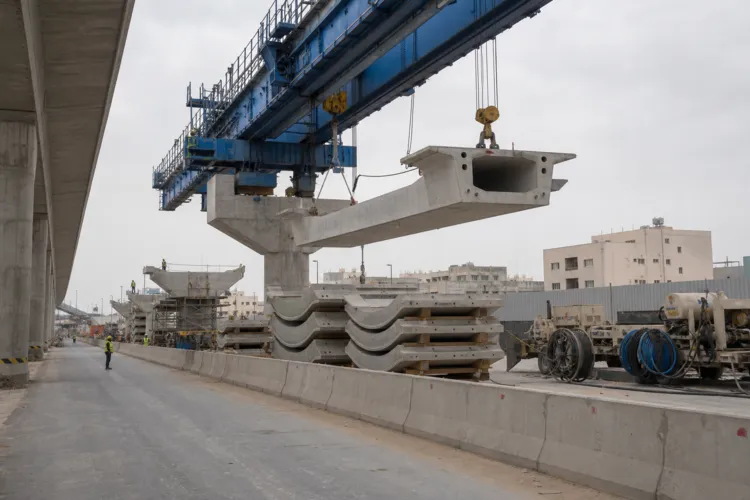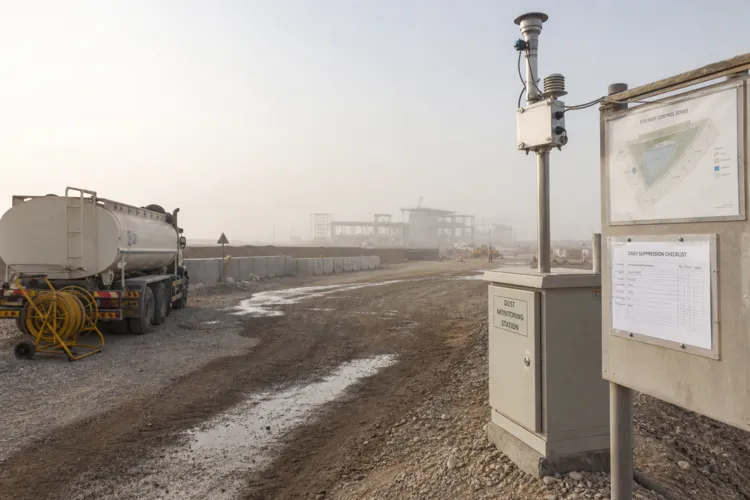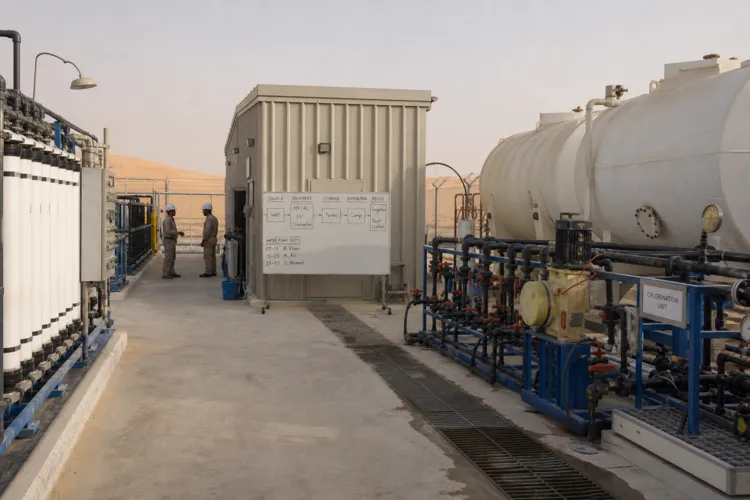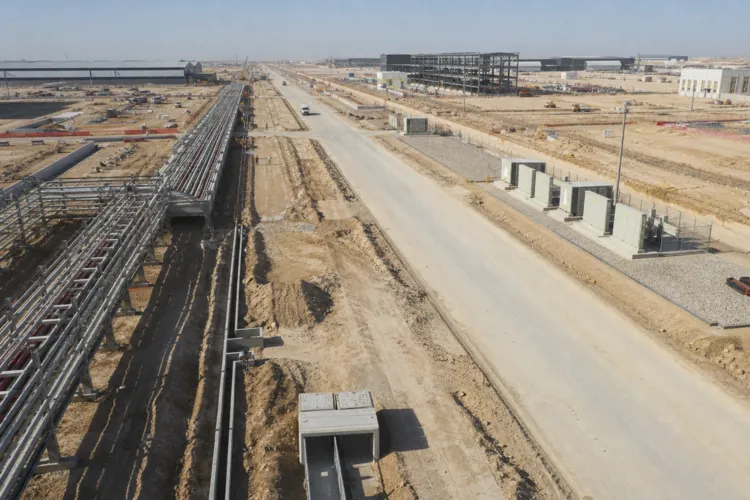
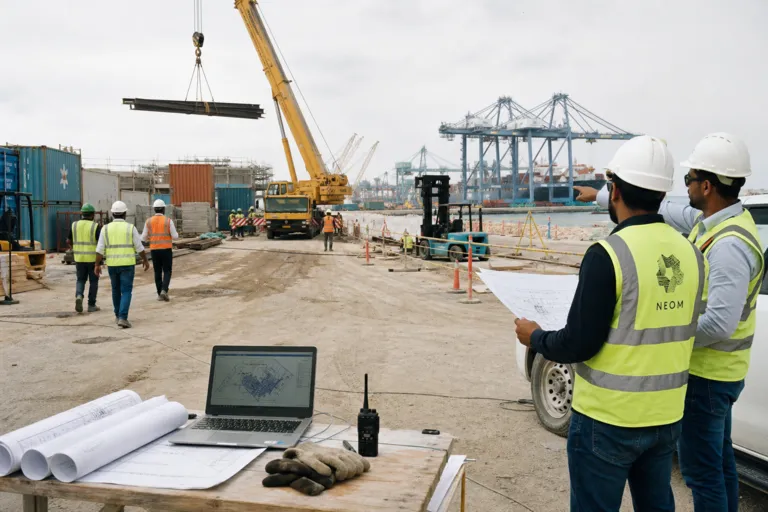
Oxagon is positioned as NEOM’s industrial-city and port strategy on the Red Sea, but it is not a finished city. The most confirmed elements are practical: an operating Port of NEOM that is already receiving cargo and handling containers, bulk, RoPax, and warehousing, plus a Terminal 1 container expansion framed for 2026. Oxagon’s role is also described as the industrial and logistics arm of NEOM, combining Industry 4.0 manufacturing, circular-economy principles, an integrated port and logistics infrastructure, and innovation facilities. In location terms, Oxagon sits in northwest Saudi Arabia, in the southwest corner of NEOM in Tabuk Province, and Port of NEOM is the renamed former Duba Port, with NEOM saying port management transferred from Mawani to NEOM in 2022.
On the port side, progress is tracked in construction and contracting language rather than renderings. Port of NEOM at Oxagon was reported in late 2025 to be 68% complete, with first cargo shipments handled and full container terminal operations targeted for 2026; Phase 2 dredging began in 2025. In May 2026, a partnership between Hassan Allam Construction Saudi, El Seif Engineering Contracting, and China Harbour Engineering Arabia was reported to have won an engineering, procurement, and construction contract to develop container terminal 1. This is the visible spine of the industrial thesis: port capability that can serve NEOM, the Kingdom, and wider regional trade, even while the industrial quarter is still seeking tenants and the wider city vision remains under phased activation.
What the DataVolt Deal Changes in the Buildout Sequence
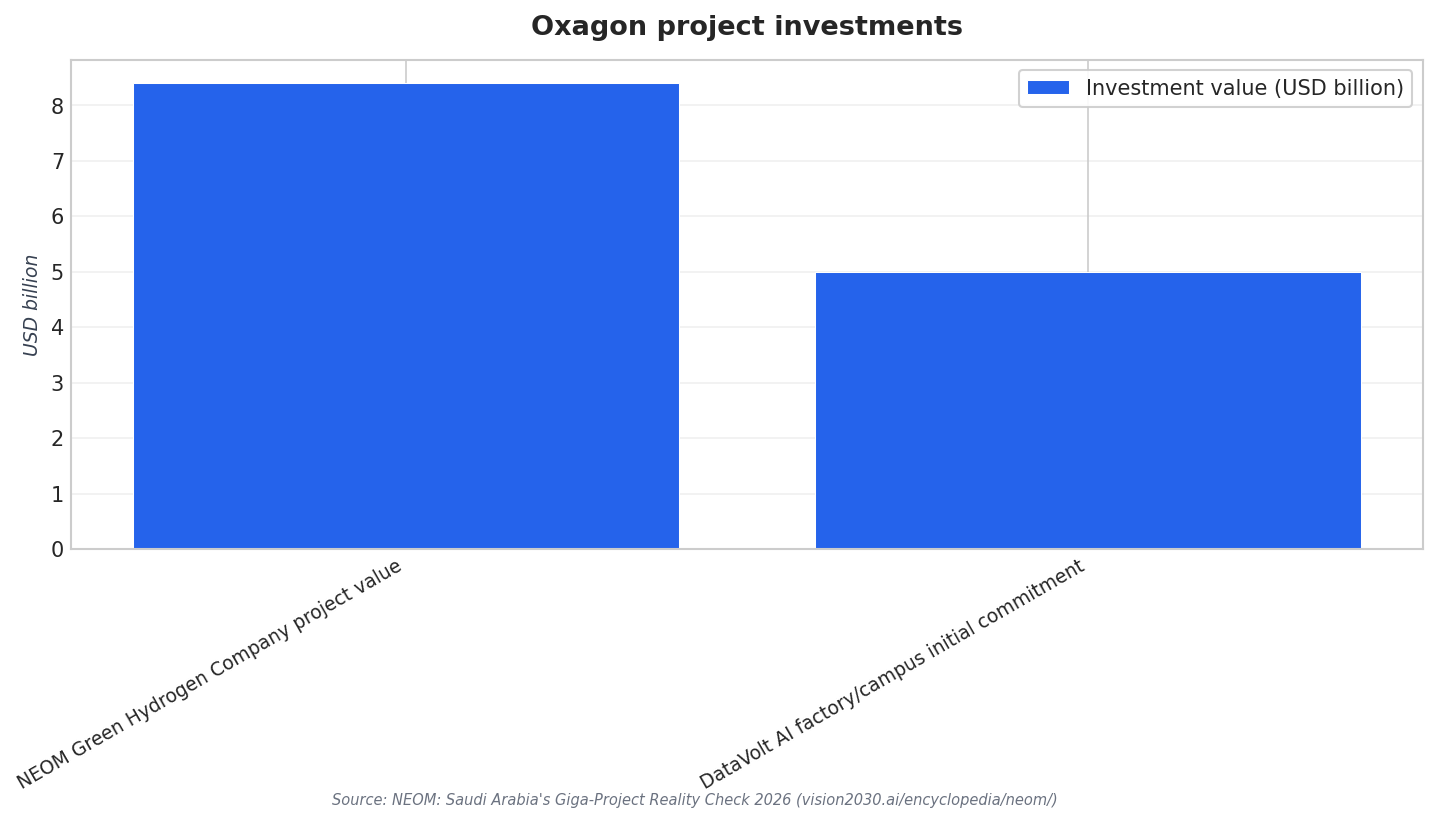
The DataVolt agreement adds a concrete tenant-anchor to the industrial construction narrative, with dates and power phases that can be planned against. At LEAP 2025, DataVolt and NEOM signed a USD 5 billion agreement to develop a 1.5 GW data center campus in Oxagon’s industrial area, with the first 300 MW phase reportedly targeted to go live in 2028. NEOM framed the project as an “AI factory” campus, and Oxagon’s CEO linked it to sustainable infrastructure and “green-AI workload” foundations in Saudi Arabia. Coverage also describes the campus as aiming to use coastal seawater for net-zero, fresh-water-free cooling. For Oxagon’s industrial delivery, this shifts attention from purely future advanced-manufacturing narratives to near-term site readiness, utilities, and reliable energy links that can support hyperscale compute operations by the stated 2028 phase target.
Energy-linked industrial projects around Oxagon create additional scheduling pressure because they bring their own operational targets. The NEOM Green Hydrogen Company facility connected to Oxagon is listed at a total project value of USD 8.4 billion, with financing closed in 2023 and USD 6.1 billion in non-recourse debt from 23 banks. One status assessment says the green hydrogen plant at Oxagon is 80% complete, and green ammonia exports are expected to begin from the port in early-to-mid 2027. Another industry source states the facility is expected to be operational by 2026 and cites a capacity of 600 tonnes per day. Separately, an industrial gases facility at Oxagon advanced via a land lease, with site preparation beginning in February 2026 and operations due in late 2026. Together, these timelines intensify the focus on port interfaces, tenant commissioning paths, and the practical sequencing of utilities and logistics.
For readers tracking Oxagon industrial construction in NEOM, the key question is not whether the 2021 pitch was ambitious, with renewable-powered advanced manufacturing and a distinctive floating component. The investable question is whether port throughput, tenant commitments, energy infrastructure, and industrial demand can make Oxagon economically useful before the full city exists. There are also enabling works that support sustained delivery at scale, including worker housing: Nesma Oxagon Village, a public-private partnership to build housing for 20,000 workers, reached financial close in May 2024. The near-term picture is therefore a set of interlocking construction packages—port capacity and dredging, Terminal 1 delivery, AI campus phasing, and energy-adjacent industrial plants—each with its own deadlines that collectively define whether Oxagon’s industrial base becomes operational in stages.
What is Oxagon’s most confirmed progress on the ground?
What are the main dates in the DataVolt AI factory campus plan at Oxagon?
Which contractors were reported to win the Port of NEOM Terminal 1 EPC contract?
How do hydrogen and industrial-gas projects affect Oxagon’s construction sequence?
What does the Oxagon industrial construction program inside NEOM rely on to become useful before the full city exists?
Talk to us for your needs in:
-
Sustainable Construction Solutions
-
Strategic Construction Planning
-
Customer-Centric Construction Services
-
Operational Excellence in Construction
-
Leadership and Change Management for Construction
-
Digital Transformation in Construction
-
Saudi Construction Market Research
-
In-Depth Market Study for Construction
-
Market Intelligence and Insights in Construction
-
Feasibility Study and Assessment in Construction
-
Saudi Construction Benchmarking