The Green Riyadh project is a large landscape-improving effort in Riyadh. It is part of Saudi Vision 2030. Sources describe goals like increasing green space per capita, improving air quality, and lowering town temperatures. This scale changes how work is planned, because planting is tied to irrigation networks and long-distance treated-water delivery.
For Green Riyadh project landscape contractors, irrigation is not a small add-on. Wikipedia states the city uses about 90,000 cubic meters per day for irrigation, and by the end of the project it needs 1 million cubic meter per day. Impact One also describes expanding the reuse of treated wastewater from 90,000 cubic meters per day to over 1 million cubic meters. 7 Wonders Future Cities adds that the program maximizes the use of 100% treated wastewater for irrigation.
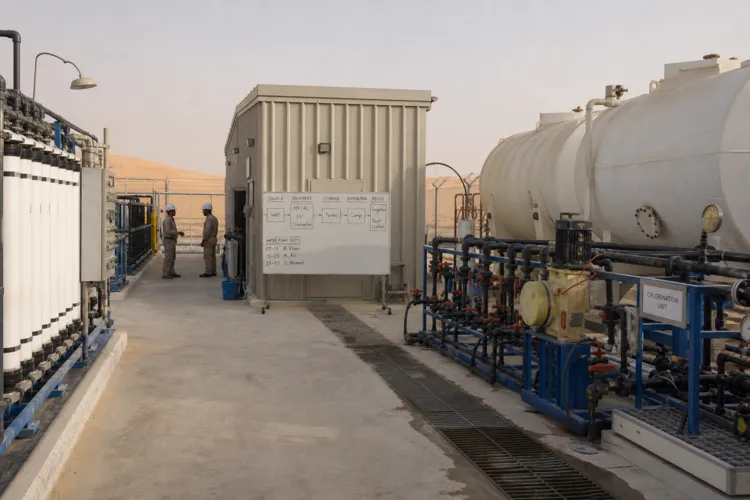
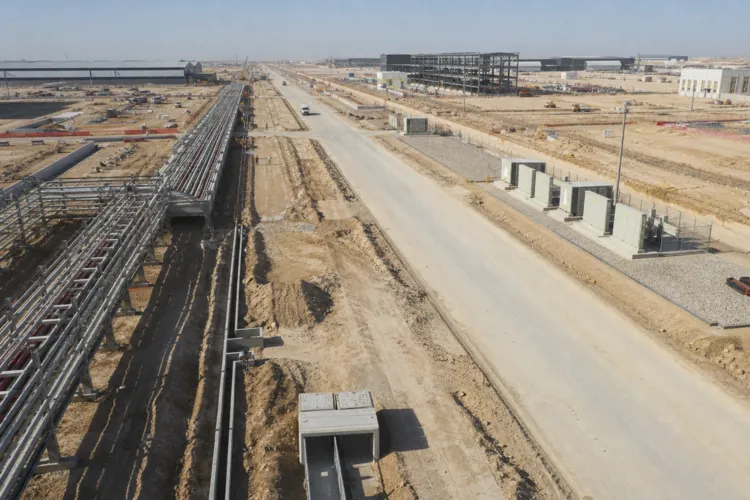
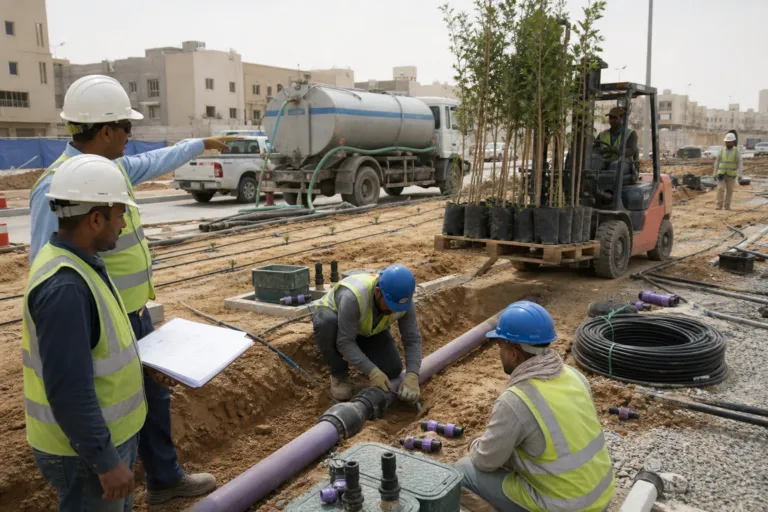
Pipeline infrastructure shapes how sites can be sequenced. Haif Company describes construction of a treated water pipeline that extends from Al-Orouba Park in central Riyadh, passing through Al-Ra’id, King Saud University, and Al-Khozama, and reaching Wadi Hanifa. The total length is approximately 11 kilometers. It uses carbon steel pipes that are internally and externally insulated to protect against environmental factors and maintain water quality.
Tree-Planting Scale Means Repeatable Site Logistics
Planting volume drives a logistics mindset. Wikipedia lists a goal of planting 7.2 million trees using 72 local tree species that can handle heat and wind in Riyadh. Other sources describe planting 7.5 million trees across Riyadh, including DMS Universe and Impact One. 7 Wonders Future Cities also says the goal is to plant over 7.5 million trees across 120 neighbourhoods and thousands of urban sites by 2030.
Those trees are distributed across many everyday places. Wikipedia lists schools, car parking sites, government facilities, healthcare facilities, universities, parks, mosques, and roads, streets, and green belts. That spread forces a practical approach: standardized planting details, traffic and access planning, and coordination between landscape work and irrigation readiness at each location.
Some sources also describe the expected environmental outcomes that guide design choices. Impact One says summer temperatures can reach 50°C, and describes reductions of land surface temperatures by 7–10°C and ambient temperatures by up to 15°C with dense greenery. It also states CO2 concentration could drop by 3–6%, and that some species can reduce particulate pollution by up to 60% in street corridors. 7 Wonders Future Cities also estimates a 3% to 6% reduction by absorbing dust and carbon dioxide. These targets reinforce why irrigation reliability and tree survival are treated as core delivery work.
What is the Green Riyadh project trying to deliver?
How much irrigation water does the project plan for?
What is known about the treated-water pipeline mentioned for Riyadh Green?
How many trees are planned, and where will they be planted?
What should Green Riyadh project landscape contractors focus on first?
Talk to us for your needs in:
-
Sustainable Construction Solutions
-
Strategic Construction Planning
-
Customer-Centric Construction Services
-
Operational Excellence in Construction
-
Leadership and Change Management for Construction
-
Digital Transformation in Construction
-
Saudi Construction Market Research
-
In-Depth Market Study for Construction
-
Market Intelligence and Insights in Construction
-
Feasibility Study and Assessment in Construction
-
Saudi Construction Benchmarking