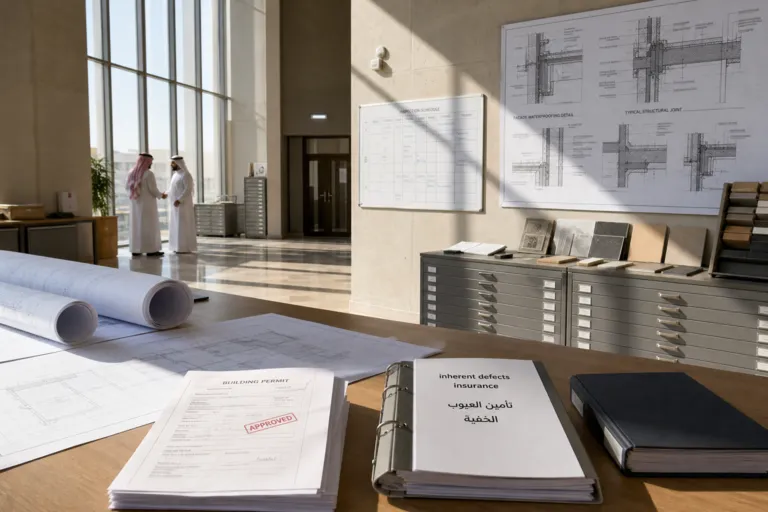
In Saudi Arabia, structural-defect liability risk does not end when a project reaches completion. That long tail is exactly where inherent defects insurance (IDI), also called latent defects insurance, is positioned. IDI covers the cost of repairing, restoring, strengthening, or fixing a building when a structural failure results from a defect in design, materials, or workmanship that existed at the time of construction but was not discoverable through reasonable inspection. A key feature is that it responds on a no-fault basis. Unlike relying on a contractor’s warranty, professional indemnity insurance, or a liability claim path that requires proving who caused the issue, IDI can respond even when specific negligence is hard to establish years later.
Saudi regulation has also pushed IDI from a “nice-to-have” into a structured requirement for certain projects. Under Cabinet Resolution No. 509 (issued on 21/09/1439AH, corresponding to 5 June 2018), contractors involved in private (non-governmental) sector projects are obliged to insure against latent defects in buildings or other structures, whether the defect is structural or otherwise. The same framework tasked SAMA with approving a standard policy wording and left the Minister of Municipal and Rural Affairs to determine scope, geography, and the required period of cover. This is part of why the topic of inherent defects insurance in Saudi Arabia construction is increasingly tied to compliance, not just post-completion risk management.
What the Saudi Standard Policy Covers and When It Applies
HFW reports that SAMA introduced a standard form IDI policy, and that from 2 May 2020 onwards contractors must obtain IDI for “qualifying projects,” with wording that cannot be amended without SAMA’s prior written approval. SAMA’s guidance confirms that non-governmental residential and non-residential projects can qualify, including towers, warehouses, hospitals, hotels, buildings for gatherings such as mosques and restaurants, education buildings, malls, telecommunication towers, industrial buildings and installations, buildings below 23 meters, and other high-risk buildings as determined by the Ministry. The policy’s core cover is for the cost of demolishing, repairing, replacing, and/or strengthening the insured premises following an inherent defect discovered and notified within the period of cover, where the defect causes physical damage or the threat of imminent collapse requiring immediate measures.
The duration element is central because the risk is long-lived. Multiple sources describe a 10-year period. Deshret Capital explains that IDI is typically placed before construction begins and commonly provides coverage for 10 years from practical completion, with the owner covered directly rather than needing to pursue fault across project parties. Almostashar, citing the Insurance Authority, states the policy period extends for 10 years from completion of construction and issuance of the occupancy certificate. That “direct” structure is presented as valuable where pursuing claims years later is difficult due to insolvency, limitation periods, or the practical challenge of proving which party caused a structural failure.
Implementation has also been described as phased. In March 2019, the Ministry of Municipality & Rural Affairs held a workshop on proposed scope, and it was agreed that the initial phase would apply to private sector construction in “main cities” in five major municipalities: the Holy Capital (Mecca), Medina, Riyadh, Jeddah Governate, and the Eastern Province. That first phase was stated to last 3 years, followed by a review phase, and then final requirements to be applied across Saudi Arabia. For project teams, this reinforces why IDI should be addressed early, including at permitting and contracting stages, because it is designed to respond to hidden defects in key elements such as “Structural Works” and the “Envelope,” as defined in the Saudi standard policy wording.
What is inherent defects insurance (IDI) in construction?
How long does IDI coverage last in Saudi Arabia?
When did Saudi Arabia require contractors to obtain IDI for qualifying projects?
Which projects can fall under the Saudi standard IDI requirement?
How does inherent defects insurance in Saudi Arabia construction differ from professional indemnity cover?
Talk to us for your needs in:
-
Sustainable Construction Solutions
-
Strategic Construction Planning
-
Customer-Centric Construction Services
-
Operational Excellence in Construction
-
Leadership and Change Management for Construction
-
Digital Transformation in Construction
-
Saudi Construction Market Research
-
In-Depth Market Study for Construction
-
Market Intelligence and Insights in Construction
-
Feasibility Study and Assessment in Construction
-
Saudi Construction Benchmarking