AI data centers are changing the rules for cooling and, with it, the entire MEP delivery model. Globally, the data center liquid cooling market was valued at USD 4.8 billion in 2025 and is expected to grow at a CAGR of 18.2% between 2026 and 2035. Separate research focused on AI data center liquid cooling values the global market at $6.6 billion in 2025 and projects $61.8 billion by 2034, with a 28.7% CAGR from 2026 to 2034. The technical driver is heat density: as of early 2026, average thermal design power per AI server rack crossed 60 kW, and frontier training clusters routinely exceed 100 kW per rack.
Those densities are difficult to sustain with traditional air-cooled CRAC approaches, which is why liquid systems are increasingly treated as foundational infrastructure rather than an upgrade. Research describes large-scale facilities from 20 MW to 500+ MW as the primary deployment environment for liquid cooling, driven by hyperscale cloud providers, AI companies, and large colocation operators building purpose-built sites. Global reporting also notes that many high-density environments now plan for rack densities exceeding 30 kW to 50 kW, with some next-generation AI deployments approaching or surpassing 100 kW. In that context, MEP teams are being asked to design around liquids, not around air.
Saudi Arabia: Climate Pressure Makes Liquid and Hybrid Cooling a Baseline
In Saudi Arabia, the need is reinforced by climate realities. One industry source notes ambient temperatures regularly exceeding 45°C, creating severe cooling challenges where traditional air cooling becomes inefficient and expensive. The same source states that over 50% of new data center constructions in the Kingdom incorporate liquid or hybrid cooling systems as essential infrastructure for reliable operations. It also links growth to Vision 2030 initiatives and highlights Riyadh, Jeddah, and the emerging NEOM project as investment magnets, alongside policies requiring local data processing and storage for government and sensitive commercial data. For project teams, that combination turns thermal strategy into a core planning decision.
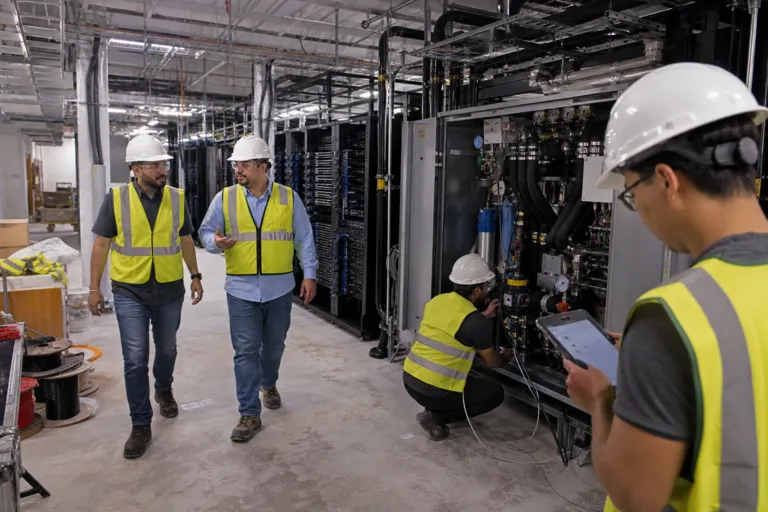
“Liquid-cooled by design” changes what gets engineered, bought, and commissioned. Large facilities are described as implementing liquid cooling from initial design phases rather than as retrofits, enabling centralized CDU farms, overhead piping distribution that minimizes floor space consumption, and redundant cooling loops that match power redundancy configurations. Technology choices are broad, spanning direct liquid cooling, immersion cooling, rear-door heat exchangers, and hybrid air-liquid systems. One analysis adds that direct-to-chip cooling delivers coolant to CPUs and GPUs through cold plates for efficient heat transfer at the source, while still maintaining compatibility with existing server designs. That shifts coordination intensity onto mechanical rooms, risers, distribution, and leak-risk management.
The delivery market is also splitting into integrated solutions and specialized services. A global report states that the solutions segment accounted for more than 74.5% of total revenue in 2025, reflecting demand for end-to-end cooling ecosystems that integrate hardware, software, monitoring, and system-level thermal management. The same report expects services to grow fastest, with a CAGR of 36.2%, as deployments become more sophisticated and operators seek expert partners for installation, deployment, maintenance, optimization, and predictive support. For Saudi contractors and consultants, this favors multidisciplinary packages where commissioning, controls, and operations readiness are planned alongside construction and fit-out. In short, data center liquid cooling construction in Saudi Arabia is increasingly an MEP-first challenge where liquids, controls, and reliability define the build sequence.
Why are AI data centers shifting to liquid cooling instead of air cooling?
What Saudi Arabia-specific factors are accelerating liquid and hybrid cooling adoption?
How does “liquid-cooled by design” change MEP scope on large projects?
Which liquid cooling technologies are most commonly considered for AI-ready builds?
What does the shift mean for data center liquid cooling construction in Saudi Arabia?
Talk to us for your needs in:
-
Sustainable Construction Solutions
-
Strategic Construction Planning
-
Customer-Centric Construction Services
-
Operational Excellence in Construction
-
Leadership and Change Management for Construction
-
Digital Transformation in Construction
-
Saudi Construction Market Research
-
In-Depth Market Study for Construction
-
Market Intelligence and Insights in Construction
-
Feasibility Study and Assessment in Construction
-
Saudi Construction Benchmarking