Cities are starting to plan for 50°C conditions, because some studies based on Intergovernmental Panel on Climate Change data project temperatures could reach 122°F (50°C) by the end of the century. A heat rehearsal in Paris was even built around that scenario, and it was designed to protect 2 million people if such heat arrives. The same reporting notes that the city’s record stands at 108.68°F (42.6°C), registered on July 25, 2019. These exercises underline a design reality: no air conditioner can cool entire cities indefinitely, and treating cooling as only a device problem misses the urban form, building envelope and public-space choices that shape heat exposure.
UNEP argues that “we cannot air condition our way out of the heat crisis,” warning that doing so would drive greenhouse gas emissions higher and raise costs. In its Sustainable Cooling Pathway, UNEP emphasizes passive techniques, low-energy and hybrid cooling that combines fans and air conditioners that consume little or no power. It also links cooling to resilient buildings and urban green spaces, and frames access to cooling as essential infrastructure alongside water, energy and sanitation. For passive cooling design Saudi buildings, that message is a practical filter: start with strategies that reduce heat gains and support safe comfort first, then reserve mechanical cooling for what remains.
Design Strategies That Reduce Heat Before Mechanical Cooling
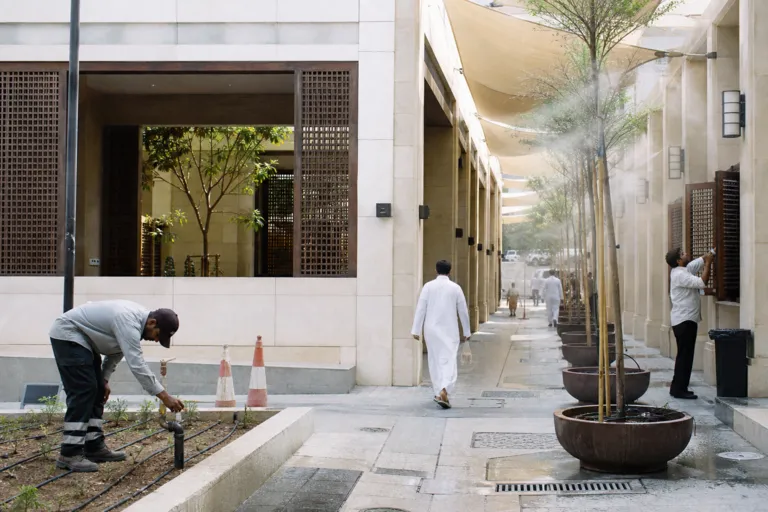
Urban shade is a first-order design move. One urban design report describes “continuous shade” created through trees, canopies, projections and height-to-width ratios, noting that shaded streets can function again as active public spaces even in peak heat. Buildings also need transitional spaces and buffer zones. Patios, ventilated atriums and open lobbies create gradual transitions between outdoor heat and indoor cooling, reducing thermal shock, and they connect back to hot-climate traditions such as internal courtyards in North Africa and the Middle East. These are spatial tools that can reduce reliance on sealed, fully conditioned interiors.
Natural ventilation is treated as a core material, not an afterthought. The same report stresses that wind direction and how a building opens, closes and is positioned determines whether air flows through it or stalls at its envelope—whether it cools or traps heat. UNEP’s pathway complements this with a push toward passive and low-energy approaches, including hybrid cooling using fans with air conditioners that consume little or no power. In parallel, a TIME opinion piece calls for adaptive measures such as green infrastructure, urban and rural cooling projects, and higher building standards, reinforcing that design standards matter when heat becomes the baseline condition.
Planning for extreme heat is also about protecting people who are most at risk. The World Health Organization estimates that heat contributes to roughly half a million deaths worldwide each year, and symptoms can escalate from fatigue to dehydration to heat stroke as the body loses its ability to cool itself. When mechanical cooling fails or is unavailable, public places with air conditioning can serve as cooling centers; one report notes that public libraries often function informally in that role. For passive cooling design Saudi buildings, the design target is not just lower energy use, but safer indoor and outdoor environments that reduce dangerous exposure when systems strain.
What does “passive cooling design Saudi buildings” focus on first?
Why can’t cities rely only on air conditioning for extreme heat?
Which public-space strategies help in peak heat?
How do buffer zones reduce indoor cooling stress?
What is the health case for better heat design?
Talk to us for your needs in:
-
Sustainable Construction Solutions
-
Strategic Construction Planning
-
Customer-Centric Construction Services
-
Operational Excellence in Construction
-
Leadership and Change Management for Construction
-
Digital Transformation in Construction
-
Saudi Construction Market Research
-
In-Depth Market Study for Construction
-
Market Intelligence and Insights in Construction
-
Feasibility Study and Assessment in Construction
-
Saudi Construction Benchmarking