After 2026’s extremes, project teams in Saudi Arabia cannot treat physical hazards as a distant risk register item. Market signals point to faster decision cycles. One industry forecast projects the climate risk management market in Saudi Arabia to grow at a CAGR of 11% from 2026 to 2035, citing Vision 2030-driven investment across infrastructure, energy, and urban development and pressure from extreme heat, water shortages, and desertification. Another Saudi-focused forecast estimates the market reaching USD 254.7 million in 2026 and USD 2,116.4 million by 2035 at a 26.5% CAGR. The same source highlights dominant physical risks in the Kingdom, including extreme heat, dust storms, and water scarcity, and expects risk assessment and analysis to lead solution adoption.
For business cases, the practical shift is that physical climate risk is being priced now, not later. The MSCI Institute’s 2025 Corporate Resilience Survey reported that 94% of companies conduct site-specific physical risk assessments, yet 68% focus on short-term horizons of 2–5 years rather than long-term capital planning. Over 80% of companies reported direct impacts from extreme weather in the last five years. The same analysis argues that organizations should screen facilities against current climate projections, not historical insurance loss data, because a 10-year horizon sits inside the depreciation and financing horizon of many capital investments. For Saudi construction and infrastructure projects, that logic pushes physical risk from “nice to have” into an investability requirement.
Insurance Repricing Makes Heat and Flood a CFO Problem
Insurance pricing is another channel that forces physical risk into the numbers. A 2026 insurance-pricing analysis reports property insurance premiums in certain high-risk zones have increased 30–50% or more over the past 2–3 years, attributing the increases to forward-looking climate risk assessment rather than historical loss experience. The same source explains that models incorporate downscaled global circulation model outputs and that climate-adjusted catastrophe models are showing higher projected losses in exposed geographies than historical models suggested, including flood models showing increased frequency of 100-year and 500-year events in coastal zones. Even though those figures are not Saudi-specific, they illustrate a mechanism Saudi project owners can expect to encounter through globally active carriers, reinsurers, lenders, and model-driven underwriting.
That mechanism matters because physical risk is already the largest addressed category in climate risk management. One market analysis states the physical risk segment held 46% share in 2025 and is expected to grow at a CAGR of over 15% from 2026 to 2035, linking growth to an increasing number of extreme weather events and larger financial hits to infrastructure owners and governments. Another report puts physical risks at 44.81% share in 2026, emphasizing that boards, insurers, and regulators prioritize physical risks because they generate immediate, measurable losses, such as asset value repricing when flood risk changes and unplanned capital expenditure when extreme weather damages critical assets. For Saudi project business cases, this reinforces why heat and flood exposure must be quantified at asset level, not handled as generic narrative.
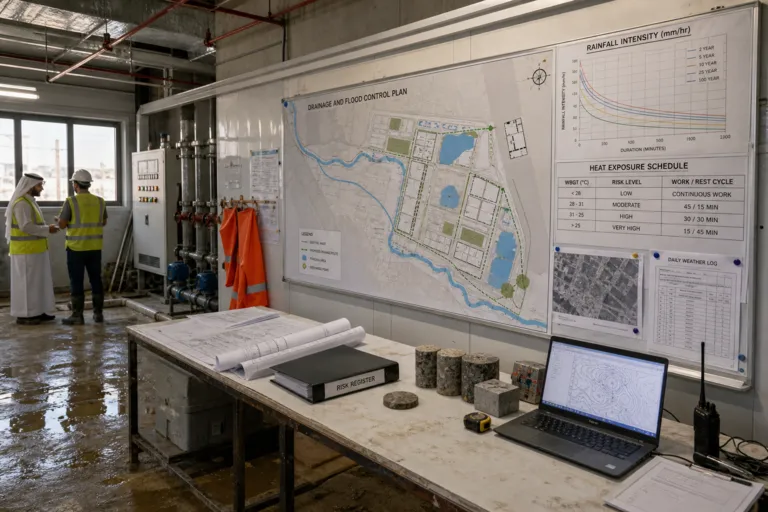
A useful way to operationalize this is to start with a clear taxonomy and then connect it to design and procurement. A climate risk assessment guide distinguishes physical risks as direct impacts on assets, operations, and supply chains, and splits them into acute event-driven risks such as floods and extreme heat events. It also notes that a single acute event can have outsized financial consequences. In practice, insurance-focused guidance points to measures like elevated mechanical systems, flood barriers, pumping capacity for flood exposure, and cooling systems and worker protections for heat exposure, alongside risk-transfer options such as parametric insurance or captives. For teams building climate risk assessment for construction projects in Saudi Arabia, the business case becomes stronger when these measures are translated into capex choices, coverage terms, and operational continuity assumptions.
Why should Saudi project business cases include physical climate-risk assessment after 2026?
What do the market-share figures say about physical risk versus other climate risks?
How is insurance pricing connected to climate risk assessment?
What horizon problem shows up in many corporate physical risk assessments?
How should teams structure climate risk assessment for construction projects in Saudi Arabia?
Talk to us for your needs in:
-
Sustainable Construction Solutions
-
Strategic Construction Planning
-
Customer-Centric Construction Services
-
Operational Excellence in Construction
-
Leadership and Change Management for Construction
-
Digital Transformation in Construction
-
Saudi Construction Market Research
-
In-Depth Market Study for Construction
-
Market Intelligence and Insights in Construction
-
Feasibility Study and Assessment in Construction
-
Saudi Construction Benchmarking