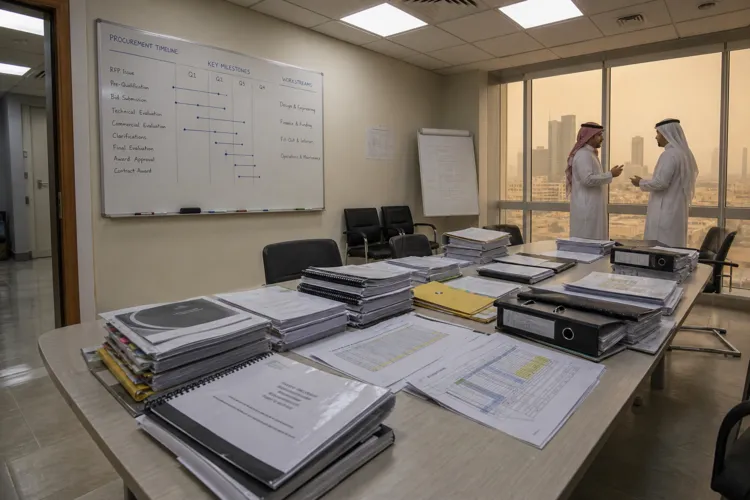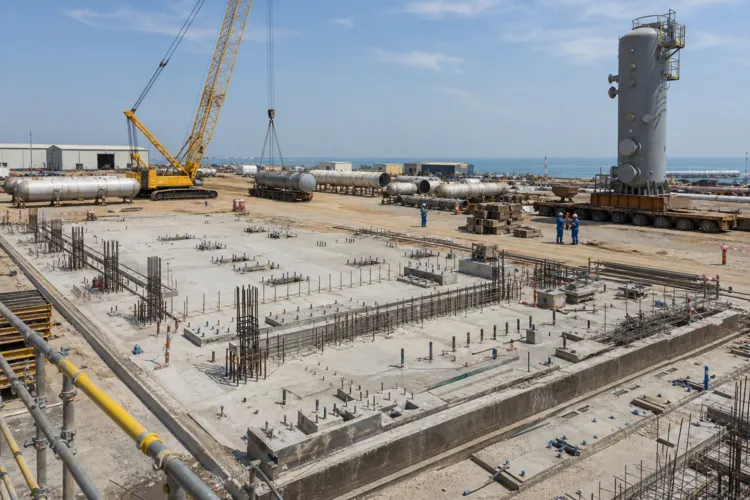
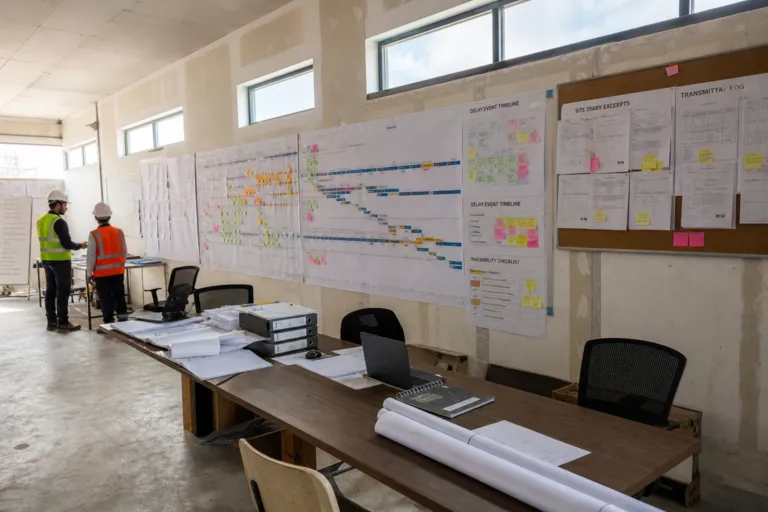
Saudi Arabia’s construction sector is expanding across transport, housing, renewable energy, healthcare, education, and industrial development under Vision 2030. In that environment, the schedule becomes the backbone of dispute readiness because delay analysis is ultimately about proving causation from the contemporaneous record. A forensic schedule analysis examines schedule submissions and updates, daily logs, correspondence, pay applications, and change orders to identify the critical drivers of delay, quantify magnitude, and apportion responsibility. That same discipline is now being augmented by AI tools that can process large volumes of schedule and document data faster, while still requiring an expert to build a defensible narrative that can withstand adversarial scrutiny.
Market activity adds pressure to get this right. One market outlook values Saudi Arabia’s construction market at USD 101.4 billion in 2025 and expects it to reach USD 138.4 billion at a CAGR of 3.52% during 2026–2034. It also describes an acceleration phase in 2026–2028, followed by stabilization in 2029–2031 and maturity in 2032–2034. On large programs, the workload behind traditional retrospective delay analysis can be heavy, especially where hundreds of schedule updates exist. That is the gap AI-assisted schedule forensics aims to narrow by automating repetitive comparisons, so analysts can spend more time on entitlement logic and evidentiary support.
AI-Assisted Schedule Forensics: Speed Without Losing Defensibility
AI delay analysis software is often discussed as if it is one thing, but sources distinguish two modes with different purposes. Predictive tools read live project inputs such as updated schedules, weather feeds, resource allocation logs, and RFI turnaround times, then assign probability scores to future delay events. Forensic tools are different. They help analysts process large schedule datasets by automating the mechanical work: comparing baseline versions, identifying critical path shifts, and tagging concurrent delays. These accelerators support established approaches like Time Impact Analysis (TIA) and Windows Analysis, but they do not replace the delay expert who must connect schedule mechanics to the documentary record and contractual entitlement.
Governance is the central risk as AI enters disputes work. Forensic schedule analysis must be traceable, explainable, and reproducible because it can underpin multimillion-dollar claims and face deposition, arbitration, and trial. AACE International has acknowledged that “there are no RPs for analytics methods at this time (e.g., machine learning and artificial intelligence)” while also noting that “there are commercial applications on the market.” That tension encourages a practical rule: do not build a black box. If an AI system suggests a cause of delay, the analyst still needs a “glass house” workflow where every step can be explained, verified against underlying data, and reproduced under scrutiny.
Adoption momentum is also visible outside construction, which matters because claims teams often overlap with legal workflows. The Thomson Reuters 2025 Generative AI in Professional Services Report reports active AI use among legal organizations rising from 14% in 2024 to 26% in 2025. In parallel, several adjacent professions have published AI governance frameworks, including the Academy of Experts (2026), the Chartered Institute of Arbitrators (2025), the SVAMC (2024), and the AICPA (2025), emphasizing human accountability and non-delegation of decision-making. In practice, teams pursuing AI delay analysis for construction claims in Saudi Arabia can use AI to accelerate schedule parsing and comparison, while keeping the expert responsible for methodology, causation logic, and the narrative supported by contemporaneous records.
What records should support a defensible construction delay claim?
How is predictive AI delay analysis different from forensic schedule analysis?
Why can’t AI be a “black box” in forensic schedule analysis?
What is the market context for AI-assisted delay work in Saudi Arabia?
How can AI delay analysis support construction claims work in Saudi Arabia without replacing experts?
Talk to us for your needs in:
-
Sustainable Construction Solutions
-
Strategic Construction Planning
-
Customer-Centric Construction Services
-
Operational Excellence in Construction
-
Leadership and Change Management for Construction
-
Digital Transformation in Construction
-
Saudi Construction Market Research
-
In-Depth Market Study for Construction
-
Market Intelligence and Insights in Construction
-
Feasibility Study and Assessment in Construction
-
Saudi Construction Benchmarking