When multiple mega-pours are scheduled at the same time, the tightest constraint is often not mix design. It is throughput and dispatch reliability. For teams thinking about ready mix concrete capacity in Saudi Arabia in 2026, the most usable reference points in the available sources are global and regional signals about how the industry is structuring production and deliveries under pressure. Mordor Intelligence sizes the global ready-mix concrete market at 5.83 billion cubic meters in 2026, up from 5.56 billion cubic meters in 2025, and projects 7.36 billion cubic meters by 2031 with a 4.78% CAGR for 2026–2031. Those volumes do not describe Saudi Arabia specifically, but they underline a simple point: demand growth amplifies the value of disciplined batching and fleet control.
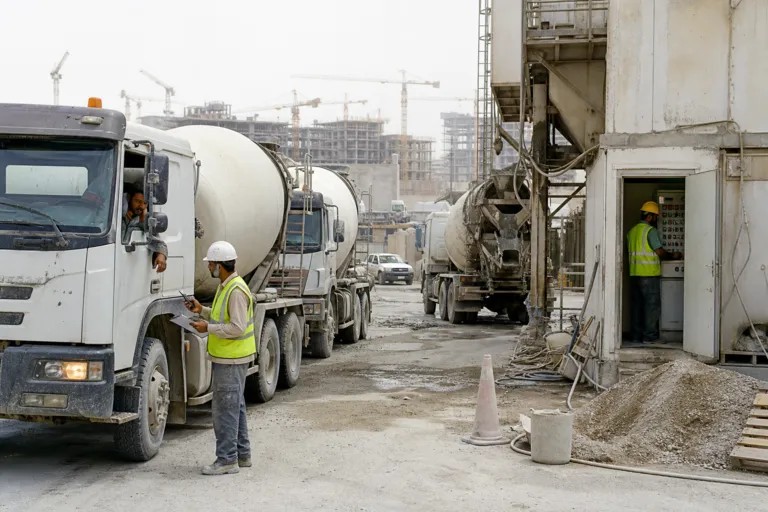
Mixing mode choices also matter when schedules are stacked. Fortune Business Insights reports that, in the overall market, the transit mix segment held 45.40% share in 2026 and is expected to keep a dominant position. Mordor Intelligence, using a different segmentation, states transit mixed concrete led with 73.22% market share in 2025. Future Market Insights adds a delivery lens: barrel trucks (in-transit mixers) have a 35% share as the dominant delivery mechanism, supporting centralized quality control before dispatch. Together, these figures frame why large pours tend to lean on fleet-based delivery. FMI explicitly links large-scale infrastructure work to the “massive, continuous pour capabilities” that only coordinated fleets can provide.
Batching Capacity Meets the Clock: What “On-Time” Requires
On giga-project days, capacity is not just cubic meters per hour. It is the ability to keep every truck inside a workable-time window. Mordor’s global report points to contract language that penalizes deliveries exceeding a 90-minute window, and it notes that Massachusetts mandates self-consolidating mixes remain workable for only 60 minutes. Those examples are not Saudi rules, but they illustrate how owners can compress the logistics margin until queuing discipline becomes a performance metric. In North America, Mordor reports that producers using AI-optimized truck queuing and automated batching boosted on-time delivery above 96%. It also reports cloud-based dispatch platforms delivering up to 15% improvement in truck utilization and 20% lower material waste through real-time slump monitoring and predictive batching algorithms.
Plant-side output still sets the ceiling. Fortune cites a specific commissioning example: Shree Cement introduced Bangur Concrete and commissioned its first Greenfield RMC plant in Hyderabad with a production capacity of 90 cubic meters per hour. Market Research Future adds an investment perspective on capacity bands, projecting that the ready-mix concrete batching plant market revenue for the 60 m3/h segment will reach USD 4.2 billion by 2032, growing at a 4.5% CAGR. MRFR also notes the market split by capacity into 60 m3/h and >60 m3/h and highlights the integration of AI and IoT for remote monitoring and optimization, plus growing use of mobile batching plants for flexibility and time-sensitive projects.
For simultaneous pours, the operational playbook becomes a layered system: choose a mixing and delivery approach suited to continuous placement, then harden dispatch with telemetry and real-time quality checks. Mordor’s North America report also flags central-mixed concrete as favored for mega-volume pours where homogeneous quality is critical, while FMI explains why volumetric mixers are gaining traction for niche work where precise small batches reduce waste. IndexBox describes the decade from 2026 to 2035 as shaped by technological adoption in batching and logistics and digital integration for supply chain efficiency. In practice, that means capacity planning is inseparable from routing, queue control, and the data needed to keep loads accepted rather than rejected.
What do the sources say about the 2026 global ready-mix concrete market volume?
Which mix type leads in the sources, and why does it matter for simultaneous pours?
What delivery-window constraints are mentioned, and how do they affect logistics planning?
What batching-plant capacity figures appear in the sources?
How should teams think about ready mix concrete capacity in Saudi Arabia for 2026 using these sources?
Talk to us for your needs in:
-
Sustainable Construction Solutions
-
Strategic Construction Planning
-
Customer-Centric Construction Services
-
Operational Excellence in Construction
-
Leadership and Change Management for Construction
-
Digital Transformation in Construction
-
Saudi Construction Market Research
-
In-Depth Market Study for Construction
-
Market Intelligence and Insights in Construction
-
Feasibility Study and Assessment in Construction
-
Saudi Construction Benchmarking