Saudi Arabia’s coastal cities—Jeddah on the Red Sea and Dammam, Al Khobar, and Jubail on the Arabian Gulf—present a severe corrosion challenge for construction materials. Salt-laden air, high humidity, saline groundwater, and tidal flooding accelerate the corrosion of metals and the deterioration of concrete structures. When chloride ions penetrate concrete and reach reinforcing steel, corrosion can progress invisibly until cracking or spalling appears. For coastal corrosion protection of reinforced concrete in Saudi Arabia, design choices cannot be treated as a cosmetic add-on. They shape durability, maintenance burden, and long-term performance in aggressive coastal and sabkha-like environments.
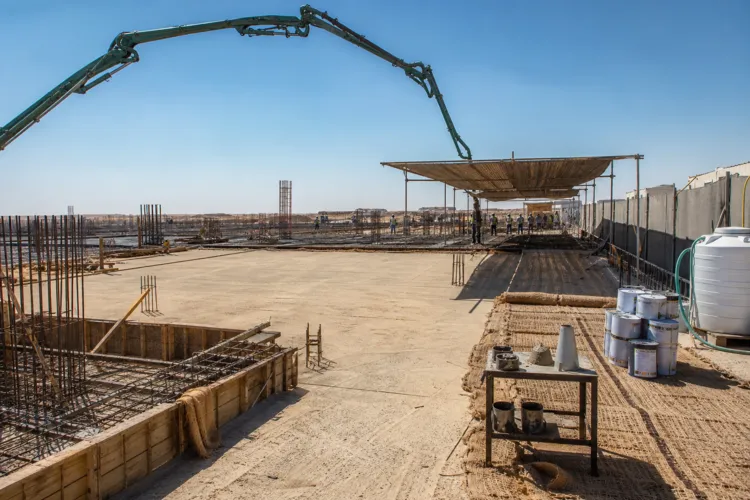
Start with the concrete itself. Dense, low-porosity concrete with a water-cement ratio below 0.40 is specified as a way to significantly reduce chloride penetration. Concrete cover also matters. In severe exposure environments, adequate cover over reinforcement is noted as a minimum 50 mm. For existing concrete facades, silane/siloxane water repellent treatments are highlighted for reducing moisture absorption and chloride penetration. These steps work together by slowing the transport of moisture and salts. They also buy time before chlorides accumulate at the steel level, where corrosion can otherwise begin behind the cover.
Coatings, Rebar Choices, and Standards That Drive Better Outcomes
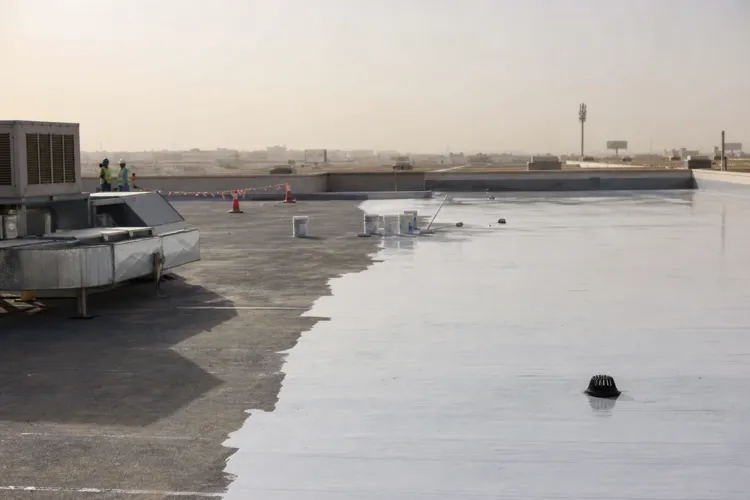
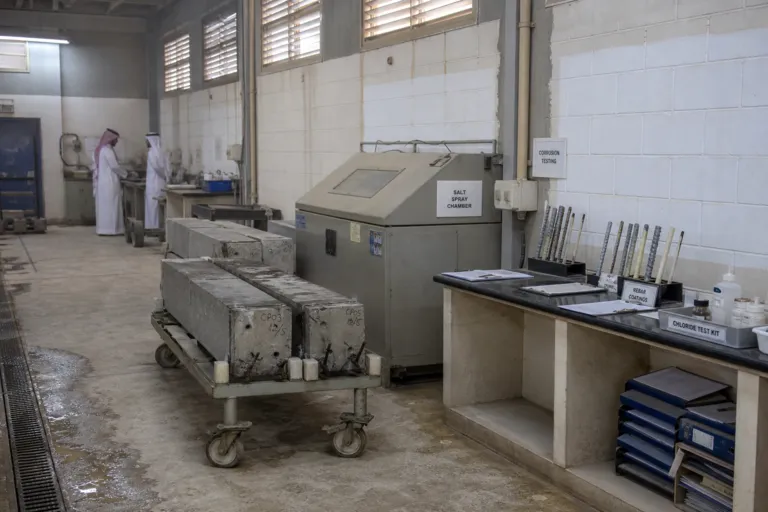
Reinforcement selection and protective systems can raise durability when exposure is harsh. Standard black steel rebar is described as corroding rapidly in chloride-rich coastal environments. Epoxy-coated rebar provides a physical barrier against chloride ingress, extending structural life significantly. Where durability demands are highest—such as waterfront structures, bridges, and desalination plants—duplex stainless steel or AISI 304/316 stainless steel rebar may be specified. Protective coatings also matter beyond the rebar. Saudi Standards, Metrology and Quality Organization (SASO) Standard SASO 2863:2022 mandates performance requirements for corrosion-protective coatings used on steel structures in infrastructure projects, including compliance testing for adhesion, thickness, and salt spray resistance with minimum thresholds of 5% adhesion loss and 1000-hour durability.
Market signals reinforce how central corrosion control has become. One Saudi Arabia-specific estimate places corrosion-related costs at more than USD 1.1 billion annually across sectors including oil and gas, construction, and transportation. On the supply side, Ken Research values the Saudi Arabia corrosion protection coating market at USD 725 million. In a narrower category, Grand View Research reports Saudi Arabia’s corrosion protective coatings market revenue of USD 0.6 million in 2025, expected to reach USD 0.9 million by 2033, with a 5.16% CAGR from 2026 to 2033. It also reports solvent-borne as the largest product segment in 2025 with an 83.33% revenue share, while powder coatings are forecast as the fastest-growing segment. Separately, Future Market Insights forecasts Saudi Arabia’s corrosion protection coatings and acid proof lining market at a 7.9% CAGR from 2026 to 2036, tying higher corrosion risk to coastal locations with high humidity and salt exposure.
Execution details finish the job. For external metalwork in coastal Saudi cities, specified options include marine-grade aluminium alloys (6000 or 5000 series), hot-dip galvanized steel with a minimum 85 micron zinc coating, or stainless steel grade 316. Where cladding is used, PVDF-coated aluminium composite panels are described as maintaining appearance and protecting against corrosion better than painted finishes in coastal salt environments. At the project level, ISO 12944 is referenced as the international standard that classifies atmospheric exposure into six corrosivity categories, from C1 (heated indoor spaces) through CX (extreme offshore conditions). Together, these choices create a layered defense that matches the reality of salt, moisture, and chloride-driven damage in Saudi coastal construction.
Why do Saudi coastal cities create a severe corrosion environment for reinforced concrete?
What mix and detailing choices help limit chloride penetration in coastal reinforced concrete?
What reinforcement options are cited for high-durability coastal structures in Saudi Arabia?
Which Saudi standard sets requirements for corrosion-protective coatings on steel structures?
What do the sources say about the Saudi market context for coastal corrosion protection in reinforced concrete?
Talk to us for your needs in:
-
Sustainable Construction Solutions
-
Strategic Construction Planning
-
Customer-Centric Construction Services
-
Operational Excellence in Construction
-
Leadership and Change Management for Construction
-
Digital Transformation in Construction
-
Saudi Construction Market Research
-
In-Depth Market Study for Construction
-
Market Intelligence and Insights in Construction
-
Feasibility Study and Assessment in Construction
-
Saudi Construction Benchmarking