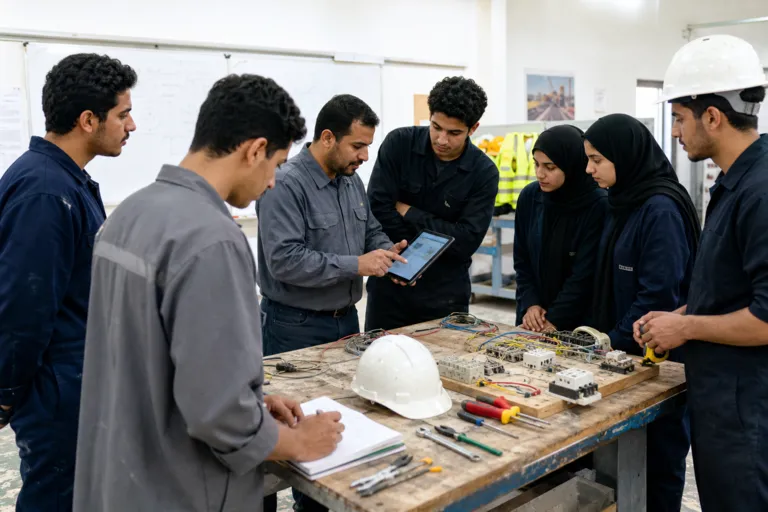
Saudi construction training academies 2026 are being discussed as a direct response to a changing workforce reality. In Jeddah, the Red Sea Development and Training Forum gathered more than 250 officials, experts, and academics under the theme “Building People, Empowering Capabilities, and Creating Impact.” The forum positioned training as a strategic driver of development, not a traditional activity. Discussions also highlighted Saudization as a key driver reshaping the training ecosystem, with a stronger link between skills development and employment pathways for Saudi graduates. This framing matters when projects become larger, more complex, and more schedule-sensitive.
A key theme for construction readiness is digital delivery. Gulf Business Solution (GBS) stated it has trained and certified over 60 Saudi engineering professionals in advanced digital project delivery workflows. The training included hands-on expertise in Autodesk Construction Cloud (ACC), Revit, AutoCAD, and Navisworks. GBS linked this enablement to building a digitally skilled talent pool capable of delivering megaprojects with efficiency and accuracy. For high-stakes builds, this kind of workflow capability can reduce friction between design, coordination, and site delivery, because teams share connected BIM workflows and common tools.
Training ecosystems also need repeatable delivery models. A useful reference point appears in the UK, where Hercules launched an infrastructure skills academy in February last year to ease skills shortages hampering major infrastructure and construction projects. The academy aimed to train up to 400 new entrants in its first year, but trained 1,100 students within its first 12 months. Hercules also said it will have trained 2,000 students by the end of that calendar year. The Saudi context is different, but the operational lesson is transferable: clear targets, scaled throughput, and fast onboarding can help projects avoid labour pinch points.
What “Academy-Ready” Training Looks Like in 2026
Beyond technical construction skills, talent development capacity is expanding through learning platforms and credential pathways. ATD Saudi Arabia described eight years of bringing learning experiences to Saudi Arabia and positioned its conference as part of the Kingdom’s learning and development landscape. The 2025 conference included ATD Certificate Programs and a first-of-its-kind AI in Talent Development Workshop developed with Arizona State University (USA). While not construction-specific, these structures signal a broader move toward formalized credentials, modern training methods, and organizational development. Construction academies can borrow this approach by blending field skills with recognized learning pathways.
Sector training examples also show how specialized academies can support national priorities. At the Future Minerals Forum (FMF) program in Riyadh held from 13-15 January, the number of locally operating mining companies was reported to have jumped from six in 2019 to more than 150 now. Exploration expenditure in Saudi Arabia reached up to SAR$1.33 billion ($530.34 million) between 2019 and 2023. The same coverage noted programs such as the Saudi Mining Polytechnic and the Institute of Mineral Resources Advanced Training (IMRT). This matters for construction because large builds need adjacent supply chains, and training models in one sector can inform academy design in another.
Large event-led infrastructure programs raise the stakes for skills planning. Consultancy commentary noted construction on 15 new smart stadiums is underway in Saudi Arabia, framed within a period where the Kingdom will host major sports events including the FIFA World Cup 2034 and the Asian Games 2034. It also reported participation rates rising from 13% of the population exercising regularly in 2015 to 50% today, with female participation growing 400% in the same period. For Saudi construction training academies 2026, the takeaway is simple: build training capacity that matches delivery complexity, embeds digital workflows, and connects skills to employment outcomes.
What does “Saudi construction training academies 2026” mean in practice?
What evidence is there that digital construction training is happening in Saudi Arabia?
Is there an example of training scale-up that construction academies can learn from?
What signals a broader shift toward skills-based workforce development in Saudi Arabia?
How do other sector academies relate to construction skills needs?
Talk to us for your needs in:
-
Sustainable Construction Solutions
-
Strategic Construction Planning
-
Customer-Centric Construction Services
-
Operational Excellence in Construction
-
Leadership and Change Management for Construction
-
Digital Transformation in Construction
-
Saudi Construction Market Research
-
In-Depth Market Study for Construction
-
Market Intelligence and Insights in Construction
-
Feasibility Study and Assessment in Construction
-
Saudi Construction Benchmarking