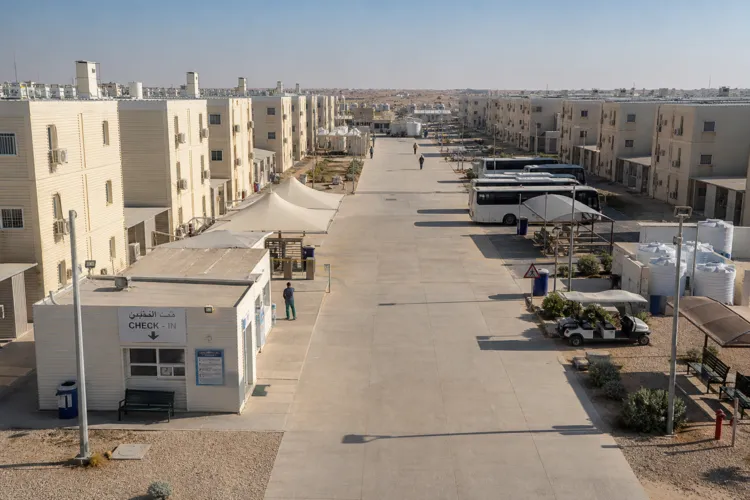
Remote construction camps and project yards need dependable electricity for day-to-day operations. When grid access is limited, diesel generators tend to fill the gap. But the direction of travel in the Kingdom is clear. Saudi Arabia installed around 7.8 GW of solar in 2025, according to GlobalData, taking cumulative solar capacity from 4,665 MW at the end of 2024 to an estimated 12,465 MW by the end of 2025. With total renewables capacity standing at around 13 GW, solar is described as the dominant form of renewables in the country. That expansion supports practical, on-the-ground applications that can reduce generator hours, especially where fuel logistics are costly and maintenance burdens are high.
Saudi procurement activity also shows the scale and pace behind new clean power. Saudi Arabia awarded one wind project and four solar projects worth a total estimated investment of $2.4 billion (9 billion Saudi riyals). The five projects total 4.5 GW of capacity as part of the sixth phase of the National Renewable Energy Program, according to the official Saudi Press Agency as reported by OilPrice. A key takeaway for contractors is not the grid-side detail, but the signal: large volumes are being contracted and priced aggressively. A reported example is the 1.4-GW Najran Solar Energy Project with an LCOE of 1.09682 U.S cents per kWh, described as the second-lowest in the world for solar electricity generation cost, following the Shuaiba 1 Project in the Kingdom.
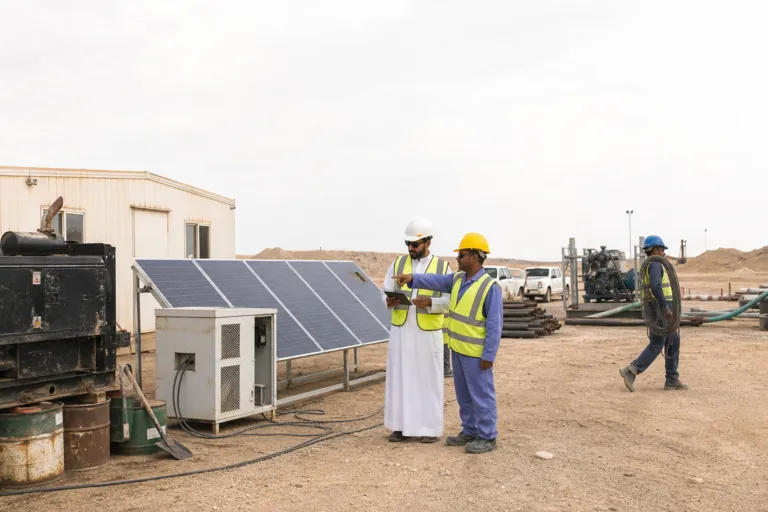
Those market signals connect to a straightforward jobsite logic: use solar to displace diesel wherever possible, especially in remote setups. CleanTechnica describes a remote site that historically required diesel generators because it was not connected to the grid. With solar energy and battery storage, it can operate with reliable, emissions-free electricity, eliminating dependence on diesel fuel, generator maintenance, and recurring costs and pollution from fossil-based backup power. The geography in that example is outside Saudi Arabia, but the operational pattern is familiar to any remote camp: if the site is off-grid, a solar-plus-storage microgrid can replace or sharply reduce generator reliance.
What Diesel-Displacement Looks Like in Saudi Projects
Saudi-based examples of diesel replacement reinforce the economics. NUUKO POWER announced the successful completion of a 4.58 MW solar-powered water pump project for REEF AL ARED in Riyadh, Saudi Arabia. The release states that by replacing traditional diesel-powered irrigation systems with clean solar energy, the project is expected to save around 1.76 million Saudi Riyals in annual operating costs and reduce carbon emissions by thousands of tons per year. Construction sites are not irrigation fields, but many remote yards share similar load types: pumps, lighting, and routine power demand. The point is the same: if diesel is currently the default energy source, solar can directly displace it and deliver measurable operating cost savings.
At a national level, the economic rationale for shifting to renewables is also being debated openly. Juan Cole reports that about 38% of Saudi power plants use petroleum and 62% of electricity generation is done by domestically produced fossil gas. He adds that in a recent year Saudi Arabia lost $11 billion on energy generation, and demand is increasing 10% a year. For construction, that context matters because jobsite power strategies sit inside a broader system under pressure to add new supply and improve economics. Site-level solar can help reduce local diesel consumption, while aligning projects with the Kingdom’s wider pivot toward wind and solar.
Planning for construction site solar power Saudi Arabia is easier when you translate national momentum into practical deployment: containerized energy storage, modular solar arrays, and hybrid controls that prioritize solar and use diesel as a backup. PV Magazine notes GlobalData expects around 5.2 GW of solar to be added in 2026 and 9.6 GW in 2027, taking cumulative capacity to 27.3 GW by the end of 2027. PV Magazine India also reports Saudi Power Procurement Company signed five solar PPAs totaling 12 GW and two wind PPAs totaling 3 GW, with projects scheduled to be operational across 2027 and 2028. For contractors, that pipeline supports a simple conclusion: the ecosystem for solar is getting larger, which helps normalize solar-backed power as a default option for remote camps and project yards.
What does "construction site solar power Saudi Arabia" mean in practice?
Is there proof in Saudi Arabia that solar can replace diesel-powered systems?
How fast is Saudi solar capacity growing?
What are Saudi’s near-term solar forecasts mentioned in the sources?
Why is reducing diesel use aligned with Saudi Arabia’s broader energy direction?
Talk to us for your needs in:
-
Sustainable Construction Solutions
-
Strategic Construction Planning
-
Customer-Centric Construction Services
-
Operational Excellence in Construction
-
Leadership and Change Management for Construction
-
Digital Transformation in Construction
-
Saudi Construction Market Research
-
In-Depth Market Study for Construction
-
Market Intelligence and Insights in Construction
-
Feasibility Study and Assessment in Construction
-
Saudi Construction Benchmarking