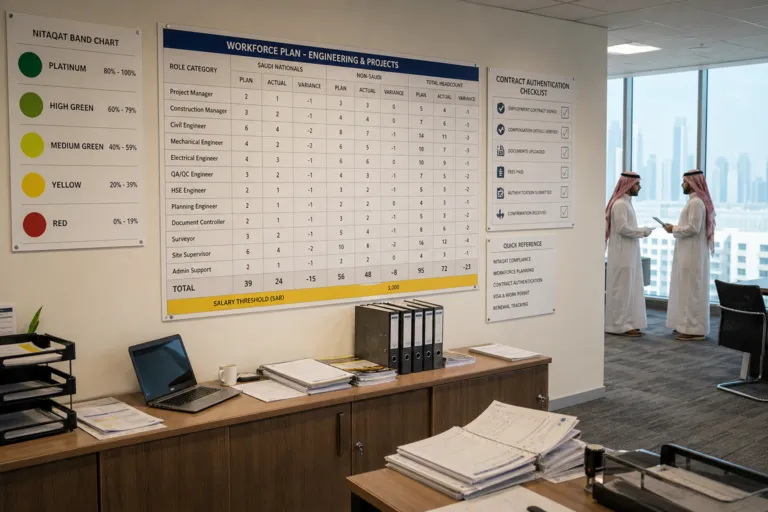
Saudi Arabia’s consultant staffing models are being forced to change as profession-level localization becomes less flexible and more auditable. The Ministry of Human Resources and Social Development (HRSD) increased the Saudization target in engineering professions to 30% and raised the minimum wage to SAR 8,000 in the private and non-profit sectors, effective December 31, 2025. Implementation is set to begin six months after issuance, starting June 30, 2026. For consulting firms supporting construction and industrial projects, this pushes workforce planning away from broad headcount tactics and toward role-by-role compliance across covered engineering jobs.
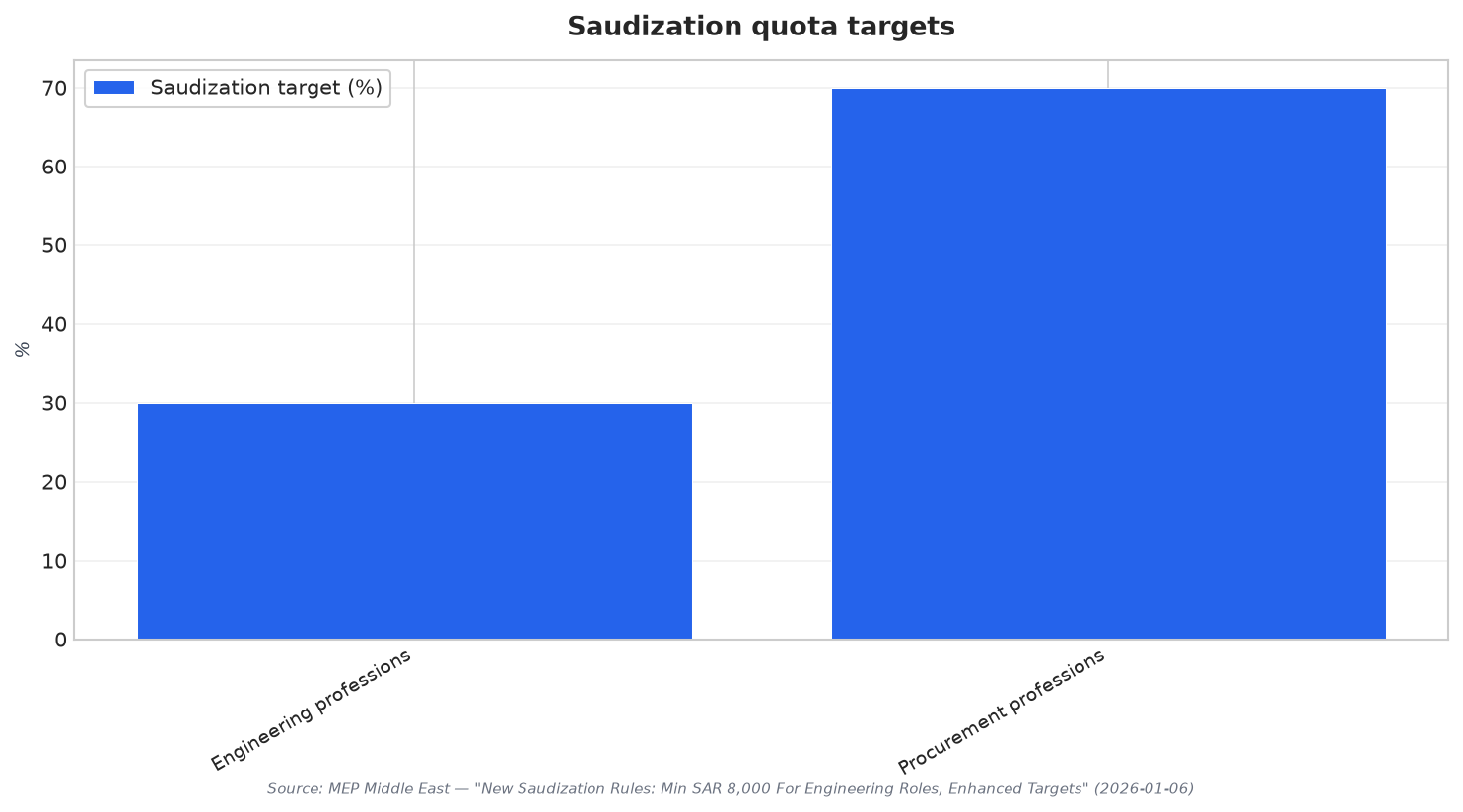
The rule is not only a percentage target. It also defines who counts. Motaded’s compliance guide states that, to be counted toward the 30% engineering requirement, a Saudi engineer’s salary registered in GOSI must not be less than SAR 8,000. The same source notes the scope applies to private and non-profit organizations employing five or more engineers in targeted roles, and that the decree covers 46 specialized engineering roles. This combination alters consultant resourcing on live assignments: a firm can no longer rely on hiring Saudis into engineering titles at any pay band and assume the quota is satisfied.
Why the “Counts Toward Quota” Test Is Now a Staffing Gate
Compliance is increasingly tied to digital verification, which changes how quickly a consultant can mobilize. Watily’s Nitaqat 2026 guide says Qiwa electronic contract authentication became mandatory effective April 15, 2026, and a Saudi employee does not count toward a company’s Saudization percentage if the contract is not authenticated on Qiwa; GOSI registration alone is no longer sufficient. The same guide also states that engineering professions require SAR 8,000 per month, and underpaid Saudi staff do not count toward quota regardless of contract status. In practice, staffing teams must align offer letters, payroll, and Qiwa documentation before they can claim compliance in a bid or audit.
Risk has also become more immediate because enforcement frameworks are tightening. The GCC Edge reports that in Saudi Arabia the Nitaqat Mutawar cycle runs through 2028, and the Yellow compliance tier has been removed, placing non-compliant establishments directly into the Red tier. Red tier classification triggers operational restrictions, including freezes on new foreign work permits, blocks on employment visa renewals, and exclusion from bidding on government contracts through the Etimad platform. Watily likewise notes the Yellow tier has been abolished and companies previously classified as Yellow are automatically reclassified as Red. For consultancies that depend on expatriate mobility to deliver engineering services, these controls turn quota gaps into direct delivery and commercial risks.
Consulting leaders are also being pushed into more deliberate organizational design. SGC Consulting notes that engineering businesses with at least five engineers face an increased Saudization rate to 30 percent, and that minimum salary thresholds apply for Saudis to count toward certain profession quotas. It adds that the general minimum monthly wage for a Saudi national to count at full weight has increased to SAR 4,000, and Saudis earning below SAR 4,000 count as only 0.5 toward the Nitaqat ratio. In the new environment, the engineering Saudization 30 percent quota construction teams plan around is not just hiring volume; it is salary structure, contract authentication, and role coverage, all tied to whether the firm can keep bidding and mobilizing at pace.
What is the new Saudization requirement for engineering professions in Saudi Arabia?
How does the SAR 8,000 rule affect whether a Saudi engineer counts toward the quota?
Which companies are in scope for the 30% engineering quota?
What role does Qiwa play in Saudization compliance for consultants?
How are engineering Saudization quotas reshaping construction consultant staffing strategies?
Talk to us for your needs in:
-
Sustainable Construction Solutions
-
Strategic Construction Planning
-
Customer-Centric Construction Services
-
Operational Excellence in Construction
-
Leadership and Change Management for Construction
-
Digital Transformation in Construction
-
Saudi Construction Market Research
-
In-Depth Market Study for Construction
-
Market Intelligence and Insights in Construction
-
Feasibility Study and Assessment in Construction
-
Saudi Construction Benchmarking