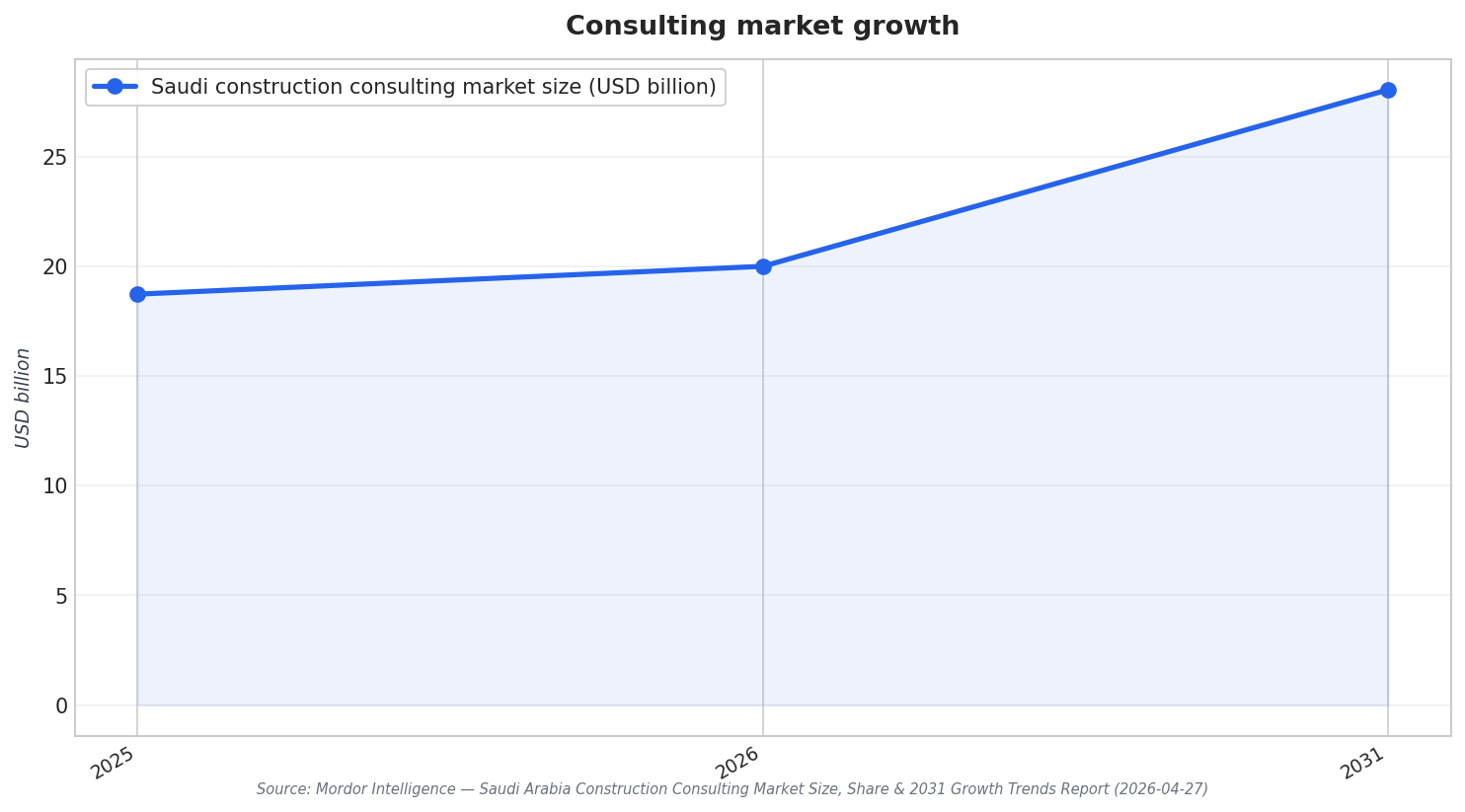
Saudi Arabia’s giga-project delivery challenge in 2026 is not only about capital and contracting. It is also about people and governance. A PMI Global Talent Gap analysis reported via Gulf Pulse projects Saudi Arabia will need around 438,000 project-management specialists by 2035, with demand growth of about 45.9%. That context helps explain why sourcing project controls and commissioning managers is becoming a board-level issue. At the same time, advisory demand is growing. Mordor Intelligence projects the Saudi Arabia construction consulting market at USD 20 billion in 2026, with a path to USD 28.05 billion by 2031 at a CAGR of 7% (2026 to 2031).
The scale of work intensifies the talent squeeze. Mordor Intelligence describes a USD 600 billion giga-project pipeline under Vision 2030, and notes that restructuring at NEOM redirected budgets from The Line to revenue-generating assets such as Sindalah, Oxagon, and Trojena. This kind of recalibration changes staffing demand rather than reducing it, because sequencing still requires rigorous controls, cost forecasting, and progress reporting. The same report also points to Saudization quotas and BIM-driven digital-twin requirements reshaping priorities. That combination makes experienced project controls specialists, BIM-aware planners, and commissioning leaders harder to replace quickly.
Sourcing Strategy: Build Governance First, Then Scale Capability
When organizations cannot hire fast enough, the fastest route to early control is often a service-led PMO setup. A practical guide to PMO setup in Saudi Arabia argues that PMO-as-a-service can be a faster, lower-risk route when an entity needs delivery control quickly or lacks senior PMO capability internally. It also warns, via secondary sources summarized by pmo365 citing Gartner and APM, that roughly half of PMOs are closed within about three years, commonly due to unclear remit, weak sponsorship, or becoming an administrative burden. That is a useful hiring signal: candidates for project controls and commissioning roles will favor environments where mandate, governance, and decision rights are explicit.
Saudi Arabia’s national delivery model also shapes how leaders should recruit and retain scarce capability. The same PMO guide describes a multi-tier structure, with CEDA at the apex, the Strategic Management Office coordinating cross-government cascade, Adaa providing independent performance measurement, and a Vision Realization Office (VRO) inside each ministry executing and reporting upward. For delivery teams on giga-projects, this implies higher expectations for portfolio truth, standardized reporting, and cross-entity escalation paths. In practical sourcing terms, that favors project controls professionals who can operate in structured governance and produce decision-grade information across multiple stakeholders.
Digital reporting and tooling can reduce friction, but they do not erase the talent constraint. Mordor Intelligence values the project management software systems market at USD 11.27 billion in 2026 and forecasts USD 23.09 billion by 2031 at a 15.42% CAGR. The same source notes that construction projects using AI cost tracking save 5–10% on materials by intercepting errors, with early deployments in North America and Europe because data quality and analytics talent are prerequisites. Saudi Arabia’s broader talent picture reinforces that point: Technavio reports that a shortage of specialized technical professionals leads to project delays in over 35% of large-scale digital initiatives in Saudi Arabia, increasing reliance on external consultants. For construction project controls talent in Saudi Arabia, the message is clear in 2026: tools help, but owners still need experienced people to set baselines, validate data, and govern changes through commissioning.
Why is there a PMO and project controls talent crunch in Saudi Arabia for 2026 delivery?
What is a practical short-term option when a giga-project cannot hire enough project controls leads?
How should organizations reduce the risk of a PMO failing after it is set up?
How do digital tools affect the need for commissioning and project controls managers?
What does the keyword topic—construction project controls talent in Saudi Arabia—mean for hiring plans?
Talk to us for your needs in:
-
Sustainable Construction Solutions
-
Strategic Construction Planning
-
Customer-Centric Construction Services
-
Operational Excellence in Construction
-
Leadership and Change Management for Construction
-
Digital Transformation in Construction
-
Saudi Construction Market Research
-
In-Depth Market Study for Construction
-
Market Intelligence and Insights in Construction
-
Feasibility Study and Assessment in Construction
-
Saudi Construction Benchmarking