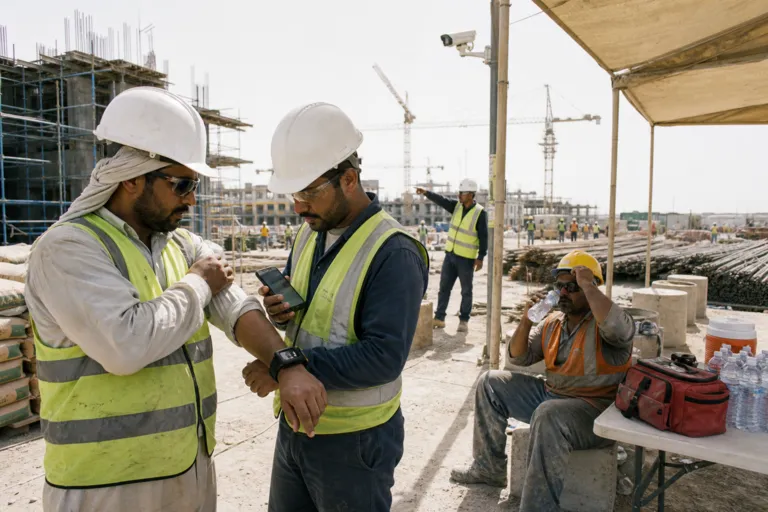
Summer work in Saudi Arabia tests every part of a site operation. Heat exposure can turn routine tasks into urgent safety decisions. That is why connected safety tools are moving from “nice to have” to operational baseline. On one construction site in Saudi Arabia, viAct combined AI video analytics with IoT smart watches to manage large numbers of workers under extreme desert conditions. The connected setup delivered real-time heat stress alerts. The reported outcome was a 63 percent reduction in on-site medical incidents. That is a direct signal that “construction wearables heat stress Saudi Arabia” is shifting from concept to measurable site impact.
The same Saudi deployment also points to a productivity link that many safety programs struggle to prove. With automatic logging of hydration breaks and PPE compliance, the site achieved 95 percent compliance rates. Logging matters because it turns heat policy into auditable behavior. It also supports supervisors who need to pace crews without guessing who has already taken a break. In parallel, research on work performance shows why heat management affects output. A study on indoor environments reported that productivity is correlated with cognitive state and thermal comfort, and that indoor temperature significantly affects these factors.
Why IoT Heat Alerts Change Decisions Before Symptoms
Heat wearables become more valuable when they give earlier warning than a human can feel. In military training, new wearable devices track metrics like heart rate and body temperature to provide insight before physical symptoms of overheating appear. Lt. Col. David deGroot said still-evolving, non-invasive wearable technologies may detect heat stroke “much, much sooner,” as many as 12 minutes sooner. The operational lesson is clear for construction leaders: minutes matter when heat illness can sideline a worker. Early alerts enable early intervention, including rest, shade, and hydration before a situation becomes critical.
Wearables also work alongside practical cooling gear that is simple to deploy at scale. An employee safety expert at Vector Solutions recommends items such as cooling scarves and evaporative cooling vests. One method is soaking the fabric in cold water at the start of the day so the vest cools slowly. There are also wearables that incorporate small fans or thermoelectric coolers. Some vests include tubed reservoirs that can be filled with water or electrolytes so workers can sip while moving. These options support hydration habits, which aligns with “rest-shade-hydration” as a proven workplace strategy to reduce heat stress.
At the organizational level, adoption is rising, but so are governance needs. A SHRM report cites a 2015 survey by Sierra-Cedar Inc. stating the number of employers using wearable technology as part of their HR strategies is up 30 percent since 2014. The same survey said 55 percent of companies using the devices draw on them to improve workforce productivity. Yet the same SHRM coverage warns that popularity may be growing faster than companies can define data security and protect employee information. Even when participation is optional, workers may feel pressured, which makes clear policies and communication part of responsible deployment.
The next phase in Saudi and GCC sites is integration, not isolated gadgets. viAct describes an “integrated closed-loop technology model,” pairing AI CCTV monitoring with biometric data from smartwatches for heat stress management. The company says it is implementing this approach with clients in the region, including Aramco, Neom, Sajco, Saudi Telecom Company, ACWA Power, SABIC, and Oxagon Industrial Complex, across construction, oil and gas, and manufacturing in Saudi Arabia and the UAE particularly. For summer productivity, the core shift is actionable data: alerts, logged breaks, and compliance evidence that managers can use immediately.
What does “construction wearables heat stress Saudi Arabia” mean in practice?
What results have been reported from a Saudi construction deployment?
How early can heat-related wearables provide warning?
Which wearable options can support cooling and hydration on hot job sites?
What HR concerns come with workplace wearables?
Talk to us for your needs in:
-
Sustainable Construction Solutions
-
Strategic Construction Planning
-
Customer-Centric Construction Services
-
Operational Excellence in Construction
-
Leadership and Change Management for Construction
-
Digital Transformation in Construction
-
Saudi Construction Market Research
-
In-Depth Market Study for Construction
-
Market Intelligence and Insights in Construction
-
Feasibility Study and Assessment in Construction
-
Saudi Construction Benchmarking